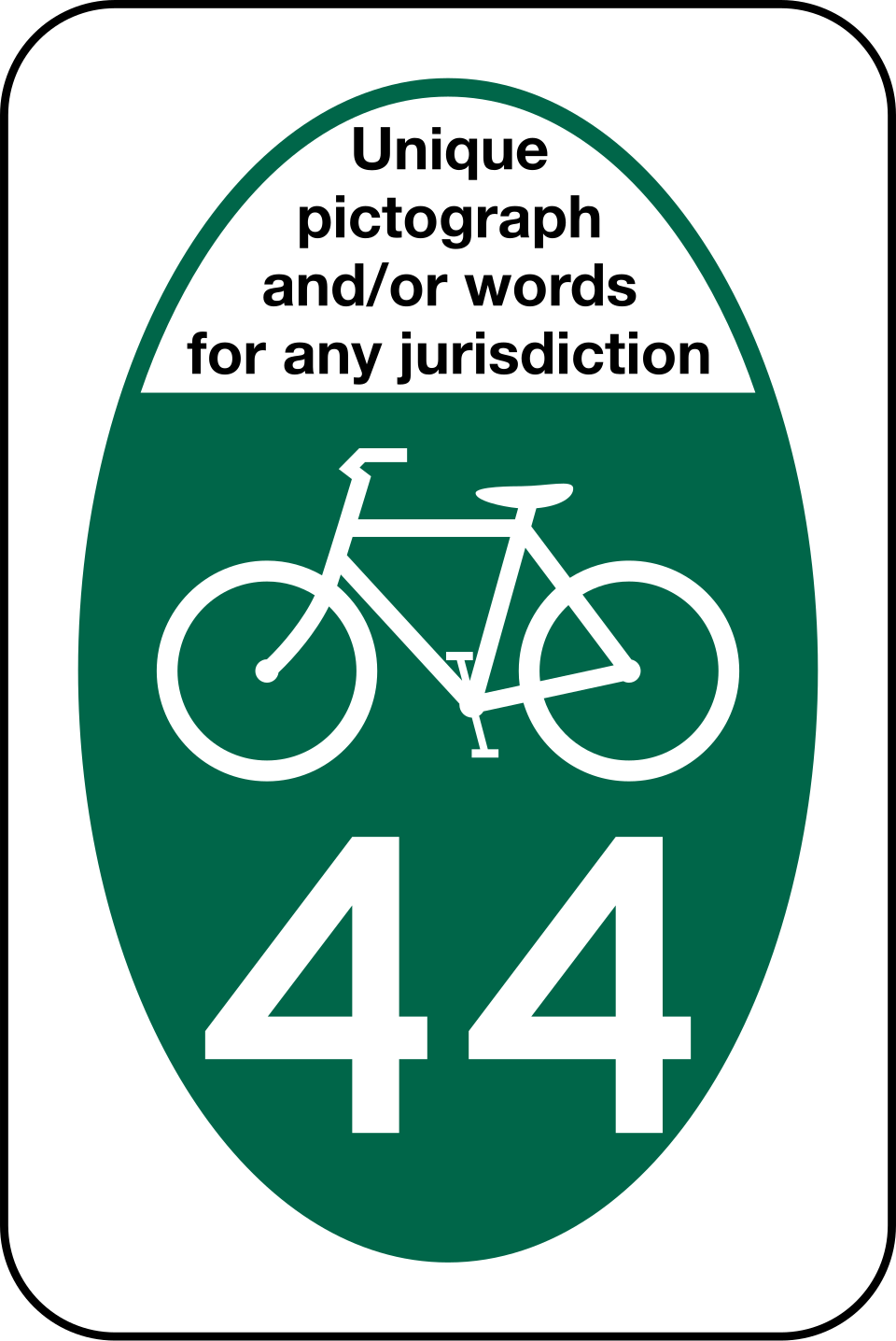
The Bicycle Route sign is a distinctive navigational aid found on roadways across the United States, designed to guide cyclists along a designated path while alerting motorists to the presence of shared traffic. Visually, this sign typically features a white background with a black border and a black symbol of a bicycle, often accompanied by an arrow indicating the direction of the route. Unlike regulatory signs that strictly prohibit or mandate specific actions, the Bicycle Route sign serves primarily as a guide, though it carries significant regulatory implications regarding driver behavior and right-of-way. It is rectangular in shape, adhering to the standard format for guide signs, and utilizes the high-contrast black-and-white color scheme to ensure visibility in various lighting conditions. For a learner driver, recognizing this sign is the first step in understanding that the road ahead is a shared space where cyclists are not merely obstacles but legitimate road users with a designated path. The sign indicates that the current roadway has been officially designated as part of a bicycle route network, meaning cyclists are expected to travel along this specific corridor, and drivers must adjust their driving habits accordingly to ensure safety for all users.
What it means
Formally, the Bicycle Route sign designates a roadway that has been selected and signed as part of a continuous network for bicycle travel. According to the Manual on Uniform Traffic Control Devices (MUTCD), while the sign itself is categorized under guide signs (specifically the D11 series), its presence triggers specific regulatory expectations for motor vehicle operators. The sign does not create a separate lane for bicycles unless accompanied by pavement markings or additional signage; rather, it signifies that the entire roadway is a shared environment. For the driver, the meaning is clear: you are entering a zone where bicyclists are a primary intended user of the facility. This designation implies that cyclists may be traveling at varying speeds, potentially slower than motor vehicles, and may need to occupy the full lane to avoid hazards such as parked cars, debris, or narrow shoulders. The sign serves as a formal notification that the route is optimized for cycling, which often correlates with lower speed limits, reduced traffic volumes, or specific traffic calming measures. Drivers must understand that the presence of this sign elevates the status of the bicycle from a casual road user to a protected element of the traffic flow. Consequently, the driver's action required is one of heightened awareness and patience. You must be prepared to encounter cyclists frequently, anticipate their movements, and yield the right-of-way when necessary, particularly when turning or changing lanes. Ignoring the implications of this sign can lead to dangerous situations, as cyclists rely on these designated routes for their safety and continuity of travel.
Where you'll see it
Bicycle Route signs are strategically placed to ensure continuity for cyclists and to provide ample warning to motorists. You will most commonly encounter these signs at the entry points of a designated route, often at the intersection where a cyclist might turn onto the street or where a route begins from a major arterial road. They are typically mounted on standard metal posts on the right-hand side of the roadway, facing oncoming traffic, at a height that ensures visibility without obstructing the view of other critical signs. In urban environments, these signs are frequently found on residential streets that have been chosen for their lower traffic volumes and slower speeds, making them ideal for family cycling or commuting. You may also see them on rural roads where shoulders are wide enough to accommodate cyclists safely, or on specific corridors connecting parks, schools, and commercial districts. The signs are often repeated at regular intervals, such as every few blocks or at every major intersection, to reinforce the route's continuity. In some jurisdictions, you might see the Bicycle Route sign accompanied by a plaque indicating the name of the route (e.g., "Blue Route") or a distance marker. Furthermore, these signs are often paired with "Share the Road" plaques (R4-1) to explicitly remind drivers of the shared nature of the roadway. They are rarely found on high-speed highways or freeways where bicycle travel is prohibited, but rather on surface streets where mixed traffic is the norm. Understanding the placement context helps a driver anticipate that cyclists are not just passing through but are likely traveling the length of the street, potentially making stops or turns along the way.
What to do when you see it
Upon seeing a Bicycle Route sign, a driver must immediately shift into a mode of defensive driving that prioritizes the safety of vulnerable road users. The first and most critical action is to scan the roadway ahead and to the sides for cyclists. Do not assume that because you do not see a cyclist immediately, one is not present; they may be approaching from a side street, riding in a blind spot, or traveling at a speed that makes them difficult to spot quickly. When approaching a cyclist, you must reduce your speed and increase your following distance. The MUTCD and state vehicle codes generally require a minimum safe passing distance, often three feet (or more in some states), when overtaking a bicycle. This means you may need to wait behind the cyclist until it is safe to pass with sufficient clearance, even if it means temporarily occupying the opposing lane. Never attempt to squeeze past a cyclist in a narrow lane; if the lane is too narrow to share safely, you must wait. Additionally, when making a right turn at an intersection where a Bicycle Route sign is present, you must check your right-side mirror and blind spot meticulously for cyclists who may be proceeding straight through the intersection. This is a common conflict point known as the "right hook." Similarly, when turning left, ensure no cyclists are overtaking you on the right. Always signal your intentions early to give cyclists time to react. If you are driving in a group or with passengers, remind them to be extra vigilant. The presence of the sign is a mandate to treat the bicycle as a vehicle with equal rights to the road, requiring the same respect and caution you would afford to a car or truck.
Common pitfalls
Learner drivers often fall into several traps when encountering Bicycle Route signs. One of the most dangerous misconceptions is the belief that the sign designates a bike lane. Unlike a solid white line with a bicycle symbol painted on the pavement, the Bicycle Route sign does not create a dedicated lane. Drivers sometimes mistakenly believe they can park in the area where a cyclist might ride, or that they can drive closer to the curb than usual, not realizing that cyclists may need to move toward the center of the lane to avoid hazards. Another common error is the failure to yield when turning. Drivers frequently focus on other cars and pedestrians, forgetting that cyclists have the right-of-way when proceeding straight through an intersection. This leads to the aforementioned "right hook" accidents. Additionally, some drivers become impatient when a cyclist is traveling slower than the speed limit, leading to aggressive tailgating or unsafe passing maneuvers. It is crucial to remember that the speed limit applies to the maximum safe speed, and cyclists are legally entitled to travel at their own pace within the lane. Another pitfall is the assumption that cyclists will always stay to the far right. In reality, cyclists often take the "lane" (positioning themselves in the center) to prevent unsafe passing or to avoid road debris. Drivers must be prepared for cyclists to occupy the full lane and must not honk or flash lights to intimidate them into moving over. Finally, some drivers ignore the sign entirely, treating the road as a standard arterial without recognizing the increased density of cyclists, which can lead to a lack of situational awareness and preventable collisions.
Permit-test context
In the context of a learner's permit or driver's license examination, the Bicycle Route sign is a frequent topic of inquiry, often appearing in multiple-choice questions or as part of a visual identification section. Examiners test your ability to recognize the sign's appearance and, more importantly, your understanding of the required driving behavior. A typical question might show an image of the sign and ask, "What does this sign indicate?" with options ranging from "Bike lane ahead" to "Bicycle route, share the road." The correct answer will always emphasize the shared nature of the roadway and the need for caution. You may also be asked about the specific actions required, such as "How should you pass a cyclist on a road with a Bicycle Route sign?" The expected answer involves maintaining a safe distance (usually 3 feet) and waiting for a clear opportunity to pass safely. Another common test scenario involves intersection rules: "When turning right at an intersection with a Bicycle Route sign, what must you check for?" The answer is cyclists proceeding straight. The test may also include questions about the legal implications, such as whether cyclists are required to yield to turning vehicles (generally, they are not if they are proceeding straight). It is vital to memorize that the sign does not create a bike lane but designates a route, and that the driver's primary responsibility is to share the road safely. Failing to demonstrate this knowledge can result in a failed section of the written exam, as it reflects a fundamental lack of understanding regarding road safety and the rights of vulnerable users.