Understanding the "Bridge Ices Before Road" Warning Sign: A Guide for New Drivers
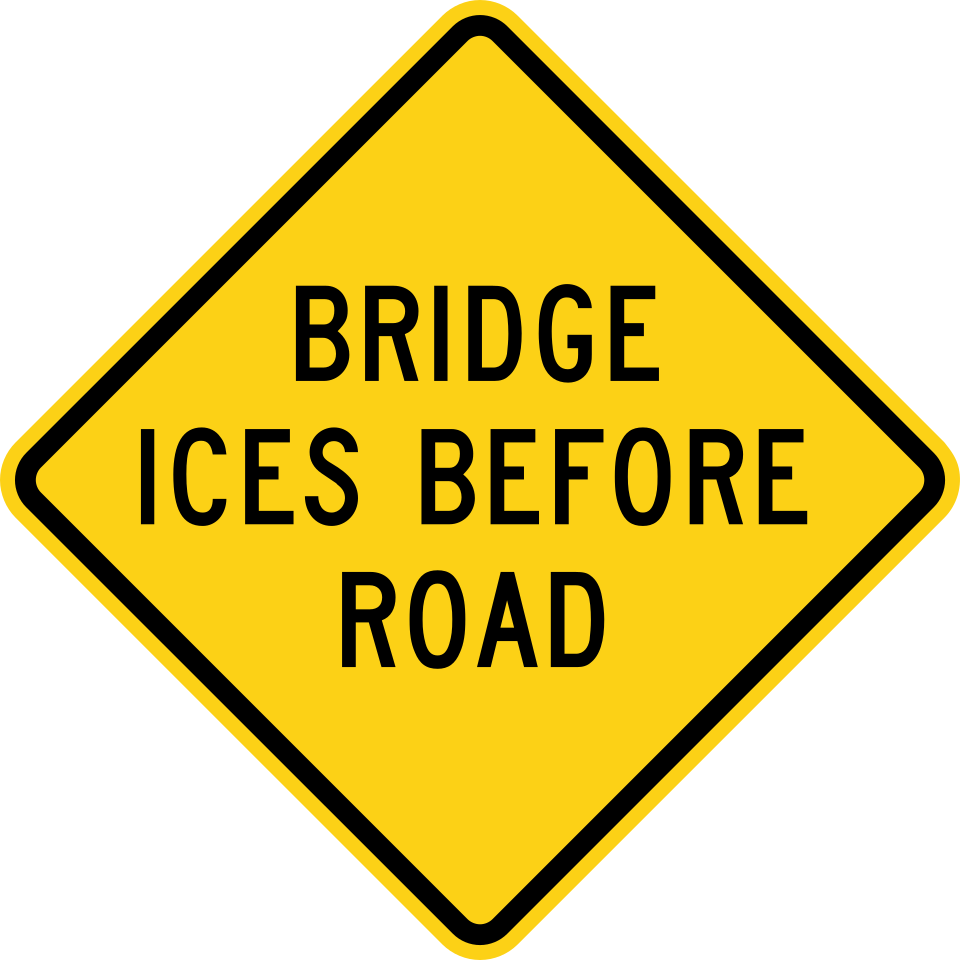
For every learner driver navigating the transition from the classroom to the open road, mastering the language of traffic signs is a non-negotiable skill. Among the vast array of symbols you will encounter, few are as critical to winter safety as the "Bridge Ices Before Road" sign. Visually, this is a standard diamond-shaped warning sign, featuring a bright yellow background with bold black lettering and a black border. The text is typically arranged in three lines: "BRIDGE" on top, "ICES" in the middle, and "BEFORE ROAD" at the bottom. Occasionally, you may see a graphic depiction of a bridge with a car skidding, though the text-only version is the most common in the United States. This sign falls under the category of warning signs, not regulatory signs, meaning it does not mandate a specific action like a stop sign does, but rather alerts you to a specific, hidden hazard that requires immediate behavioral adjustment. Its primary purpose is to inform drivers that the surface of an upcoming bridge or overpass will freeze significantly earlier than the adjacent roadways, even when the surrounding pavement remains clear. Understanding this sign is a matter of physics and safety, as it warns of a sudden loss of traction that can catch even experienced drivers off guard.
What it means
The formal definition of the "Bridge Ices Before Road" sign is rooted in the unique thermal properties of bridge structures compared to standard roadways. While a standard road is insulated from below by the earth, which retains heat absorbed during the day, a bridge is exposed to cold air on both its top and bottom surfaces. This dual exposure allows heat to escape rapidly from the bridge deck, causing the surface temperature to drop below the freezing point of water much faster than the ground-level road. Consequently, moisture on the bridge can turn to ice while the road leading up to it remains dry or merely wet. For a driver, the meaning of this sign is a direct command to anticipate a sudden change in road conditions. It signifies that the friction coefficient of the road surface will drop precipitously at the bridge entrance. The required driver action is to reduce speed before reaching the bridge, avoid sudden steering inputs, and refrain from braking while actually on the bridge. If you are driving at a speed appropriate for dry pavement, you are likely driving too fast for the icy bridge surface. The sign serves as a critical reminder that "road conditions" are not uniform; they can change instantly over a distance of a few feet. Ignoring this sign often leads to a loss of vehicle control, as the tires encounter a surface that offers almost no grip, potentially causing the vehicle to slide sideways or fail to stop in time for an obstacle.
Where you'll see it
You will typically encounter the "Bridge Ices Before Road" sign in specific geographic and infrastructural contexts. The most common placement is immediately preceding an overpass, underpass, or any structure where the roadway is elevated above the ground. These signs are almost exclusively found in regions that experience freezing temperatures, snow, or freezing rain during the winter months. In the northern United States, Canada, and parts of Europe, these signs are a staple of highway infrastructure. Placement is strategic: the sign is usually mounted on the right-hand side of the road, often accompanied by a supplementary plaque indicating the distance to the hazard (e.g., "1/4 MILE" or "500 FT"). In some jurisdictions, you might also see the sign repeated on the left side of the road or on overhead gantries to ensure visibility for all lanes of traffic. It is frequently paired with other warning signs, such as "Slippery When Wet" or "Low Clearance" signs, creating a cluster of warnings that heighten driver awareness. You are less likely to see this sign in tropical climates or areas where temperatures rarely dip below freezing, as the physical phenomenon it describes does not occur there. However, in mountainous regions where elevation changes cause rapid temperature drops, these signs can appear even in areas that generally have mild winters, specifically at high-altitude crossings.
What to do when you see it
When your eyes catch the yellow diamond of the "Bridge Ices Before Road" sign, your brain must immediately trigger a sequence of defensive driving actions. The first and most important step is to ease off the accelerator. Do not slam on the brakes, as this can lock your wheels and cause a skid, especially if the bridge is already icy. Instead, gently reduce your speed well before you reach the bridge structure. If you are traveling at 60 mph on a clear road, you should aim to slow down to a speed that allows for safe stopping distances on ice, which might be 30 or 40 mph depending on the severity of the cold. Once you have reduced your speed, maintain a steady, gentle pressure on the gas pedal as you cross the bridge. Avoid any sudden movements. Do not change lanes on the bridge, do not make sharp turns, and do not brake while your tires are on the icy surface. If you must stop, try to do so before the bridge begins. If you feel your vehicle begin to slide, steer gently in the direction you want to go and avoid overcorrecting. The key is smoothness; every input you make to the steering wheel or pedals should be gradual. Additionally, increase your following distance from the vehicle in front of you. If that car encounters ice and slides, you need extra space to react without colliding. Remember that the bridge may be black ice, which is invisible to the naked eye, so treat the entire surface as if it is covered in a sheet of glass.
Common pitfalls
Learner drivers often fall into several dangerous traps when encountering this sign. The most common mistake is the "it's not that cold" fallacy. Many new drivers assume that because the road leading up to the bridge is dry and the sun is shining, the bridge must also be safe. They fail to understand the thermal dynamics of bridge decks and assume road conditions are uniform. Another frequent error is braking on the bridge. A driver sees the sign, panics, and hits the brakes the moment they see the bridge structure. This sudden deceleration on a low-friction surface often results in a loss of control. Additionally, some drivers underestimate the severity of the hazard, thinking that modern all-wheel-drive (AWD) or four-wheel-drive (4WD) vehicles are immune to ice. While AWD helps with acceleration, it offers no advantage in braking or steering on ice. A four-wheel-drive truck is just as likely to slide off a bridge as a compact sedan if the driver brakes too hard. Finally, there is the pitfall of inattention. Because the sign is a warning and not a regulatory command, some drivers glance at it and immediately return their focus to their phone or the radio, failing to adjust their driving behavior until it is too late. The sign requires an active mental shift, not just passive recognition.
Permit-test context
In the context of a driver's permit test, the "Bridge Ices Before Road" sign is a frequent subject of multiple-choice questions designed to test your understanding of winter driving safety and hazard recognition. You may be shown an image of the sign and asked what it indicates, with distractors like "Bridge is under construction" or "Road is slippery only when it rains." The correct answer will always relate to the specific timing of the freezing: the bridge freezes before the road. Alternatively, the test may present a scenario: "You are driving on a highway in winter. You see a sign that says 'Bridge Ices Before Road.' What should you do?" The correct response will involve slowing down before the bridge and avoiding sudden maneuvers. Test writers often include questions that differentiate between warning signs and regulatory signs. While this sign warns of a hazard, it does not carry a legal speed limit or a mandatory stop, but ignoring it can lead to citations for careless driving if an accident occurs. Understanding the physics behind the sign—why bridges freeze first—is often the key to answering these questions correctly, as it demonstrates a deeper comprehension of road safety beyond simple memorization.