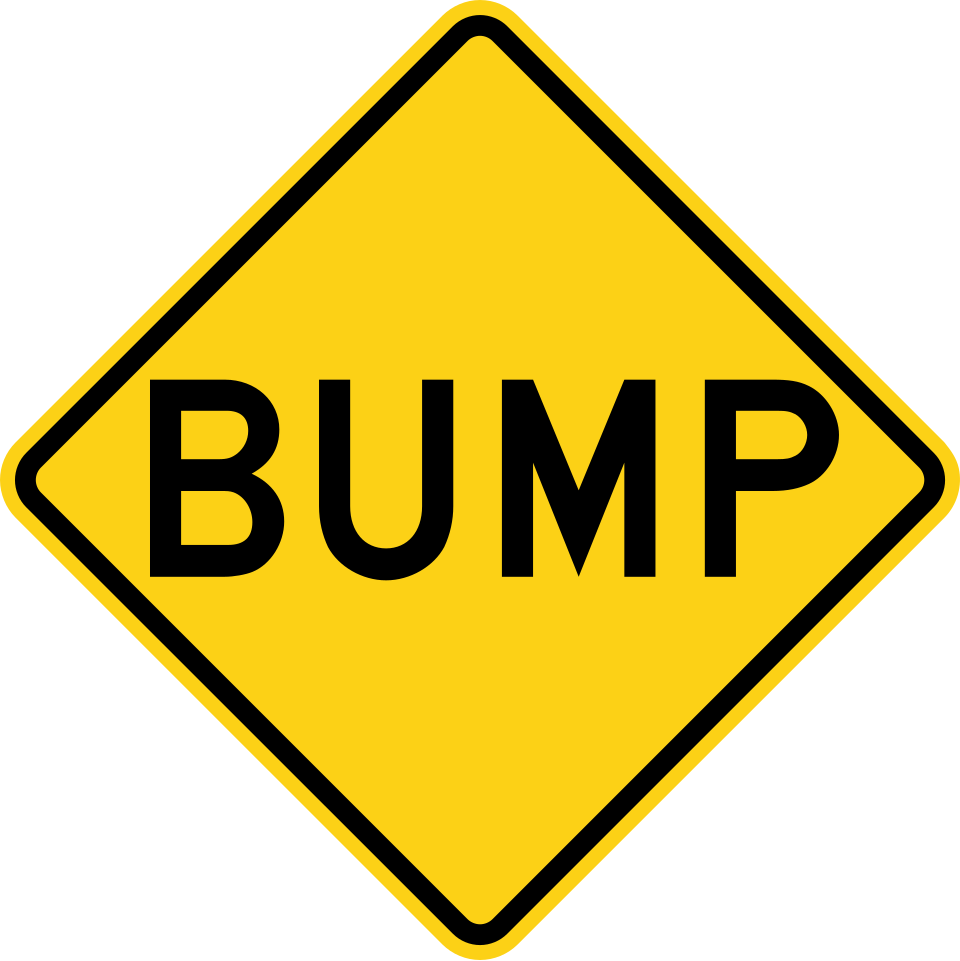
Understanding the Bump Road Sign: A Comprehensive Guide for Learner Drivers
If you are preparing for your driving permit test or have recently started your journey behind the wheel, you have likely encountered a variety of warning signs designed to alert you to potential hazards. Among these, the Bump sign is a critical indicator of road surface irregularities that require immediate attention. This sign is a standard yellow diamond with a black border, featuring a black silhouette of a vehicle driving over a raised hump or bump. The bright yellow background serves as a universal warning color in the United States, signaling caution, while the diamond shape specifically denotes a warning rather than a regulatory command. The meaning is straightforward: the road ahead contains a significant vertical deviation that could affect vehicle stability, comfort, and safety if not navigated correctly. Unlike a speed bump sign, which often indicates an artificial traffic calming measure, the "Bump" sign typically warns of a natural or structural irregularity in the pavement, such as a settling roadbed, a bridge joint, or a washboard effect. Recognizing this sign early allows drivers to adjust their speed and trajectory, preventing loss of control or damage to the vehicle.
What it means
Formally, the Bump sign is defined by the Manual on Uniform Traffic Control Devices (MUTCD) as a warning sign indicating a sudden, sharp change in the vertical alignment of the roadway. It is classified under the W-series of warning signs, specifically designated as W8-1 in the MUTCD standards. While the MUTCD does not always assign a specific alphanumeric code to every variation in every edition, the W8-1 is the standard identifier for the "Bump" warning. The primary function of this sign is to alert drivers to a hazard that may not be immediately visible due to the crest of a hill, a curve, or poor lighting conditions. The driver action required upon seeing this sign is immediate and deliberate. The sign does not mandate a specific speed, but it implicitly requires the driver to reduce speed to a level where the vehicle can traverse the irregularity without losing traction, becoming airborne, or suffering mechanical damage. For learner drivers, it is crucial to understand that the "Bump" sign is distinct from the "Speed Bump" sign (W8-8). A speed bump is an engineered structure intended to force drivers to slow down, whereas a "Bump" sign warns of an unintended or structural anomaly that the driver must navigate carefully. The required action involves scanning the road ahead, checking mirrors for following traffic, and smoothly decelerating before reaching the hazard. Abrupt braking at the last second can cause the vehicle to nose-dive, exacerbating the impact of the bump. Therefore, the core meaning of the sign is a call for proactive speed management and heightened situational awareness.
Where you'll see it
The placement of the Bump sign is strategic and follows strict guidelines to ensure maximum visibility and reaction time. You will typically encounter this sign in areas where road maintenance has been deferred, where the roadbed has settled due to soil erosion, or where there are structural transitions, such as the approach to a bridge or a culvert. Common contexts include rural highways where heavy truck traffic has caused pavement fatigue, older residential streets with aging infrastructure, and construction zones where temporary road surfaces may be uneven. In terms of physical placement, the sign is usually mounted on a post on the right-hand side of the roadway, approximately 6 to 7 feet above the ground, ensuring it is visible to drivers without obstructing the view of the road. It is often placed 100 to 250 feet before the actual hazard, depending on the posted speed limit and the severity of the bump. In high-speed zones, the sign may be placed further in advance to give drivers ample time to slow down. You might also see this sign accompanied by a supplementary plaque reading "AHEAD" or "XX FT" to specify the distance to the hazard. In some jurisdictions, you may find the sign repeated on the left side of the road or mounted on overhead gantries if the road is a multi-lane highway, ensuring that drivers in all lanes receive the warning. It is also common to see this sign in conjunction with other warning signs, such as "Road Work" or "Uneven Lanes," providing a comprehensive picture of the road conditions ahead.
What to do when you see it
When you spot the Bump sign, your immediate priority is to transition from a passive driving mode to an active hazard-avoidance mode. The first step is to check your speed. If you are traveling at or near the posted limit, you must begin to decelerate smoothly. Do not slam on the brakes; instead, ease off the accelerator and apply gentle pressure to the brake pedal to lower your speed significantly before the vehicle reaches the bump. A good rule of thumb for learner drivers is to reduce speed to a point where the vehicle remains firmly planted on the road surface. Next, scan the road ahead to locate the exact position of the bump. If the road is wide, you may have the option to steer slightly to avoid the deepest part of the irregularity, provided it is safe to do so and you do not cross into oncoming traffic or off the road. However, if the bump spans the entire lane, your focus should be on maintaining a straight trajectory. Keep a firm grip on the steering wheel with both hands at the 9 and 3 o'clock positions. As you approach the bump, keep your eyes focused on the exit path, not directly at the bump itself, to prevent the "target fixation" phenomenon where the driver inadvertently steers toward the hazard. Once you are over the bump, do not accelerate immediately. Wait until the vehicle has fully stabilized and you have regained a clear view of the road ahead before resuming normal speed. This is particularly important if the bump is part of a series of irregularities or if the road surface behind the bump is also compromised. Finally, always check your mirrors after passing the hazard to ensure that following traffic has also reacted appropriately and that you have not created a dangerous situation by slowing down too abruptly.
Common pitfalls
Learner drivers often make several critical mistakes when encountering the Bump sign. The most common error is failing to slow down sufficiently. Many new drivers assume that because the sign is a warning and not a regulatory command, they can maintain their current speed. This leads to a jarring impact that can damage the vehicle's suspension, cause passengers to lose their balance, or even result in a temporary loss of steering control. Another frequent pitfall is braking too late. Drivers often wait until they are directly over the bump to react, which causes the vehicle to pitch forward violently, increasing the force of the impact. Additionally, some learners panic and swerve erratically when they see the sign. Unless the bump is clearly avoidable and it is safe to change lanes, swerving can lead to a collision with other vehicles or a run-off-road crash. Another misconception is confusing the "Bump" sign with a "Speed Bump" sign. While the driving action is similar (slowing down), the context is different; a speed bump is a deliberate traffic calming device, while a "Bump" sign warns of a defect. Failing to distinguish between the two can lead to confusion about why the hazard exists and how to anticipate it. Finally, some drivers ignore the sign entirely, assuming the bump is minor. This is dangerous because even small bumps can be hazardous at high speeds, especially for motorcycles or vehicles with low ground clearance.
Permit-test context
On your driving permit test, the Bump sign is a frequent subject of multiple-choice questions and scenario-based assessments. Examiners want to ensure you can identify the sign visually and understand the appropriate response. You may be shown an image of the sign and asked to select the correct meaning from a list of options. Common distractors include "Speed Bump Ahead," "Road Narrows," or "Bridge Out." It is vital to memorize the specific silhouette of the vehicle on the hump to distinguish it from similar signs. In a written test scenario, you might be presented with a situation: "You are driving on a rural road and see a yellow diamond sign with a car on a bump. What should you do?" The correct answer will always involve reducing speed and proceeding with caution. You may also be asked about the placement of the sign, such as "Where is the Bump sign typically located?" The answer would be "On the right side of the road, in advance of the hazard." During the practical driving portion of the test, if you encounter a real Bump sign, the examiner will be watching to see if you slow down smoothly and maintain control. Failing to react to this sign can result in a critical error, potentially leading to an automatic failure of the driving test. Therefore, mastering the response to the Bump sign is not just about passing a written quiz; it is a fundamental skill for safe driving that demonstrates your ability to anticipate and react to road hazards.