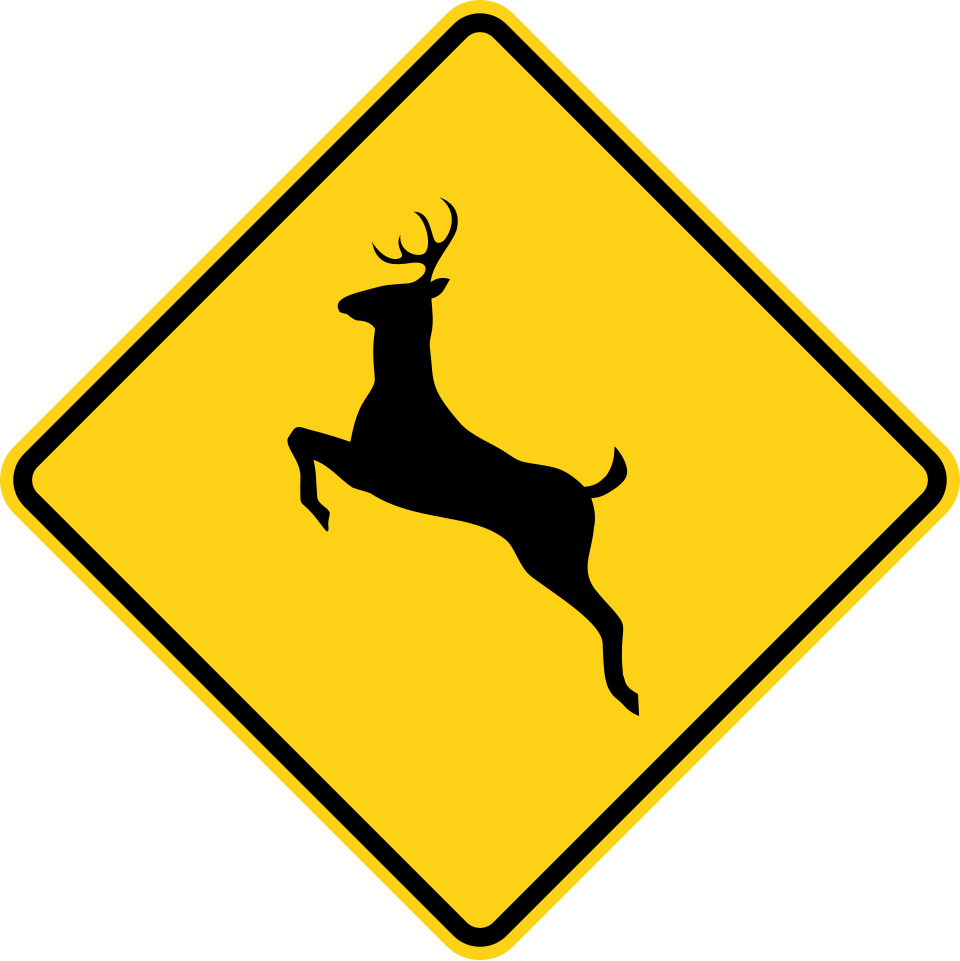
For every learner driver navigating the complex web of American roadways, the Deer Crossing sign is a familiar yet often misunderstood sentinel. Visually, it is distinct and impossible to ignore: a diamond-shaped plaque featuring a black silhouette of a leaping deer against a vivid yellow background. Unlike the red octagon of a stop sign or the white rectangle of a regulatory speed limit, the yellow diamond serves as a universal warning, alerting motorists to potential hazards rather than mandating a specific legal command. While it does not carry the same immediate "stop" or "yield" legal weight as regulatory signs, its meaning is profound: the area ahead is a known corridor for wildlife movement. For a new driver, recognizing this sign is the first step in transitioning from passive observation to active, defensive driving, understanding that the road environment is shared with unpredictable, large animals that can cause catastrophic damage and injury.
What it means
Formally, the Deer Crossing sign is classified as a warning sign, specifically designated under the Manual on Uniform Traffic Control Devices (MUTCD) as W11-8. It is crucial for learner drivers to understand that despite the prompt's initial categorization, this sign is not a "regulatory" sign. Regulatory signs (like Stop, Yield, or Speed Limit) dictate the rules of the road and must be obeyed under penalty of law. Warning signs, conversely, advise drivers of a change in road conditions or a potential hazard that requires heightened attention and a reduction in speed. The specific meaning of the W11-8 sign is that the roadway traverses an area with a high frequency of deer crossings. It indicates that deer are likely to enter the roadway from the roadside vegetation, often without warning. The driver action required is not a mandatory stop, but rather a mandatory adjustment of driving behavior. Upon seeing this sign, a driver must immediately increase their situational awareness, scan the road edges and shoulders more aggressively, and be prepared to slow down or stop if a deer appears. The sign serves as a pre-warning that the risk of a collision is statistically higher in this specific zone. It implies that the driver should anticipate the unexpected, as deer often travel in groups; if one crosses, others may follow shortly after. The sign essentially tells the driver, "The rules of the road remain the same, but the environment is now hostile to your vehicle's safety; proceed with extreme caution."
Where you'll see it
Deer Crossing signs are strategically placed by transportation engineers based on historical data and ecological studies. You will most frequently encounter these signs in rural and semi-rural areas where highways intersect with forests, wetlands, or agricultural fields. These are typically locations where the natural migration paths of deer cross the paved surface of the road. Common placement contexts include the entrances and exits of state parks, national forests, and large nature reserves. They are also prevalent along two-lane country roads that wind through wooded areas, particularly during dawn and dusk when deer are most active. In some regions, you may see these signs accompanied by a supplementary plaque (W16-7P) that reads "Migratory" or "Seasonal," indicating that the hazard is temporary or cyclical, often correlating with mating seasons or winter migrations. In mountainous regions, these signs are often found on steep grades or sharp curves where visibility is already compromised, compounding the danger. Furthermore, you might see them in suburban fringes where urban development has encroached on natural deer habitats, creating a "edge effect" that forces wildlife to cross roads to find food or water. It is important to note that these signs are rarely placed in dense urban city centers, as deer populations are generally absent from such environments. Instead, they mark the transition zones where the human-built environment meets the wild.
What to do when you see it
When a learner driver spots the yellow diamond with the leaping deer, the immediate response must be a shift into "defensive driving" mode. The first and most critical action is to slow down. Reducing speed increases the driver's reaction time and decreases the severity of a potential impact. If a collision occurs at 60 mph, the outcome is almost invariably fatal for the deer and often catastrophic for the vehicle and its occupants. At 40 mph, the chances of survival for both increase significantly. Secondly, the driver must scan the road edges. Do not just look straight ahead; use your peripheral vision to monitor the tree lines and grassy shoulders. Deer have excellent night vision but poor depth perception, and they often freeze in headlights before bolting. If you see one deer, assume there are more. Do not be lulled into a false sense of security after the first animal crosses; wait until the area is completely clear. Thirdly, use your high beams when appropriate. In rural areas with no oncoming traffic, flashing your high beams can help illuminate the eyes of deer in the bushes, making them visible before they step onto the road. However, remember to dim them for oncoming traffic. Finally, never swerve violently to avoid a deer. Swerving can lead to a loss of vehicle control, a rollover, or a collision with oncoming traffic or roadside obstacles like trees or guardrails. The recommended action is to brake firmly and stay in your lane, letting the deer cross if possible, or accepting the impact if avoidance is impossible, as the vehicle is designed to withstand a frontal collision better than a side-impact or rollover.
Common pitfalls
Learner drivers often fall into several dangerous traps when encountering the Deer Crossing sign. The most common error is complacency. Because the sign is a warning and not a regulatory command, new drivers often glance at it and then immediately return to their previous driving habits, failing to actually adjust their speed or scanning patterns. They treat the sign as a piece of scenery rather than an active instruction to change behavior. Another significant pitfall is the "herd mentality" assumption. A driver sees one deer cross safely and assumes the danger has passed, only to be blindsided by a second or third deer following immediately behind. This is a frequent cause of multi-animal collisions. Additionally, many learners panic and swerve. The instinct to avoid hitting an animal is strong, but swerving on a two-lane road often results in a head-on collision with another vehicle, which is statistically more dangerous than hitting the deer. Finally, there is a misconception regarding the time of day. Some drivers believe these signs are only relevant at night. In reality, dawn and dusk are the peak activity times for deer, and visibility is often poorest during these twilight hours. Failing to recognize that the sign applies 24/7, but is most critical during low-light conditions, is a major oversight for new drivers.
Permit-test context
On the written permit test, the Deer Crossing sign is a staple question designed to assess a candidate's ability to recognize warning signs and understand the appropriate response. The test will typically present an image of the sign and ask what it indicates or what the driver should do. The correct answer will almost always involve "slowing down," "increasing awareness," or "being prepared to stop." Test questions may also present a scenario: "You see a sign with a leaping deer. What should you do?" Options might include "Speed up to get through the area quickly," "Honk your horn continuously," "Slow down and scan the sides of the road," or "Stop immediately." The correct choice is invariably to slow down and scan. Furthermore, the test may ask about the shape and color of the sign to ensure the driver can identify it without reading the text. You must know that it is a yellow diamond. Questions may also probe the concept of "herd behavior," asking what to do if you see one deer cross. The correct answer is to wait and watch for others. Understanding that this is a warning sign, not a regulatory one, is also a common testing point; the test may ask if you are legally required to stop, and the answer is no, unless a deer is actually in the road. Mastering these nuances is essential for passing the written exam and, more importantly, for surviving the road.