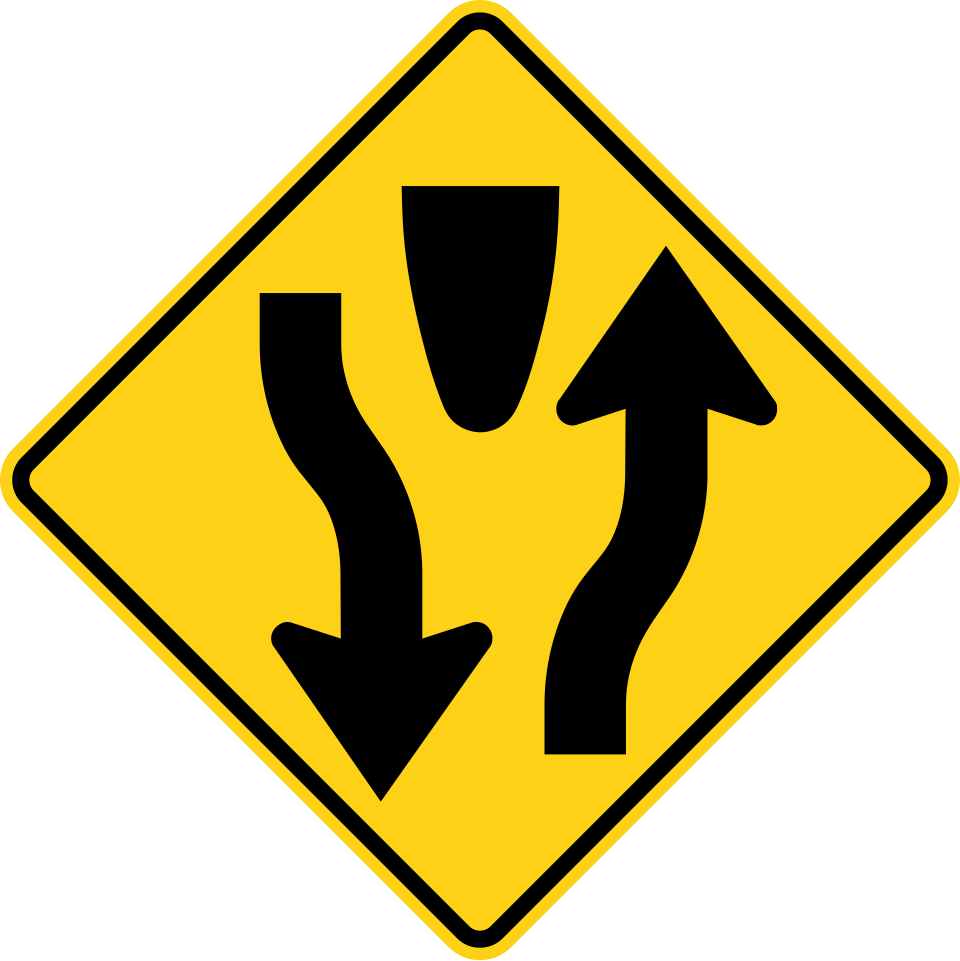
Understanding the Divided Highway Begins Sign: A Guide for New Drivers
The Divided Highway Begins sign is a critical warning marker that every learner driver must recognize immediately. Visually, it is a diamond-shaped sign with a yellow background and black symbols, adhering to the standard color code for warning signs. The graphic depicts two vertical black arrows pointing upward, separated by a small, solid black rectangle in the center, representing a physical median or barrier. This sign serves as a pivotal transition point in road design, signaling to drivers that the two-way traffic they have been sharing is about to be physically separated into distinct, one-way roadways. Unlike regulatory signs that dictate immediate actions like stopping or yielding, this sign warns of a change in the road environment that requires heightened situational awareness and a shift in driving strategy.
What It Means
Formally, the Divided Highway Begins sign indicates that the roadway ahead is transitioning from a two-way undivided road to a divided highway. In a divided highway, opposing flows of traffic are separated by a physical median, which can take the form of a concrete barrier, a grassy strip, a raised curb, or a painted island with bollards. The primary purpose of this separation is to eliminate the risk of head-on collisions, which are among the most severe types of accidents on undivided roads.
For the driver, the meaning is twofold. First, it signifies that oncoming traffic will no longer be in the immediate lane to your left; they will be on the other side of the median. Second, and perhaps more importantly for learner drivers, it means that the rules of the road regarding passing and lane usage change. On a divided highway, you generally cannot cross the median to pass another vehicle or to turn left across traffic. The sign acts as a definitive boundary: once you pass it, you are entering a controlled-access environment where U-turns and left turns across the median are typically prohibited unless a specific opening or designated turn lane is provided.
While the sign itself is a warning sign (W-series in the MUTCD), it often precedes a change in regulatory conditions. It tells the driver, "Prepare for a new set of rules." The separation ensures that traffic moves in a single direction on your side of the road, allowing for higher speeds and smoother traffic flow, but it also removes the flexibility drivers might have had on a two-lane country road to turn left into a driveway or make a U-turn.
Where You'll See It
Learner drivers will most commonly encounter the Divided Highway Begins sign at the transition point where a standard two-lane rural road or a suburban arterial road upgrades to a multi-lane divided highway. This often happens as you approach a major city, a highway interchange, or a bridge. You might see it after a long stretch of two-way traffic where passing was allowed with caution, just as the road widens and a concrete barrier appears in the center.
Another common location is at the entrance to a bridge or tunnel where the roadway splits. For instance, if you are driving on a two-lane road that leads to a bridge, the sign will appear just before the bridge begins, indicating that the bridge itself is divided. Similarly, you will see this sign when a road that has been undivided for several miles suddenly introduces a median strip. It is rarely found in the middle of a highway; rather, it is a "beginning" marker. The corresponding "Divided Highway Ends" sign will appear later when the median disappears and the road reverts to two-way traffic.
In urban environments, this sign might appear where a street is converted into a one-way pair or where a new median is installed to improve traffic flow. It is crucial to look for this sign when driving in areas undergoing road construction or when entering toll roads, as these facilities are almost always divided highways to ensure safety and efficiency.
What to Do When You See It
Upon seeing the Divided Highway Begins sign, your immediate action should be to scan the road ahead for the physical median and adjust your driving behavior accordingly. First, check your speed. Divided highways often have higher speed limits, but you should only accelerate if the traffic flow and posted limits allow. Do not assume the speed limit increases automatically; look for the new speed limit sign.
Second, mentally prepare for the loss of turning flexibility. If you were planning to turn left into a driveway or a side street, you must do so before the median begins. Once the median is in place, you cannot cross it. If you miss your turn, you must continue to the next designated opening or exit. This is a critical safety rule: never attempt to cross a physical median, even if it looks like a small grassy strip. It is illegal and extremely dangerous.
Third, adjust your lane positioning. On a divided highway, you will likely be in a multi-lane environment. Stay in the right lane unless passing, and be mindful that oncoming traffic is now completely separated from you. This reduces the need for constant vigilance regarding head-on collisions, but it increases the need to watch for vehicles merging from on-ramps or changing lanes within your direction of travel. Finally, ensure your vehicle is in good condition, as divided highways often involve sustained higher speeds, requiring reliable brakes and tires.
Common Pitfalls
One of the most dangerous mistakes learner drivers make is confusing the Divided Highway Begins sign with a "One Way" sign. While both indicate that traffic in your direction is moving forward, the Divided Highway sign specifically warns of a physical separation from opposing traffic. Failing to recognize the physical barrier can lead to drivers attempting to make illegal U-turns or left turns across the median, resulting in severe accidents or traffic citations.
Another common pitfall is the assumption that the road is now a highway with no intersections. While divided highways often have limited access, they can still intersect with cross streets via traffic lights or stop signs. New drivers sometimes become complacent, thinking the road is a freeway, and fail to watch for cross traffic at intersections that do exist. Additionally, some learners mistake the sign for a "Divided Highway Ends" sign. The visual difference is subtle but critical: the "Begins" sign shows the arrows moving away from the center, while the "Ends" sign shows the arrows converging. Confusing these two can lead to driving into oncoming traffic if the driver expects a median that isn't there.
Finally, learners often fail to anticipate the change in road width. The transition from a narrow two-lane road to a wide divided highway can be disorienting. Drivers may drift toward the center of the road, forgetting that the median is now to their left, or they may struggle to judge the distance to the median when changing lanes. Practicing lane discipline and maintaining a safe distance from the median is essential.
Permit-Test Context
On the learner's permit written exam, the Divided Highway Begins sign is a frequent subject of multiple-choice questions. Examiners typically ask what the sign indicates or what action the driver should take. A classic question might be: "What does the yellow diamond sign with two arrows separated by a rectangle mean?" The correct answer will always relate to the physical separation of traffic and the prohibition of crossing the median.
Another common test scenario involves a situational question: "You see a Divided Highway Begins sign. You need to turn left into a driveway. What should you do?" The correct answer is to turn before the median begins. If you have already passed the sign, the correct action is to continue driving until you find a designated U-turn or left-turn opening. Test questions may also ask you to distinguish this sign from the "Divided Highway Ends" sign, requiring you to identify the direction of the arrows.
Understanding the logic behind the sign is key to passing. The test is not just checking if you can memorize the shape; it is checking if you understand the safety implications. If you know that the sign means "no crossing the center," you can answer almost any variation of the question correctly. Remember, the yellow diamond is a warning, but the action required is a strict adherence to the new traffic pattern established by the median.