Mastering the Divided Highway Ends Sign: A Guide for New Drivers
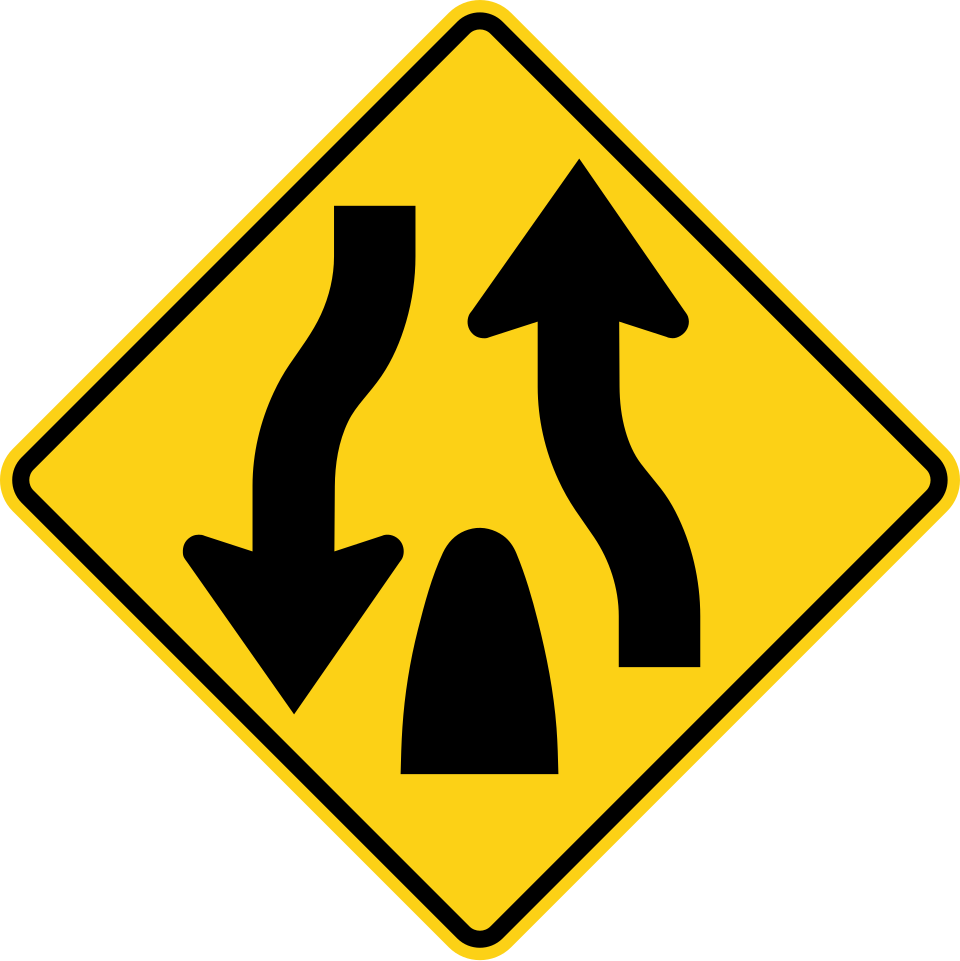
For learner drivers navigating the transition from quiet residential streets to bustling multi-lane thoroughfares, understanding traffic control devices is paramount. Among the most critical signs you will encounter is the Divided Highway Ends sign. Visually, this is a yellow diamond-shaped warning sign featuring a black graphic of two vertical lines that are separated at the bottom but converge at the top, symbolizing the termination of a physical median. The sign utilizes the standard high-visibility yellow background with black borders and symbols, adhering to the universal color code for caution. Its primary meaning is to alert drivers that the physical separation between opposing lanes of traffic is about to disappear, and they must prepare to share the roadway with oncoming traffic, often necessitating a reduction in speed and heightened situational awareness.
What it Means
Formally, the Divided Highway Ends sign (often designated as W6-2 in the Manual on Uniform Traffic Control Devices, or MUTCD) serves as a critical warning that the roadway configuration is changing from a divided highway to an undivided two-way street. On a divided highway, opposing flows of traffic are separated by a physical barrier, such as a concrete median, a grassy strip, or a raised curb. This separation provides a significant safety buffer, preventing head-on collisions and allowing for higher speed limits. When this sign appears, it indicates that this protective barrier is ending.
The driver action required upon seeing this sign is immediate and deliberate. You must recognize that the road ahead will no longer have a physical separation between your lane and the lanes of oncoming traffic. Instead, the road will likely transition into a standard two-way street, potentially with a painted centerline or, in rural areas, no centerline at all. Drivers must mentally prepare to yield to oncoming traffic when necessary, adhere to strict lane discipline, and be vigilant for vehicles that may cross the centerline. In many jurisdictions, this sign is accompanied by a "No Passing Zone" plaque (R4-1) or a "Do Not Pass" sign, reinforcing that overtaking maneuvers are dangerous and prohibited in the immediate vicinity of the transition.
Where you'll see it
The placement of the Divided Highway Ends sign is strategic and follows strict engineering guidelines to ensure adequate reaction time. You will typically encounter this sign at the precise point where a controlled-access highway, expressway, or major arterial road transitions into a standard surface street. Common contexts include:
- Exiting Major Arterials: When a four-lane divided road narrows or merges into a two-lane undivided road, often near the exit of a city or the beginning of a rural stretch.
- Urban Transitions: In metropolitan areas, where a divided boulevard ends and merges into a commercial district with on-street parking and pedestrian crossings.
- Construction Zones: Temporary traffic patterns may force a divided highway to merge into a single carriageway, necessitating the use of this sign (often with orange temporary backgrounds).
- Bridge Approaches: Occasionally, a divided highway may run over a bridge where the median is removed, requiring drivers to merge into a single two-way flow.
According to MUTCD standards, this sign is usually placed on the right-hand side of the road, approximately 100 to 200 feet before the physical median ends. In high-speed environments, it may be placed further in advance to allow for speed adjustment. You may also see a duplicate sign on the left side of the road or a median-mounted sign if the road is wide enough, ensuring visibility for all lanes.
What to do when you see it
Upon spotting the Divided Highway Ends sign, your driving behavior must shift from the relaxed vigilance of a divided highway to the active engagement required for undivided roads. The first step is to check your speed. Divided highways often have higher speed limits; as the median ends, the speed limit may drop, or the road geometry may become more complex. Slow down to a safe speed that allows you to react to oncoming vehicles.
Next, scan the road ahead for the centerline markings. Look for the transition from a wide median to a double yellow line or a single broken yellow line. If the centerline is not yet painted, assume a two-way traffic pattern and stay strictly to the right. Check your mirrors to ensure no vehicles are attempting to pass you, as passing zones are often restricted immediately following this sign. If you are following another vehicle, increase your following distance to account for the potential of sudden stops or erratic maneuvers by oncoming traffic.
Finally, prepare for intersections. Undivided roads often have more frequent intersections, driveways, and pedestrian crossings than divided highways. Be ready to yield to cross traffic and pedestrians. If you are in a left-turn lane, ensure you are not blocking oncoming traffic, as the lack of a median means oncoming vehicles are much closer to your path.
Common pitfalls
Learner drivers often make several critical errors when encountering the Divided Highway Ends sign. The most dangerous mistake is complacency. Because the road may look wide and straight, new drivers may fail to realize that the safety buffer of the median is gone, leading them to maintain high speeds or drift toward the center of the road. Another common error is misinterpreting the sign as a "Divided Highway Begins" sign. The graphic is similar, but the direction of the lines is reversed; confusing the two can lead to driving into oncoming traffic or failing to prepare for a merge.
Additionally, drivers often fail to adjust their lane position. On a divided highway, drivers are accustomed to being far from the center. When the median ends, some learners unconsciously continue to hug the centerline, leaving insufficient space for oncoming vehicles. This is particularly dangerous on narrow roads or at night. Finally, some drivers ignore the associated "No Passing" signs that frequently accompany the Divided Highway Ends sign, attempting to overtake a slow-moving vehicle just as the road becomes undivided, which is a leading cause of head-on collisions.
Permit-test context
In the context of a learner's permit or driver's license written exam, the Divided Highway Ends sign is a frequent subject of multiple-choice questions. Examiners often test your ability to distinguish it from the "Divided Highway Begins" sign. A typical question might show the sign and ask, "What does this sign indicate?" with options like "The road is ending," "You are entering a one-way street," or "The divided highway is ending, and you must prepare for two-way traffic." The correct answer is always the latter.
Exams may also present a scenario: "You see a yellow diamond sign with two lines converging at the top. What should you do?" The expected answer involves reducing speed, checking for oncoming traffic, and preparing to share the road. Some tests include a visual identification section where you must match the sign to its meaning. It is crucial to memorize the specific graphic: the lines are separated at the bottom (representing the divided highway you are on) and come together at the top (representing the undivided road ahead). Understanding this visual logic is key to passing the test and, more importantly, staying safe on the road.