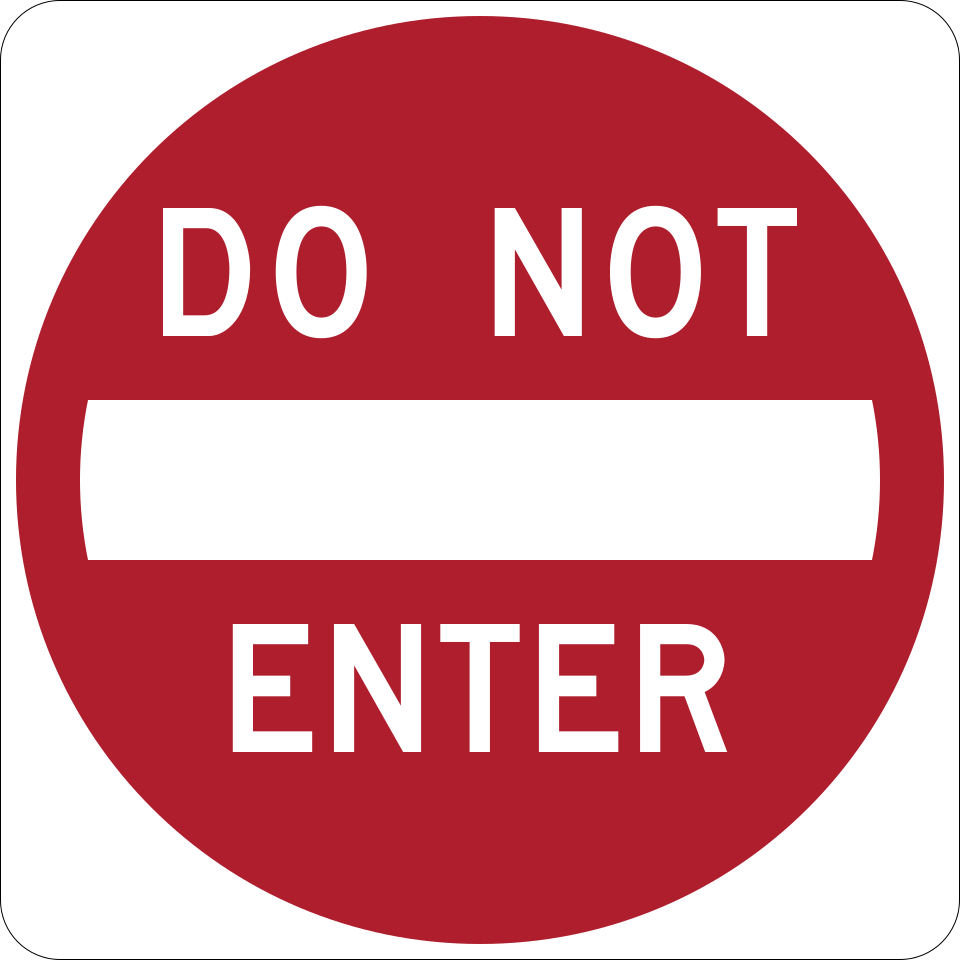
The Do Not Enter Sign: A Comprehensive Guide for Learner Drivers
For every new driver navigating the complex web of American roadways, the "Do Not Enter" sign stands as one of the most critical and non-negotiable regulatory markers. Visually, it is unmistakable: a square white sign featuring a red circle with a white horizontal bar across the center, often accompanied by the text "DO NOT ENTER" in bold white letters. The red circle signifies a prohibition, while the white bar acts as a universal symbol for "stop" or "forbidden." Unlike warning signs that suggest caution, this sign issues a direct command. Its meaning is absolute: entry into the roadway or ramp ahead is strictly prohibited for all traffic. For a learner driver, recognizing this sign instantly is not just a matter of passing a test; it is a fundamental safety skill that prevents catastrophic head-on collisions on one-way streets and highway off-ramps.
What It Means
Formally, the "Do Not Enter" sign (designated as R5-1 in the Manual on Uniform Traffic Control Devices, or MUTCD) is a regulatory sign that prohibits drivers from entering a restricted roadway. The MUTCD defines this sign as a means to prevent vehicles from entering a roadway where traffic flows in the opposite direction, such as a one-way street, a divided highway, or an exit ramp of a controlled-access highway. The legal implication is clear: crossing the threshold marked by this sign constitutes a traffic violation and, more importantly, creates an immediate and severe hazard.
The driver action required upon seeing this sign is immediate and decisive. You must not proceed past the sign. If you are approaching an intersection or a ramp and see this sign, your only legal and safe maneuver is to stop, turn around, or find an alternative route. There are no exceptions for emergency vehicles unless directed by law enforcement, and certainly no exceptions for passenger vehicles. The sign effectively creates a physical and legal barrier. It tells the driver that the path ahead leads against the flow of traffic. Ignoring this sign often results in driving into oncoming traffic at highway speeds, a scenario that frequently leads to fatal accidents. Therefore, the definition extends beyond mere regulation; it is a life-saving instruction that demands total compliance.
Where You'll See It
Learner drivers will encounter the "Do Not Enter" sign in specific, high-risk contexts designed to channel traffic correctly. The most common location is at the entrance of a one-way street. In urban environments, city planners often convert two-way streets into one-way pairs to improve traffic flow. At the entrance of the street where traffic is prohibited, you will see the R5-1 sign. It is crucial to note that these signs are often placed on the right side of the road, but they may also be mounted on the left side or on overhead gantries to ensure visibility from multiple angles.
Another frequent placement is at the exit ramps of limited-access highways, such as interstates and freeways. When you are driving on a highway and see a ramp leading off to the left or right, that ramp is designed for traffic exiting the highway. If you mistakenly try to enter the highway via that ramp, you will encounter a "Do Not Enter" sign. These signs are often accompanied by a supplementary plaque reading "WRONG WAY" to reinforce the message. Additionally, you will see these signs at the entrances of divided highways where the median separates opposing lanes of traffic. If a driver attempts to cross the median to enter the highway from the wrong side, they will be met with this sign. In some cases, particularly in rural areas or construction zones, temporary versions of this sign may be used to close off a lane or a road segment that has been converted to one-way traffic for safety reasons.
What to Do When You See It
When a learner driver spots the "Do Not Enter" sign, the reaction must be instinctive and calm. The first step is to immediately cease forward motion. Do not attempt to squeeze past the sign, do not try to "peek" around the corner, and do not assume the sign is for someone else. The sign applies to your vehicle. If you are still moving, apply the brakes smoothly but firmly to bring the vehicle to a complete stop before crossing the imaginary line of the sign.
Once stopped, assess your surroundings. Check your mirrors and blind spots to ensure it is safe to maneuver. You will likely need to perform a three-point turn, a U-turn (if legal and safe), or simply reverse back to the previous intersection to find a legal route. It is vital to communicate your intentions to other drivers using your turn signals. If you are on a highway exit ramp and realize you have entered the wrong way, do not stop in the middle of the ramp if traffic is approaching from the highway; instead, try to pull over to the shoulder safely if possible, or follow the ramp to a safe stopping point where you can turn around. The key is to never proceed past the sign. If you are unsure of your location, it is better to stop, consult a map or GPS, and retrace your steps than to risk entering a restricted roadway. Remember, the sign is a hard boundary; crossing it is a violation of the law and a direct threat to your life and the lives of others.
Common Pitfalls
Learner drivers often fall into several traps when encountering the "Do Not Enter" sign. One of the most dangerous misconceptions is confusing this sign with a "One Way" sign. While both relate to traffic direction, the "One Way" sign (a black arrow on a white rectangle) indicates the direction of traffic flow but does not necessarily prohibit entry if you are entering from a perpendicular street. The "Do Not Enter" sign, however, explicitly forbids entry. Another common error is assuming that the sign is only for large trucks or commercial vehicles. This is false; the prohibition applies to all motor vehicles, regardless of size. Some new drivers also mistake the sign for a temporary construction sign and assume they can bypass it if the road looks clear. This is a fatal error, as the restriction is permanent or semi-permanent based on the road design, not the current traffic volume.
Additionally, drivers sometimes fail to notice the sign because they are focused on the road ahead rather than the periphery. The sign is often placed on the left side of a one-way street entrance, which is the side drivers are less accustomed to checking for regulatory signs. In low-light conditions or heavy rain, the reflective properties of the sign might be missed if the driver is not actively scanning the entire roadway environment. Finally, a psychological pitfall is the "sunk cost" mentality: a driver who has already committed to a turn might feel embarrassed to stop and turn back, leading them to proceed past the sign. This hesitation can result in a collision with oncoming traffic. The only correct response is to stop immediately, regardless of the inconvenience.
Permit-Test Context
In the context of the driver's permit written exam, the "Do Not Enter" sign is a staple question. Examiners test your ability to identify the sign by its shape, color, and symbol. You may be shown an image of the sign and asked what it means, or presented with a scenario: "You see a red circle with a white horizontal bar. What should you do?" The correct answer is always to stop and not enter. The test may also include questions about the placement of the sign, such as "Where is this sign typically found?" with the correct answer being "At the entrance to a one-way street or highway exit ramp." Furthermore, the test often includes questions about the legal consequences of ignoring the sign. You might be asked, "What is the penalty for driving past a Do Not Enter sign?" While specific fines vary by state, the general answer is that it is a moving violation that can result in fines, points on your license, and in severe cases, criminal charges if an accident occurs. The test aims to ensure that you understand the sign is not a suggestion but a mandatory command. Some tests may also ask you to distinguish between the "Do Not Enter" sign and the "No Left Turn" or "No U-Turn" signs, emphasizing that the R5-1 sign specifically prohibits entry into a roadway, whereas the others prohibit specific maneuvers at an intersection. Mastery of this sign is essential for passing the permit test and, more importantly, for becoming a safe, responsible driver.