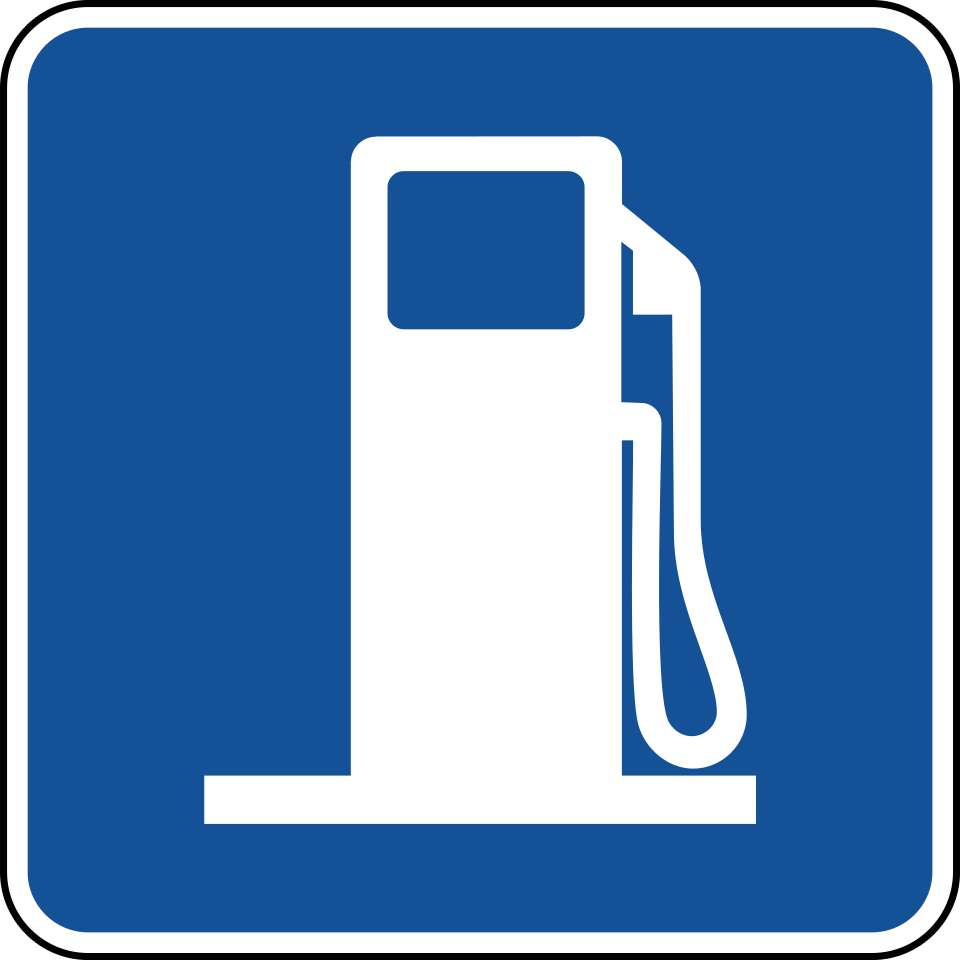
For new drivers navigating the complex web of American roadways, recognizing service signs is just as critical as obeying regulatory commands. The Gas Station road sign is a quintessential example of a guide sign, designed not to restrict movement but to inform and assist. Visually, this sign is instantly recognizable by its distinctive green background, which signifies general information and guidance, paired with a white silhouette of a fuel pump. While the shape can vary—often rectangular or square with rounded corners, though sometimes taking the form of a shield on specific highway systems—the color scheme is the primary identifier. Unlike red regulatory signs that demand immediate compliance or yellow warning signs that caution of hazards, the green gas pump sign serves as a helpful beacon for drivers needing to refuel. It indicates the proximity of a fueling station, often accompanied by distance markers or directional arrows, ensuring that motorists can plan their stops efficiently without disrupting the flow of traffic. For learner drivers, mastering the identification of this sign is a fundamental step in developing situational awareness and understanding the hierarchy of road signage.
What It Means
Formally, the Gas Station sign falls under the category of Guide Signs, specifically within the series of Motorist Service Signs. According to the Manual on Uniform Traffic Control Devices (MUTCD), these signs are designated to provide information about available services such as gas, food, lodging, and camping. The primary definition of the sign is to alert drivers to the presence of a fueling facility ahead, typically located at an upcoming exit or along a specific route. It does not, however, carry a regulatory mandate; seeing the sign does not legally require a driver to stop, turn, or change lanes. Instead, it offers a choice. The sign serves as a navigational aid, confirming that the driver's current route provides access to essential vehicle maintenance resources. For the driver, the required action is purely cognitive and preparatory. Upon seeing the sign, a driver should assess their current fuel levels. If the tank is low, the sign triggers a decision-making process: should I take the upcoming exit to refuel, or can I continue to the next available station? The sign often includes a distance plaque (e.g., "1/2 MILE" or "NEXT EXIT") which allows the driver to calculate whether they have sufficient range to reach the station. In the context of a learner driver, understanding that this sign is informational rather than regulatory is crucial. It represents an opportunity for a planned stop, contrasting sharply with a "Do Not Enter" or "Stop" sign which demands immediate, mandatory action. The sign effectively bridges the gap between the driver's immediate needs and the infrastructure available on the road network.
Where You'll See It
The placement of the Gas Station sign is highly strategic, governed by the principles of visibility and advance warning found in the MUTCD. You will most frequently encounter these signs on controlled-access highways, interstates, and major arterial roads where exits are spaced significantly apart. They are rarely found on local residential streets, as gas stations in those areas are usually visible directly from the road or marked by local business signage. On interstates, the sign is typically mounted on overhead gantries or on the right-hand side of the roadway, positioned well in advance of the exit ramp. The standard placement sequence usually involves an advance guide sign located one to two miles before the exit, followed by a confirmation sign at the exit gore (the point where the ramp diverges from the main highway). In some jurisdictions, you may also see these signs on blue backgrounds rather than green. While green is the standard for general guide signs, the MUTCD permits the use of blue for specific motorist services to distinguish them from general directional information. If you see a blue sign with a white gas pump, it carries the exact same meaning but is part of a specific series dedicated to services. Additionally, these signs are often grouped with other service icons, such as food, lodging, and hospitals, on a single panel to provide a comprehensive overview of available amenities at a particular exit. This clustering helps drivers make quick decisions without being overwhelmed by multiple individual signs.
What to Do When You See It
When a learner driver spots the Gas Station sign, the immediate response should be a systematic evaluation of the vehicle's status and the driving environment. First, check the fuel gauge. If the needle is in the red zone or below a quarter tank, the sign indicates a viable solution. The driver must then look for accompanying distance plaques. If the sign reads "Gas 1 Mile," the driver has ample time to prepare for an exit. The correct action involves signaling early, checking mirrors and blind spots, and merging smoothly into the rightmost lane if not already there. It is vital to avoid last-minute lane changes, which are a leading cause of accidents for new drivers. If the fuel level is adequate, the sign can be acknowledged and ignored, allowing the driver to maintain their current speed and lane position. However, even if a stop is not immediately necessary, noting the location is a good defensive driving habit. In case of an emergency or unexpected traffic congestion that prevents reaching the next planned stop, knowing where the nearest gas station is located can be invaluable. Furthermore, if the driver decides to exit, they must adhere to all standard exit procedures: reducing speed appropriately for the ramp, obeying any posted speed limits on the exit, and following the specific directional arrows that guide them to the station. The sign is a cue for planning, not a command for immediate maneuvering, and treating it as such helps maintain the smooth flow of traffic.
Common Pitfalls
Learner drivers often stumble over the nuances of service signs due to a lack of experience or misinterpretation of the sign's intent. One of the most common errors is confusing the Gas Station sign with a regulatory sign. Some new drivers may feel an urgent, almost compulsive need to exit the highway immediately upon seeing the sign, even if they have plenty of fuel. This can lead to erratic driving behavior, such as cutting across multiple lanes of traffic or braking suddenly. It is essential to remember that the sign is an invitation, not an order. Another frequent pitfall is misjudging the distance. A sign might say "Gas 1/4 Mile," and a driver might assume they can make a sharp turn or a sudden lane change at the last second. This underestimation of the distance required to safely merge and exit can result in dangerous situations. Additionally, learners sometimes confuse the green background with the blue background used for services. While the meaning is the same, failing to recognize the blue variant can cause confusion if a driver is only familiar with the green standard. Finally, some drivers become so focused on the sign that they neglect their primary task of scanning the road ahead, leading to a lapse in situational awareness. The sign should be processed quickly, and the driver's attention should immediately return to the road and surrounding traffic.
Permit-Test Context
In the context of a learner's permit or driver's license written exam, the Gas Station sign is a staple question designed to test the candidate's knowledge of sign categories and meanings. Examiners often present an image of the sign and ask the candidate to identify its purpose. The correct answer will almost always be related to "information," "guidance," or "services," rather than "regulation" or "warning." A typical multiple-choice question might ask: "What does a green sign with a white gas pump symbol indicate?" The distractors might include options like "Gas station ahead, must stop," "Warning of fuel spill," or "Regulatory speed limit for fueling." The correct choice will be "Gas station ahead" or "Service available." The test may also include questions about the color coding, asking why the sign is green or blue, to ensure the driver understands the MUTCD color hierarchy. Furthermore, situational questions may arise, such as: "You see a gas station sign 2 miles ahead, but your tank is full. What should you do?" The correct response is to continue driving, as the sign is informational. Understanding that this sign does not impose a legal requirement to stop is a key concept that examiners look for, as it distinguishes a safe, knowledgeable driver from one who might react impulsively to every visual cue on the road.