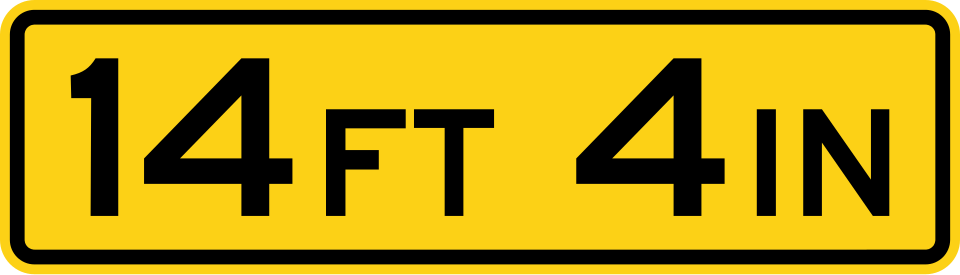
The height restriction sign is a distinctive regulatory marker designed to prevent catastrophic collisions between tall vehicles and low-clearance structures. Visually, it is a rectangular white sign with bold black lettering and a black border, often accompanied by a graphic illustration of a vehicle striking a barrier. The sign prominently displays a specific measurement, such as "14 FT 6 IN," indicating the maximum vertical clearance available. Unlike warning signs that use yellow, this sign is regulatory, meaning it conveys a mandatory limit rather than a suggestion. For a learner driver, recognizing this sign is not merely about reading a number; it is about understanding the immediate physical limitation of the road ahead and the absolute necessity of stopping if your vehicle exceeds that height. Ignoring this sign can lead to severe vehicle damage, structural collapse, traffic gridlock, and significant legal liability.
What it means
Formally, the height restriction sign indicates the maximum vertical clearance available for safe passage under an overpass, bridge, tunnel, or overhead utility line. In the context of the Manual on Uniform Traffic Control Devices (MUTCD), while specific sign codes like R12-1 are used for clearance plaques, the concept is a strict regulatory limit. The number displayed represents the lowest point of the overhead structure measured from the road surface. It is crucial to understand that this measurement is the absolute limit. It does not account for vehicle suspension bounce, road crown, or temporary road surface variations. For the driver, the required action is binary and immediate. If your vehicle's height is less than the posted number, you may proceed with caution, keeping a safe distance from the structure. If your vehicle's height equals or exceeds the posted number, you must stop immediately and find an alternate route. There is no "close enough" margin of error. The sign serves as a final warning before a physical barrier that cannot be moved. Unlike speed limits where a small variance might be tolerated by law enforcement, a height violation is a physical certainty of impact. The sign effectively says, "Do not enter if your vehicle is taller than this measurement."
Where you'll see it
Height restriction signs are strategically placed well in advance of the obstruction to give drivers ample time to react. You will most commonly encounter these signs at the entrance to underpasses, railway bridges, and low-clearance tunnels. They are frequently found on routes that transition from main highways to local industrial areas, where older infrastructure may have lower clearances than modern standards. In urban environments, these signs are critical near parking garages, loading docks, and historic districts with low-hanging utility lines or decorative arches. For commercial drivers, they are ubiquitous near distribution centers and warehouses. However, learner drivers should be particularly vigilant in rural areas where older bridges may not have been updated to accommodate modern semi-trailers or RVs. The placement follows a specific pattern: an advance warning sign is usually placed 500 to 1,000 feet before the obstruction, followed by a second sign closer to the structure, and finally, the clearance plaque mounted directly on the bridge or overpass itself. This redundancy ensures that even if a driver misses the first sign, they have multiple opportunities to assess the situation before reaching the danger zone.
What to do when you see it
Upon spotting a height restriction sign, the first step is to know your vehicle's exact height. Many learner drivers, especially those renting vehicles or driving large SUVs, vans, or trucks, may not be aware of their vehicle's total height including roof racks, antennas, or cargo. If you are unsure, you must assume the worst and treat the sign as a hard stop. If your vehicle is shorter than the posted limit, proceed with caution. Do not speed up; maintain a steady speed and stay in the center of the lane to maximize clearance, as road crowns can reduce effective height at the edges. If your vehicle is taller than the limit, or if you are uncertain, you must stop before the obstruction. Do not attempt to "squeeze through" or guess. Look for detour signs, which are often posted alongside the height restriction sign, guiding oversized vehicles to a safer route. If no detour is marked, you must reverse safely (if legal and possible) or turn around before reaching the bridge. In a driving test scenario, the examiner will be looking for your ability to recognize the sign, recall your vehicle's dimensions, and demonstrate the decision-making process to stop or turn around. Hesitation or attempting to proceed when the vehicle is too tall is an automatic failure.
Common pitfalls
One of the most dangerous misconceptions among new drivers is the belief that a small margin of error is acceptable. Drivers often think, "My van is 14 feet 5 inches, and the sign says 14 feet 6 inches, so I'll make it." This is a fatal error. Road surfaces can be uneven, suspension can compress and rebound, and the sign measurement might be the absolute lowest point of a bolt or beam. A collision can occur even with a one-inch gap. Another common pitfall is failing to account for added height. A standard sedan might fit under a 13-foot clearance, but if you have a roof rack loaded with kayaks or a bike carrier, your effective height increases significantly. Learner drivers often forget to measure the vehicle with all accessories attached. Additionally, some drivers confuse the height restriction sign with a warning sign for a steep grade or a low bridge that is merely a suggestion. It is a regulatory limit, not a recommendation. Finally, panic is a major issue; when a driver realizes they are too tall, they may slam on the brakes in the middle of the lane or attempt a dangerous U-turn. The correct reaction is a controlled stop well before the bridge, followed by a safe maneuver to exit the roadway.
Permit-test context
In the context of the driver's permit written exam, the height restriction sign is a frequent topic. Questions typically present an image of the sign and ask what action the driver should take. The correct answer is almost always to "check vehicle height and stop if too tall" or "do not enter if vehicle height exceeds the limit." Examiners may also include scenario-based questions, such as: "You are driving a rental truck and see a sign indicating a 12-foot clearance. Your truck is 12 feet 2 inches tall. What should you do?" The only acceptable answer is to turn around or find an alternate route. The test aims to verify that you understand the sign is a regulatory prohibition, not a warning. You may also be asked to identify the sign among other regulatory signs like weight limits or width restrictions. Remember, on the test, there is no partial credit for "almost making it." The sign represents a hard physical barrier, and the correct driving behavior is to respect that barrier without exception.