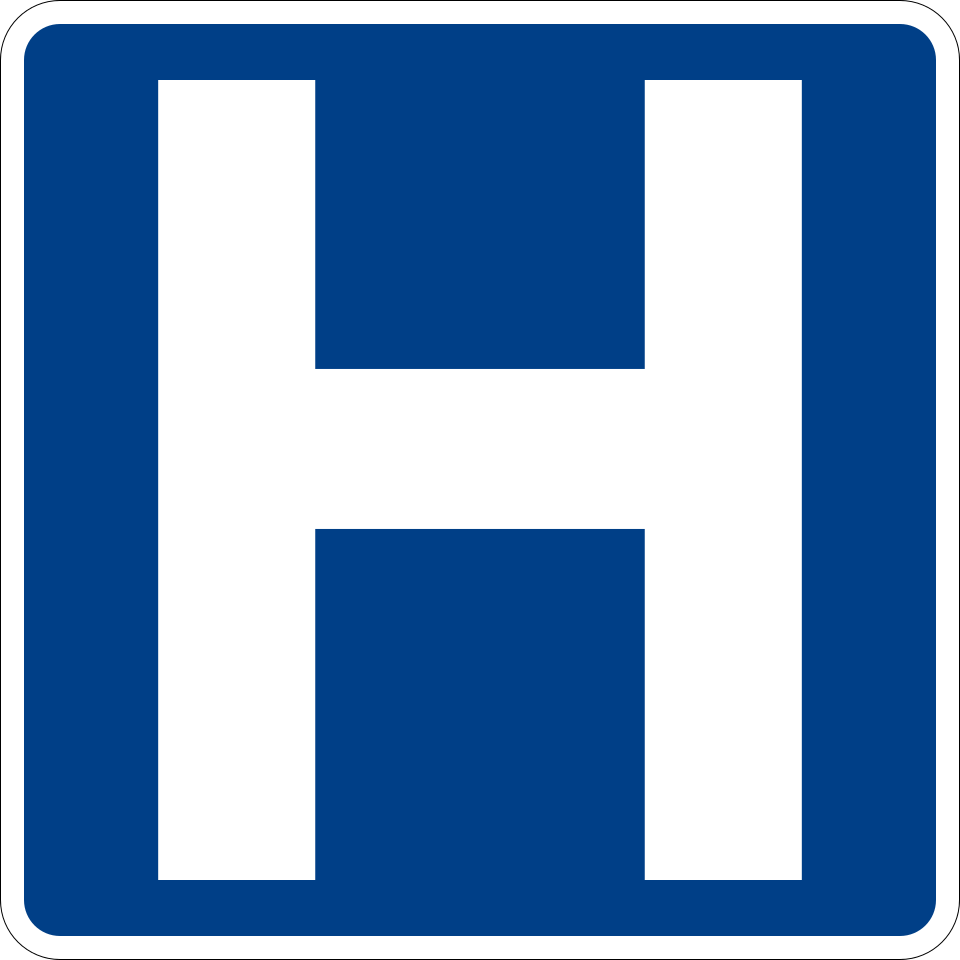
Understanding the Hospital Road Sign: A Guide for Learner Drivers
For new drivers navigating the complex web of road signage, distinguishing between regulatory, warning, and guide signs is a fundamental skill. Among the most recognizable symbols on the road is the hospital sign. Contrary to a common misconception held by many learner drivers, the standard hospital sign is not a regulatory sign that mandates a specific action like stopping or yielding; rather, it is a **guide sign** designed to provide critical location information. Visually, this sign typically features a white "H" centered on a blue square background, often accompanied by an arrow pointing in the direction of the medical facility. In some jurisdictions, you may also see a red cross symbol, though the blue square with the white "H" is the standard adopted by the Manual on Uniform Traffic Control Devices (MUTCD) for general guidance. The color blue signifies that the sign is providing information about services, while the square shape indicates a directional or informational purpose. Understanding this sign is vital not just for passing your permit test, but for ensuring you can locate emergency services quickly when seconds count. While it does not impose a legal restriction on your driving behavior, ignoring it during an emergency could have life-altering consequences.
What It Means
Formally, the hospital sign serves as a **Service Sign** within the traffic control system. Its primary definition is to identify the location of a hospital or medical facility and to guide drivers toward it. Unlike regulatory signs (such as Stop or Yield signs) which command immediate compliance, or warning signs (like Yellow Diamond signs) which alert drivers to potential hazards, the hospital sign is purely informational. It tells the driver, "A hospital is located in the direction indicated by the arrow." The driver action required upon seeing this sign is situational. If you are driving normally, the sign requires no immediate physical action other than mental acknowledgment. You are simply being informed of a nearby resource. However, the meaning of the sign shifts dramatically in the context of an emergency. If you or a passenger is experiencing a medical crisis, or if you are following an ambulance, this sign becomes the most important piece of information on the road. It dictates your route. The sign implies that the facility is accessible via the indicated turn or straight path. Furthermore, in many jurisdictions, the presence of this sign near an intersection may be accompanied by specific traffic patterns, such as dedicated lanes for emergency vehicles or specific turning restrictions designed to keep access clear, though the sign itself does not create these rules.
Where You'll See It
Hospital signs are strategically placed to ensure maximum visibility and utility for drivers. You will typically encounter these signs in several specific contexts. The most common placement is on **guide sign assemblies** along highways, freeways, and major arterial roads. In these locations, they are often grouped with other service signs indicating gas stations, food, lodging, and rest areas, usually mounted on a green background for highway guides or a blue background for local service roads. You will also see them at **intersections** where a turn is required to reach the facility. In these cases, the sign is often mounted on a post at the corner or suspended over the lane, featuring a directional arrow pointing left, right, or straight. It is crucial to note that these signs are rarely placed directly at the hospital entrance itself; rather, they are placed at decision points where a driver must choose a route. Additionally, you may find them on **route markers** for emergency access roads. In rural areas, where hospitals are spaced further apart, you might see these signs appearing well in advance of the facility to allow drivers ample time to prepare for a turn. They are also frequently found in conjunction with "Emergency Vehicle Only" signs near the actual hospital driveway, serving as a final confirmation of the destination.
What to Do When You See It
When you encounter a hospital sign, your response should be calibrated to your current driving situation. Under normal driving conditions, the correct action is **awareness**. Acknowledge the sign, note the direction of the arrow, and mentally file that information away. If you are driving in an unfamiliar area, this is the moment to check your navigation system to confirm the route to the nearest medical center, just in case it is needed. If you are driving in an emergency situation, the sign demands **immediate and decisive action**. If you are the one experiencing a medical emergency, or if you are transporting someone who is, follow the arrow indicated on the sign. Do not hesitate. If you are following an ambulance or other emergency vehicle, the sign confirms you are on the correct path. In this scenario, you must yield the right-of-way to the emergency vehicle and follow it toward the facility. It is also important to remember that while the sign points you to the hospital, it does not grant you the right to violate other traffic laws to get there. You must still stop at red lights and obey speed limits unless directed otherwise by emergency personnel. However, if you are the emergency vehicle operator, the sign serves as a confirmation of your route, and you may proceed with caution, using sirens and lights as required by law.
Common Pitfalls
Learner drivers frequently make several mistakes regarding the hospital sign. The most pervasive error is **misclassifying the sign**. Many students believe the hospital sign is a regulatory sign that requires them to stop or yield immediately upon seeing it. This is incorrect. The sign does not command a stop; it provides information. Failing to understand this distinction can lead to confusion during the permit test and dangerous hesitation on the road. Another common pitfall is **ignoring the directional arrow**. Some drivers see the "H" and assume the hospital is directly ahead, failing to notice that the arrow points to a side street. This can result in missing the turn and driving past the facility, which is dangerous in an emergency. Additionally, learners often confuse the **blue square "H" sign** with the **red cross symbol**. While both indicate medical facilities, the red cross is often used for specific organizations (like the Red Cross) or in older signage, whereas the blue "H" is the standard MUTCD guide sign. Confusing these can lead to misinterpretation of the sign's authority and purpose. Finally, some drivers mistakenly believe that the presence of a hospital sign means they must pull over or stop to let others in, which is not a rule associated with the sign itself, though yielding to emergency vehicles is always required.
Permit-Test Context
On your driver's permit test, the hospital sign is a frequent subject of questions designed to test your knowledge of sign categories and meanings. You may be shown an image of the blue square with a white "H" and asked to identify its category. The correct answer is **Guide Sign** (or Service Sign), not Regulatory or Warning. Be prepared to distinguish it from a "No Parking" sign (Regulatory) or a "Slippery When Wet" sign (Warning). You might also encounter scenario-based questions. For example: "You see a blue sign with a white H and an arrow pointing right. What should you do?" The correct answer is to recognize that a hospital is located to the right. If the question asks about the color, remember that **blue** indicates motorist services. If the question presents a red cross symbol, be aware that while it also indicates medical aid, the standard guide sign is the blue "H." Furthermore, test questions may ask about the appropriate action when an ambulance is approaching with sirens. While the hospital sign itself doesn't dictate the yield, the context of being near a hospital often implies the presence of emergency vehicles, and the correct action is always to pull over to the right and stop. Understanding the sign's role as an informational guide, rather than a command, is the key to answering these questions correctly.