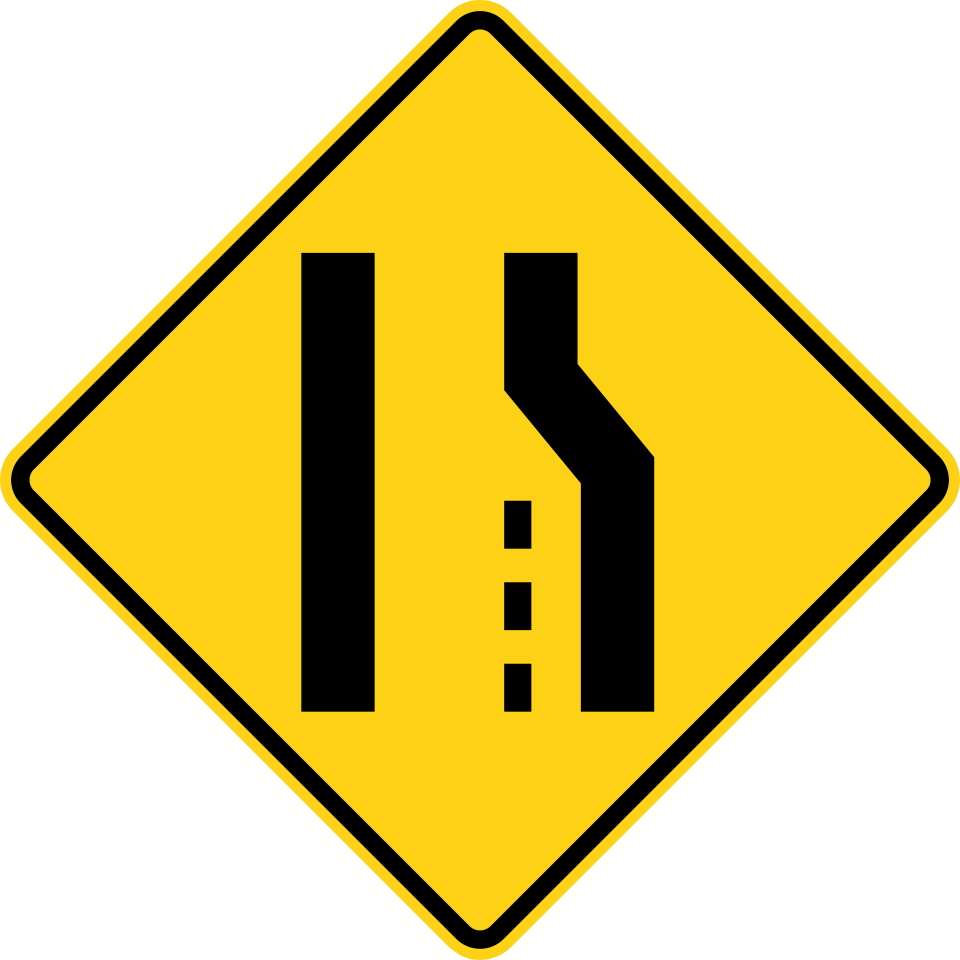
Understanding the Lane Ends Road Sign: A Guide for Learner Drivers
For new drivers navigating the complex web of American roadways, recognizing and reacting to traffic control devices is a fundamental skill. Among the most critical signs for maintaining traffic flow and safety is the "Lane Ends" sign. Visually, this sign is a diamond-shaped yellow plaque featuring a black graphic. The graphic typically depicts two parallel vertical lines representing lanes, with the right-hand line curving inward to merge into the left-hand line, often accompanied by the text "LANE ENDS" or "MERGE LEFT." As a warning sign, its primary color scheme is yellow with black symbols, adhering to the standard for cautionary messages. Unlike regulatory signs which are often white rectangles or red octagons, the yellow diamond immediately signals to the driver that a change in road geometry is imminent, requiring heightened attention and a potential adjustment in driving behavior. Understanding this sign is not merely about memorizing a shape; it is about grasping the dynamic nature of traffic merging and the responsibility of the driver to facilitate a safe transition.
What It Means
Formally, the Lane Ends sign (often designated as W4-2 in the Manual on Uniform Traffic Control Devices, or MUTCD) indicates that a specific lane of travel is terminating ahead. This is a warning, not a command, but it carries significant operational implications. The sign informs drivers that the lane they are currently occupying will disappear, forcing traffic to merge into an adjacent lane. Crucially, the sign itself does not dictate which driver has the right-of-way. It simply alerts the driver in the ending lane that they must prepare to merge. In many jurisdictions, the driver in the ending lane is expected to yield to traffic in the continuing lane, although the "zipper merge" concept is increasingly taught as the safest method. The core meaning is one of transition: the road configuration is changing, and the driver must anticipate a reduction in available lanes. Failure to recognize this sign can lead to last-minute, dangerous swerving, sudden braking, or collisions as drivers attempt to force their vehicle into a lane that no longer exists.
Where You'll See It
Lane Ends signs are strategically placed in locations where road capacity is reduced. The most common context is highway construction zones. When a lane is closed for roadwork, maintenance crews will place a series of Lane Ends signs well in advance of the actual closure to give drivers ample time to merge. You will also frequently encounter these signs on urban arterials where a multi-lane road narrows due to bridge approaches, tunnel entries, or intersections. Another typical scenario is the end of a passing lane on a two-lane highway, where the passing lane merges back into the main travel lane. Additionally, these signs appear at the exit of temporary detours or when a dedicated turn lane ends before an intersection, requiring drivers to merge into a through lane. The placement is governed by the MUTCD, which mandates that warning signs be placed far enough in advance to allow a driver traveling at the posted speed limit sufficient time to react and merge safely. This distance varies based on speed, but it is rarely less than 500 feet in urban areas and can be over a mile on high-speed freeways.
What to Do When You See It
Upon spotting the Lane Ends sign, a driver must immediately initiate a sequence of safe driving actions. First, check your mirrors and blind spots to assess the traffic density in the adjacent lane. Do not wait until the lane physically ends to look for a gap; the sign is your early warning system. If you are in the lane that is ending, you must begin the process of merging. This involves signaling your intention early, checking for a safe gap, and smoothly moving into the continuing lane. If you are in the continuing lane, you should be aware that a merge is occurring. While you technically have the right-of-way, defensive driving principles suggest that if a safe gap exists, you should consider slowing down slightly to allow the merging vehicle to enter, preventing a bottleneck or collision. The goal is a smooth flow of traffic. Avoid aggressive maneuvers such as speeding up to block a merging vehicle or making sudden lane changes. If the merge point is approaching and traffic is heavy, prepare to stop or slow down significantly. The key is anticipation: the sign tells you the road is changing, so your driving must adapt before the change happens.
Common Pitfalls
Learner drivers often fall into several traps when encountering Lane Ends signs. The most dangerous error is the "last-second merge." Drivers may ignore the sign, assuming they can make it to the end of the lane, only to find themselves forced to cut sharply across traffic or stop abruptly. This behavior is a leading cause of rear-end collisions and side-swipe accidents in construction zones. Another common mistake is failing to check blind spots. Drivers often focus entirely on the sign and the road ahead, neglecting to look over their shoulder to ensure the target lane is clear. Additionally, some drivers in the continuing lane exhibit "merge aggression," speeding up to prevent a merging car from entering, which disrupts traffic flow and increases the risk of accidents. Conversely, some drivers in the ending lane may hesitate too long, waiting for a gap that never comes, causing a backup. Finally, confusing the Lane Ends sign with a "Road Closed" sign can lead to confusion; the Lane Ends sign means the lane disappears but traffic continues in another lane, whereas a Road Closed sign means the entire road is impassable.
Permit-Test Context
On the written permit test, questions regarding the Lane Ends sign focus on your understanding of right-of-way and appropriate reaction. You may be asked to identify the sign from a description or an image. A typical question might ask: "What should you do when you see a Lane Ends sign?" The correct answer will always involve preparing to merge and yielding to traffic in the adjacent lane. Be wary of trick questions that suggest you have the right-of-way simply because you are in the lane that hasn't ended yet; while legally true in many contexts, the test often emphasizes the responsibility of the driver in the ending lane to yield. You might also encounter questions about the "zipper merge," where the correct answer is to use both lanes until the merge point and then take turns merging. The test aims to ensure you understand that the sign is a warning of a geometric change, not a command to stop, and that safe merging requires cooperation and early preparation. Memorizing the diamond shape and the black-on-yellow color scheme is essential for the visual identification portion of the exam.