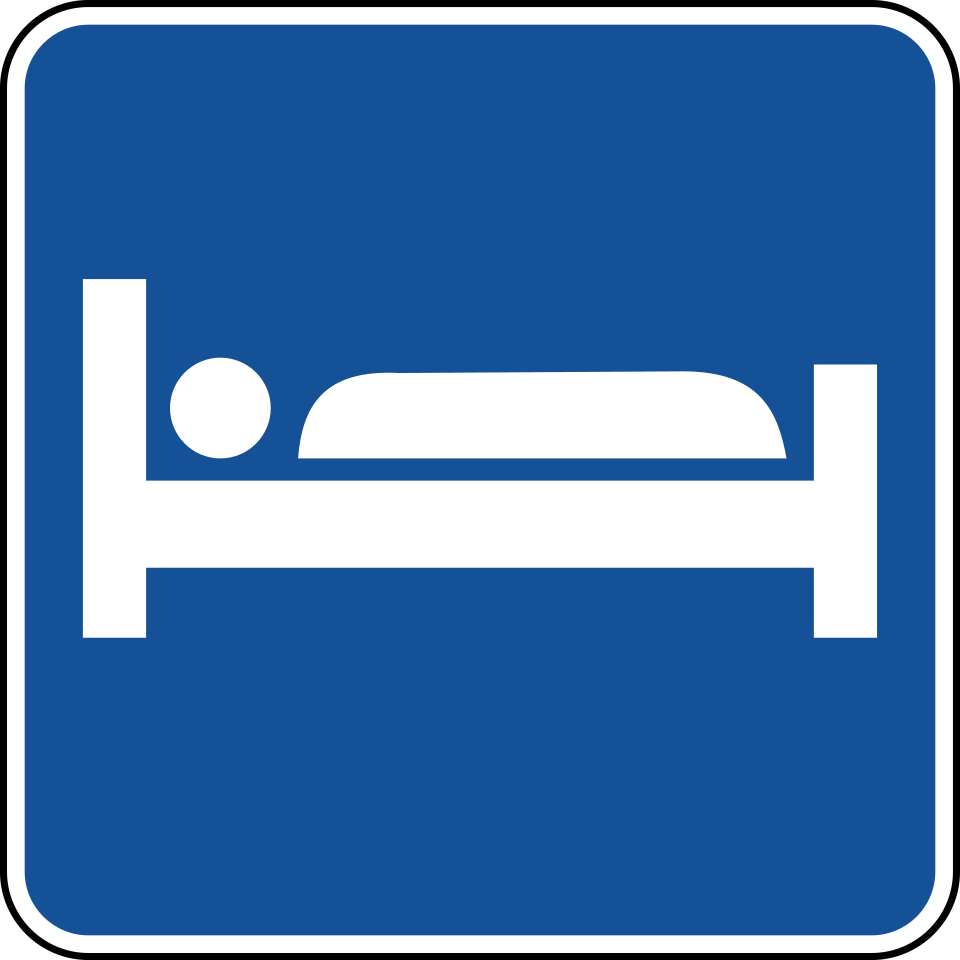
For new drivers navigating the complex web of American roadways, recognizing and interpreting regulatory signs is a fundamental skill that ensures safety and legal compliance. Among the myriad of symbols encountered on the highway, the "Lodging" sign stands out as a unique category of information that, while often grouped with service signs, carries specific regulatory implications regarding where a driver may legally stop or park. Visually, the Lodging sign is distinct: it features a white silhouette of a bed or a stylized building with a roof against a solid blue rectangular background. The text "LODGING" or "MOTEL" is typically displayed in white capital letters, often accompanied by an arrow pointing in the direction of the facility. Unlike warning signs which are yellow and diamond-shaped, or regulatory signs like "Stop" which are red and octagonal, the blue background immediately signals to the driver that this is a guide sign providing information about services available. However, for the learner driver, it is crucial to understand that while the sign itself is informational, the actions it prompts—pulling off the road, stopping, and parking—are governed by strict regulatory rules. Misinterpreting the intent of this sign can lead to dangerous maneuvers, such as stopping on a high-speed shoulder or blocking a travel lane, which are serious traffic violations. This article delves deep into the definition, placement, and correct driver response to the Lodging sign, ensuring that every new driver can navigate these scenarios with confidence and adherence to the Manual on Uniform Traffic Control Devices (MUTCD).
What It Means
Formally, the Lodging sign is classified as a guide sign within the broader category of service signs, though its function often intersects with regulatory behavior. According to the Manual on Uniform Traffic Control Devices (MUTCD), specifically Chapter 2E, signs with a blue background and white symbols or text are designated to provide information about motorist services. The Lodging sign specifically indicates the availability of overnight accommodations, such as hotels, motels, inns, or campgrounds, in the immediate vicinity or at the next exit. The primary meaning of the sign is to inform the driver that a place to rest is available ahead, which is a critical safety feature for long-distance travelers suffering from fatigue.
However, the driver action required goes beyond simple recognition. The sign does not grant an automatic right to stop anywhere visible. Instead, it serves as a directive to prepare for a lane change or exit maneuver if the driver intends to utilize the service. The regulatory implication is that the driver must only stop at the designated facility indicated by the sign. Stopping on the shoulder of the highway solely because a Lodging sign is visible is illegal and dangerous unless the vehicle is disabled. The sign acts as a beacon for a legal stopping point, but the act of stopping is contingent upon reaching the specific off-ramp or driveway associated with the lodging. For learner drivers, the core lesson is that the sign identifies a destination, not a current permission to halt traffic flow. It signifies a transition from the through-traffic environment to a service environment, requiring a change in driving behavior from high-speed cruising to cautious maneuvering.
Where You'll See It
The placement of the Lodging sign is highly strategic and governed by strict guidelines to ensure maximum visibility and safety. Learner drivers will most commonly encounter these signs on interstate highways, freeways, and major arterial roads where traffic speeds are high and exits are spaced further apart. They are typically mounted on overhead gantries or on large posts on the right-hand shoulder, positioned well in advance of the exit ramp that leads to the lodging facility. This advance placement allows drivers sufficient time to react, check their mirrors, signal, and merge into the correct lane without making sudden, erratic movements.
In addition to highway exits, Lodging signs are frequently found at the beginning of service plazas or rest areas. In these contexts, the sign may be accompanied by other service icons, such as gas, food, or restrooms, forming a cluster of blue signs. You might also see them at the entrance to a specific motel complex located directly off a state highway or a busy city street. In rural areas, where lodging is sparse, these signs are often placed at the very first opportunity to turn off the main road, sometimes accompanied by a distance marker (e.g., "1 Mile"). The consistency of the blue background is key; regardless of whether the sign is on a rural two-lane road or a multi-lane interstate, the blue color and white bed symbol remain constant, providing a universal language for drivers across the country. It is important to note that these signs are rarely placed on local residential streets, as the primary audience is long-distance or inter-city travelers.
What to Do When You See It
Upon spotting a Lodging sign, the immediate action for a driver depends on their current intent. If the driver is not seeking accommodation, the correct response is to simply acknowledge the sign and continue driving. No lane change or speed adjustment is necessary. However, if the driver is fatigued, needs a break, or is looking for a place to stay, the sign triggers a specific sequence of actions. First, the driver must verify their need to stop. If they decide to proceed to the lodging, they must check their mirrors and blind spots to ensure it is safe to change lanes. They should then activate their turn signal well in advance of the exit or turn-off indicated by the sign.
As the vehicle approaches the exit, the driver must reduce speed gradually, adhering to the posted speed limit for the ramp, which is often lower than the highway speed. It is critical to remain in the designated exit lane and not to attempt to turn directly from a through-lane if a dedicated turn lane is provided. Once off the main roadway, the driver should follow the directional arrows often found on the Lodging sign or subsequent guide signs until the facility is reached. Only upon entering the property of the lodging establishment is the driver legally permitted to stop the vehicle. Throughout this process, the driver must maintain awareness of other vehicles, particularly large trucks that may also be following the Lodging sign. The sign is a guide to a safe stopping location, and the driver's responsibility is to navigate to that location smoothly and legally, avoiding any abrupt stops on the shoulder or in travel lanes.
Common Pitfalls
Learner drivers often fall into several traps when encountering service signs like the Lodging sign. One of the most dangerous misconceptions is the belief that the sign authorizes an immediate stop on the shoulder. Some new drivers, feeling tired upon seeing the sign, may pull over to the right shoulder of the highway, thinking they are "at" the lodging. This is a severe violation; the sign indicates the lodging is ahead, not that the shoulder is a parking lot. Stopping on the shoulder without an emergency is a traffic infraction and poses a significant risk of rear-end collisions.
Another common error is the "last-minute lane change." Drivers who ignore the sign until they are directly under it often panic and attempt to cut across multiple lanes of traffic to reach the exit. This aggressive maneuver can cause accidents and is a frequent cause of failure in driving tests. Additionally, some learners confuse the Lodging sign with a regulatory "No Stopping" sign due to the blue color, or conversely, they treat the blue sign as a green light to stop anywhere. It is vital to remember that blue signs are informational, not regulatory permissions to stop in the travel lane. Finally, failing to check for the distance marker is a pitfall; drivers may assume the lodging is immediately adjacent when it could be several miles away, leading to confusion and erratic driving as they search for a turn that hasn't appeared yet.
Permit-Test Context
In the context of the learner's permit written exam, the Lodging sign is a staple question designed to test the candidate's knowledge of sign colors and meanings. Examiners often present an image of the blue sign with the bed symbol and ask, "What does this sign indicate?" The correct answer is always related to the availability of overnight accommodations or motorist services. Candidates must distinguish this from green signs (which indicate directional guidance to destinations) and yellow signs (which warn of hazards). A typical multiple-choice question might ask, "A blue sign with a white bed symbol means: A) No parking allowed, B) Lodging is available ahead, C) Rest area is closed, D) Hospital nearby." The correct choice is B.
Furthermore, situational questions may appear, such as, "You see a Lodging sign and you are tired. What should you do?" The correct response in these scenarios emphasizes safety and legality: "Continue to the exit indicated by the sign before stopping." Questions may also test the color coding, asking, "What color are signs that provide information about motorist services like lodging, gas, and food?" The answer is blue. Understanding the distinction between the informational nature of the sign and the regulatory rules of stopping is a key differentiator between a passing and failing score. The test aims to ensure that new drivers do not just memorize the symbol but understand the safe driving behavior associated with it.