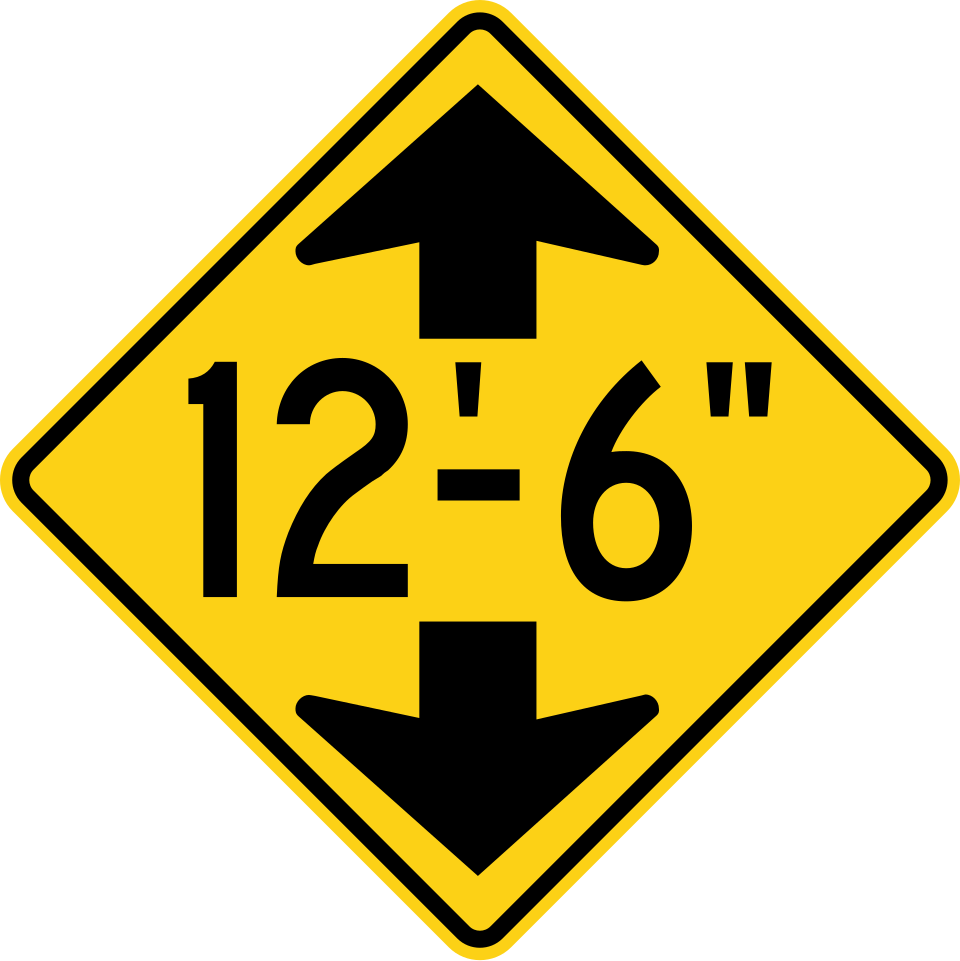
Mastering the Low Clearance Sign: A Guide for New Drivers
For learner drivers navigating the complexities of the road, recognizing regulatory signs is a fundamental skill that ensures safety and legal compliance. Among these, the Low Clearance sign stands out as a critical warning that demands immediate attention and precise action. Visually, this sign is unmistakable: it is a rectangular yellow sign with black lettering and a black border. Unlike the diamond-shaped warning signs that alert drivers to curves or pedestrian crossings, the Low Clearance sign is strictly rectangular, often featuring a large, bold number indicating the vertical height limit in feet and inches (e.g., "14 FT 6 IN"). The color scheme of yellow and black is designed for high contrast and visibility, ensuring that the message is legible even in poor weather conditions or at night. The meaning is direct and non-negotiable: the structure ahead—whether a bridge, overpass, tunnel, or canopy—has a vertical clearance lower than the standard roadway height. If a vehicle exceeds the indicated height, it will physically strike the structure, potentially causing catastrophic damage to the vehicle, the infrastructure, and endangering all occupants and other road users.
What It Means
Formally, the Low Clearance sign is a regulatory warning sign that communicates the maximum safe vertical height for vehicles passing underneath a specific overhead structure. While often categorized alongside warning signs due to its yellow background, its function is regulatory because it establishes a physical limit that cannot be exceeded without consequence. The number displayed represents the lowest point of the overhead structure, measured from the road surface to the underside of the bridge or beam. It is crucial for drivers to understand that this measurement is absolute; it does not account for vehicle suspension bounce, uneven road surfaces, or the height of a load that may shift during transit.
The driver action required upon seeing this sign is immediate verification of the vehicle's total height. This is not a suggestion but a mandatory safety check. If the driver is operating a standard passenger car, the sign serves as a confirmation that the vehicle will pass safely. However, if the driver is operating a truck, RV, camper, or a vehicle carrying a roof rack, ladder, or other overhead load, they must compare their vehicle's total height against the sign's figure. If the vehicle's height equals or exceeds the number on the sign, the driver must not proceed. The required action is to stop, turn around, or find an alternate route before reaching the structure. Ignoring this sign is not a matter of receiving a traffic ticket; it is a matter of preventing a high-impact collision that can result in the vehicle becoming wedged, power lines being severed, or the bridge structure being compromised.
Where You'll See It
Low Clearance signs are strategically placed well in advance of the hazard to give drivers sufficient time to react. You will typically encounter these signs on highways, rural roads, and urban streets where bridges, overpasses, or tunnels intersect with the roadway. The placement follows a logical progression: the first sign is often placed 500 to 1,000 feet before the structure, followed by a second sign closer to the bridge, and sometimes a final sign directly at the approach. This redundancy ensures that even if a driver misses the first warning, they have multiple opportunities to assess their situation.
These signs are particularly common in areas with older infrastructure, where bridges were constructed before modern vehicle height standards were established. You will frequently see them in industrial zones where truck traffic is heavy, near construction sites with temporary overhead barriers, and in scenic areas with historic tunnels. In some jurisdictions, you may also see these signs at the entrance of parking garages or drive-throughs, though these often use different signage formats. For learner drivers, it is important to scan the horizon not just for traffic lights and stop signs, but for these rectangular yellow markers. They often appear in conjunction with other warning signs, such as "Bridge Ice" or "Narrow Lane," indicating that the road ahead requires heightened caution in multiple dimensions.
What to Do When You See It
Upon spotting a Low Clearance sign, the driver must engage in a mental calculation that involves three steps: identification, measurement, and decision. First, identify the number on the sign. Second, know the exact height of the vehicle you are driving. For a standard sedan, this is usually between 4.5 and 5.5 feet. For an SUV or minivan, it might be 6 to 7 feet. For an RV or box truck, it can easily exceed 13 feet. If you are unsure of your vehicle's height, you must assume you are too tall and treat the sign as a stop command until you can verify.
If your vehicle is shorter than the clearance, you may proceed with caution, keeping a steady speed and staying in the center of the lane to maximize the available vertical space. If your vehicle is taller than the clearance, you must execute a safe maneuver to avoid the structure. This usually means pulling over safely before the bridge, activating hazard lights, and turning around. Do not attempt to "squeeze" under the bridge, as the clearance is often measured at the lowest point, which may be a beam or a signpost that is lower than the main span. Furthermore, never rely on the clearance of the vehicle in front of you; a flatbed truck might have passed, but your RV might not fit. Always verify your own vehicle's dimensions against the sign.
Common Pitfalls
Learner drivers often fall into several traps when encountering Low Clearance signs. The most dangerous pitfall is the assumption that "it will fit." Drivers may glance at the sign, see a number like 14 feet, and assume their 12-foot RV will easily pass. However, they fail to account for dynamic factors such as road dips, suspension compression, or the height of a roof-mounted air conditioner or satellite dish. Another common error is misreading the sign due to glare or poor lighting, confusing the feet and inches (e.g., reading 14'6" as 14 feet instead of 14 feet 6 inches).
Additionally, some drivers mistakenly believe that if the sign is yellow, it is merely a suggestion rather than a hard limit. This is a fatal misconception. Unlike a "Yield" sign where you can proceed if the way is clear, a Low Clearance sign represents a physical barrier that cannot be negotiated. Another pitfall is following a large vehicle blindly. If a semi-truck passes under a bridge, it does not mean the bridge is safe for all vehicles; the truck may have a different height profile, or the driver may have already known the clearance and taken a different route. Finally, failing to check the sign until the last second is a critical error. Once a driver is directly under the bridge, it is too late to stop or turn around. The sign must be read and acted upon well before the structure is reached.
Permit-Test Context
In the context of the driver's permit test, the Low Clearance sign is a frequent subject of multiple-choice questions and visual identification sections. Examiners want to ensure that new drivers can distinguish this sign from others and understand the specific action required. You may be shown an image of the rectangular yellow sign with a number and asked, "What does this sign indicate?" The correct answer will always relate to the maximum vertical height of the vehicle.
Scenario-based questions are also common. For example, the test might present a situation: "You are driving a vehicle that is 13 feet tall. You see a sign that says 13 feet 2 inches. What should you do?" The correct answer is to proceed with caution, but be aware of the small margin. However, if the sign says 13 feet and your vehicle is 13 feet 2 inches, the answer is to turn around. The test may also ask about the color and shape of the sign to ensure you can identify it quickly while driving. Remember, the key to passing these questions is understanding that the sign is a hard physical limit, not a recommendation. If the vehicle height is greater than or equal to the sign's number, the answer is always to avoid the structure.