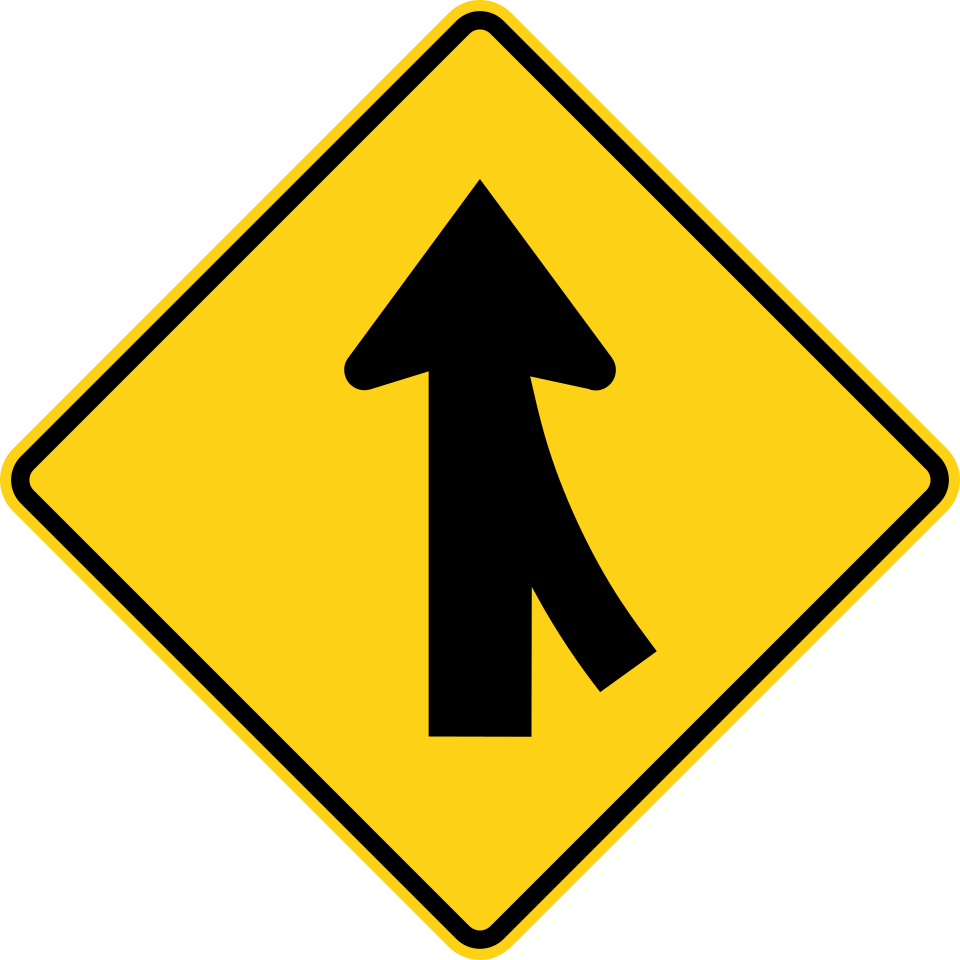
Mastering the Merge Sign: A Comprehensive Guide for Learner Drivers
For new drivers navigating the complex web of American roadways, understanding the nuances of traffic control devices is paramount to safety. Among the most critical yet frequently misunderstood signs is the Merge sign. Distinctively rectangular and vertical, this sign features a bold black arrow curving from the right or left to join a straight arrow, set against a bright yellow background with black lettering. Unlike the red octagon of a stop sign or the white rectangle of a regulatory speed limit, the yellow Merge sign serves as a specific warning and instruction: traffic from an adjacent lane is entering your roadway, or you are entering a roadway where traffic is already flowing. While often categorized broadly under regulatory guidance, its primary function is to manage the flow of traffic at points of convergence, ensuring that drivers anticipate the merging vehicle and adjust their speed or position accordingly. For a learner driver, recognizing this sign is the first step in mastering the art of highway integration and safe lane management.
What It Means
The formal definition of the Merge sign, often designated as the W4-1 sign in the Manual on Uniform Traffic Control Devices (MUTCD), is to warn drivers that traffic from another roadway or lane is entering the same roadway. It indicates a point where two separate streams of traffic must combine into a single lane or a reduced number of lanes. Crucially, the sign does not automatically assign the right-of-way to the merging traffic, nor does it grant the through-traffic absolute priority without context. Instead, it serves as a directive for both parties to prepare for a change in traffic patterns.
For the driver seeing the sign on the main roadway, the meaning is clear: "Expect traffic entering from the side." You must be prepared to adjust your speed, change lanes if safe, or create a gap to allow the merging vehicle to enter smoothly. For the driver on the ramp or side road who sees a similar sign (often accompanied by a "Yield" sign), the meaning is that they must merge into the flow of traffic, yielding to vehicles already on the main road if necessary. The core action required is anticipation. The sign transforms a potentially chaotic convergence into a predictable event. It demands that the driver scan the horizon, check mirrors, and mentally prepare for a vehicle to appear in their blind spot or adjacent lane. It is a call to action that prioritizes cooperation over competition, reminding drivers that the road is a shared space requiring constant communication through speed and position adjustments.
Where You'll See It
The Merge sign is a ubiquitous sight in the United States, appearing in specific contexts where road geometry necessitates the joining of traffic flows. The most common location is at the entrance of highway on-ramps. As a driver approaches a highway, they will often see the Merge sign placed on the ramp itself, indicating that the acceleration lane is ending and they must join the main traffic stream. Conversely, drivers traveling on the main highway will see the sign placed on the right shoulder, warning them that an on-ramp is approaching and vehicles will be entering their lane.
Beyond highway interchanges, Merge signs are frequently found at the end of auxiliary lanes, such as those used for passing or climbing lanes on steep hills. When a passing lane ends, a Merge sign alerts drivers in that lane that they must merge back into the slower, right-hand lane. They are also common at the exit of construction zones where a temporary lane closure forces traffic to merge into a single lane. In urban environments, you might encounter them where a side street or a driveway widens to become a full travel lane, or where a dedicated turn lane ends and must merge with the through traffic. The placement is strategic: it is always positioned far enough in advance to give drivers adequate time to react, typically 500 feet to 1,000 feet before the actual point of convergence, depending on the speed limit and road conditions. This distance allows for the necessary speed adjustments and lane changes required for a safe merge.
What to Do When You See It
When a learner driver encounters the Merge sign, the immediate response should be a systematic check of the vehicle's surroundings and a modification of driving behavior. If you are the driver on the main roadway seeing the sign, your first action is to scan your side mirrors and check your blind spots. Look for a vehicle approaching in the adjacent lane or ramp. Once a merging vehicle is identified, assess the gap. If there is sufficient space, maintain your speed or slightly adjust to create a comfortable buffer. If the gap is tight, the safest and most courteous action is to change lanes to the left (if clear) to open up space for the merging driver. If a lane change is not possible, you should slow down slightly to allow the other vehicle to enter safely. Remember, aggressive driving, such as speeding up to block a merge, is dangerous and illegal in many jurisdictions.
If you are the driver on the ramp or side road seeing the Merge sign, your responsibility is to accelerate to match the speed of the traffic on the main highway. Merging at a significantly lower speed than the flow of traffic is a leading cause of accidents. Use the acceleration lane to reach a speed that allows you to blend seamlessly into the traffic stream. Continuously check your mirrors and blind spots to find a gap. If traffic is heavy and no gap is immediately available, you may need to adjust your speed—slowing down or speeding up slightly—to find an opening. Never stop on an acceleration lane unless traffic is completely at a standstill. The goal is a smooth, continuous flow where the merging vehicle becomes part of the traffic stream without disrupting the rhythm of the vehicles already on the road.
Common Pitfalls
Learner drivers often fall into several traps when dealing with Merge signs. One of the most dangerous misconceptions is the belief that the Merge sign grants the merging vehicle the right-of-way. In reality, the driver on the main roadway generally has the right-of-way, and the merging driver must yield. However, the driver on the main road has a duty to cooperate. Another common error is "speeding up to block." Some drivers, upon seeing a merge sign, instinctively accelerate to prevent a car from cutting them off. This creates a high-speed conflict zone and often leads to rear-end collisions or sideswipes. Conversely, merging drivers often fail to accelerate sufficiently, entering the highway at speeds far below the flow of traffic, which forces other drivers to brake suddenly and creates a hazard.
Another pitfall is the failure to check blind spots. Merging vehicles often appear suddenly in a driver's peripheral vision, leading to panic braking or erratic steering. Learners must be trained to perform a "head check" or shoulder check before making any lane adjustments. Additionally, some drivers misinterpret the sign as a signal to stop. The Merge sign is not a stop sign; stopping on an acceleration lane or in a merge zone is illegal and highly dangerous unless traffic is completely stopped. Finally, drivers often fail to anticipate the merge until the last second. By the time the merging vehicle is directly alongside, it is often too late to react safely. The key to avoiding these pitfalls is early detection, early communication (using turn signals), and proactive speed management.
Permit-Test Context
On the written permit test, the Merge sign is a frequent subject of multiple-choice questions designed to assess a candidate's understanding of right-of-way rules and safe driving practices. Questions may ask, "What should you do when you see a Merge sign on the highway?" with options ranging from "Speed up to block the merging car" to "Check mirrors and adjust speed to allow merging." The correct answer invariably involves checking mirrors, scanning for traffic, and adjusting speed or position to facilitate a safe merge. Test-takers must also distinguish the Merge sign from the Yield sign. While both involve yielding, the Merge sign specifically implies a merging of lanes, whereas a Yield sign can apply to intersections or other scenarios. Another common test scenario involves the "zipper merge" concept, which is increasingly taught in driver education. Although the physical sign may not always explicitly state "zipper merge," the principle is tested: drivers should use both lanes until the point of merge and then take turns merging one-by-one. Questions may also probe the difference between a Merge sign and a Lane Ends sign. While similar, the Lane Ends sign (often a diamond-shaped warning sign) indicates a lane is disappearing, whereas the Merge sign (rectangular) specifically indicates the joining of two traffic streams. Understanding these nuances is critical for passing the exam and, more importantly, for surviving real-world driving scenarios where split-second decisions determine safety.