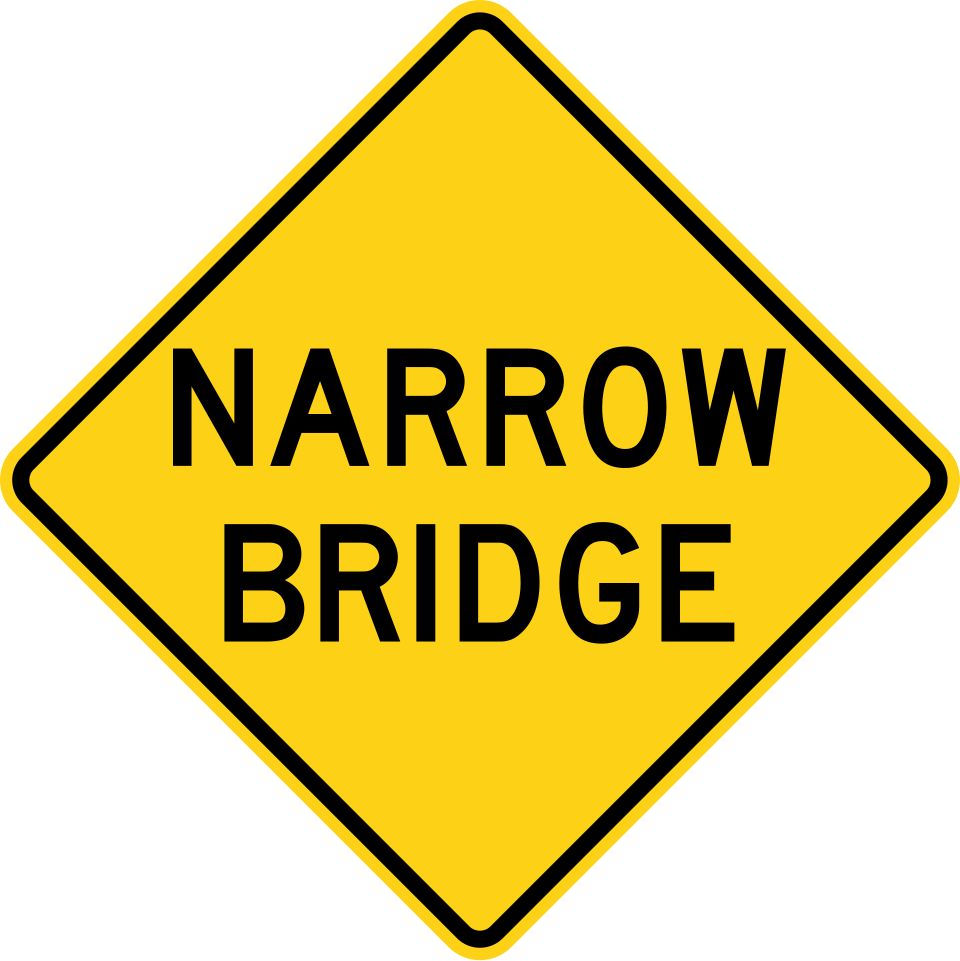
Mastering the Narrow Bridge Sign: A Comprehensive Guide for Learner Drivers
For every new driver navigating the complexities of the road, recognizing and reacting appropriately to warning signage is a fundamental skill that ensures safety for everyone. Among the most critical of these signs is the Narrow Bridge sign. Visually, this sign is distinct and impossible to miss: it is a yellow diamond shape with a black border, featuring a black silhouette of a bridge that appears to constrict in the middle, often accompanied by the text "NARROW BRIDGE" or simply the graphic symbol. In the United States, this falls under the category of a warning sign (despite the prompt's initial classification as regulatory, the MUTCD strictly categorizes the W5-2 sign as a warning device intended to alert drivers to a condition, not to issue a legal command like a stop sign). Its primary color scheme of yellow and black is designed to grab attention immediately, signaling a potential hazard ahead where the roadway width decreases significantly, often to the point where two-way traffic cannot pass simultaneously without one vehicle yielding. Understanding this sign is not just about passing a written test; it is about preventing head-on collisions and ensuring smooth traffic flow in constrained environments.
What It Means
The formal definition of the Narrow Bridge sign, designated as W5-2 in the Manual on Uniform Traffic Control Devices (MUTCD), is to warn drivers that the bridge or structure ahead has a width that is less than the standard roadway width. This reduction in width may be so severe that the bridge cannot accommodate two-way traffic at the same time. Unlike a regulatory sign that mandates a specific action (like "Do Not Enter"), the Narrow Bridge sign is a warning that requires the driver to assess the situation and prepare to yield. The core meaning is one of congestion and limited clearance. When you see this sign, you are being informed that the physical infrastructure ahead does not support the standard two-lane flow of traffic. In many cases, the bridge is wide enough for only one vehicle to cross at a time. This creates a temporary bottleneck. The sign does not automatically mean you must stop, but it implies that if you encounter an oncoming vehicle on the bridge, one of you must wait. The specific rule of the road usually dictates that the vehicle already on the bridge has the right-of-way, or that the vehicle approaching the narrower section must yield if the other is already committed to the crossing.
Where You'll See It
Learner drivers will typically encounter the Narrow Bridge sign in rural areas, on older infrastructure, or in regions with challenging topography where building wide bridges is cost-prohibitive or structurally difficult. You are most likely to see this sign on two-lane highways that traverse rivers, creeks, or deep ravines in the countryside. It is also common in historic districts where bridges were constructed decades or even centuries ago before modern vehicle widths became the standard. The sign is usually placed at a sufficient distance before the bridge to allow a driver to slow down and scan for oncoming traffic. The MUTCD recommends that the sign be placed anywhere from 100 to 500 feet before the hazard, depending on the speed limit of the road. In high-speed zones, the sign is placed further back to give drivers ample reaction time. You might also see supplementary plaque signs below the main diamond, such as "ONE LANE" or "YIELD TO ONCOMING TRAFFIC," which provide more specific instructions for the immediate bridge crossing. These signs are rarely found in dense urban centers where bridges are engineered to accommodate multi-lane traffic, but they are a staple of the scenic byways and backroads that learner drivers often explore during practice sessions.
What to Do When You See It
Upon spotting the yellow diamond with the narrow bridge graphic, your immediate action should be to reduce speed and increase situational awareness. Do not assume the bridge is clear. As you approach the structure, scan the bridge for any oncoming vehicles. If the bridge is wide enough for only one car, you must determine who has the right-of-way. The general rule of thumb is that the vehicle already on the bridge has the right-of-way. If you are approaching and see a car already on the bridge, you must pull over to the right and wait for them to clear the structure before you proceed. If you arrive at the same time as an oncoming vehicle, the driver who is closer to the bridge or who has already entered it typically has priority. However, if there is no clear indication, communication is key. Use eye contact or a hand wave to signal the other driver to proceed if you are yielding. Never attempt to "race" to the bridge. If the bridge is extremely narrow, you may need to stop completely before entering to ensure your vehicle fits without scraping the sides. Always check for pedestrians or cyclists, as they may be sharing the limited space. The goal is to cross the bridge safely, one vehicle at a time if necessary, without causing a standoff or a collision.
Common Pitfalls
Learner drivers often make several critical errors when encountering the Narrow Bridge sign. The most dangerous mistake is assuming the bridge is wide enough for two cars. Many new drivers see a bridge and assume it functions like the road leading up to it, failing to realize the width reduction until they are already on the structure, leading to a dangerous standoff in the middle. Another common pitfall is failing to yield. Some drivers, eager to maintain their speed, refuse to pull over for an oncoming vehicle, believing they have the right-of-way simply because they arrived first, ignoring the rule that the vehicle already on the bridge has priority. This can lead to gridlock or, worse, a head-on collision on the bridge. Additionally, learners often fail to check for pedestrians. On narrow bridges, sidewalks may be non-existent, and pedestrians might be walking along the edge of the roadway. Failing to account for them can result in a severe accident. Finally, some drivers panic when they see the sign and brake too hard, causing a rear-end collision with traffic behind them. The correct response is a smooth, controlled deceleration while scanning the environment.
Permit-Test Context
In the context of the driver's permit written exam, the Narrow Bridge sign is a frequent subject of multiple-choice questions. The test will likely show an image of the sign and ask what it indicates. The correct answer will always relate to a reduction in road width or a hazard where two-way traffic cannot pass. Be wary of distractors that suggest the sign means "Bridge Closed" or "No Trucks Allowed"; while those might be true in specific scenarios, the sign itself only warns of the narrow width. Another common test question involves a scenario: "You are approaching a narrow bridge and see an oncoming car. What should you do?" The correct answer is to yield if the other vehicle is already on the bridge or to communicate and yield if the situation is ambiguous. The test may also ask about the color and shape, reinforcing that it is a yellow diamond warning sign. Understanding the logic behind the sign—safety through yielding and speed reduction—is more important than memorizing the specific MUTCD code, though knowing it is a warning sign (W5-2) can help you eliminate regulatory options on the test.