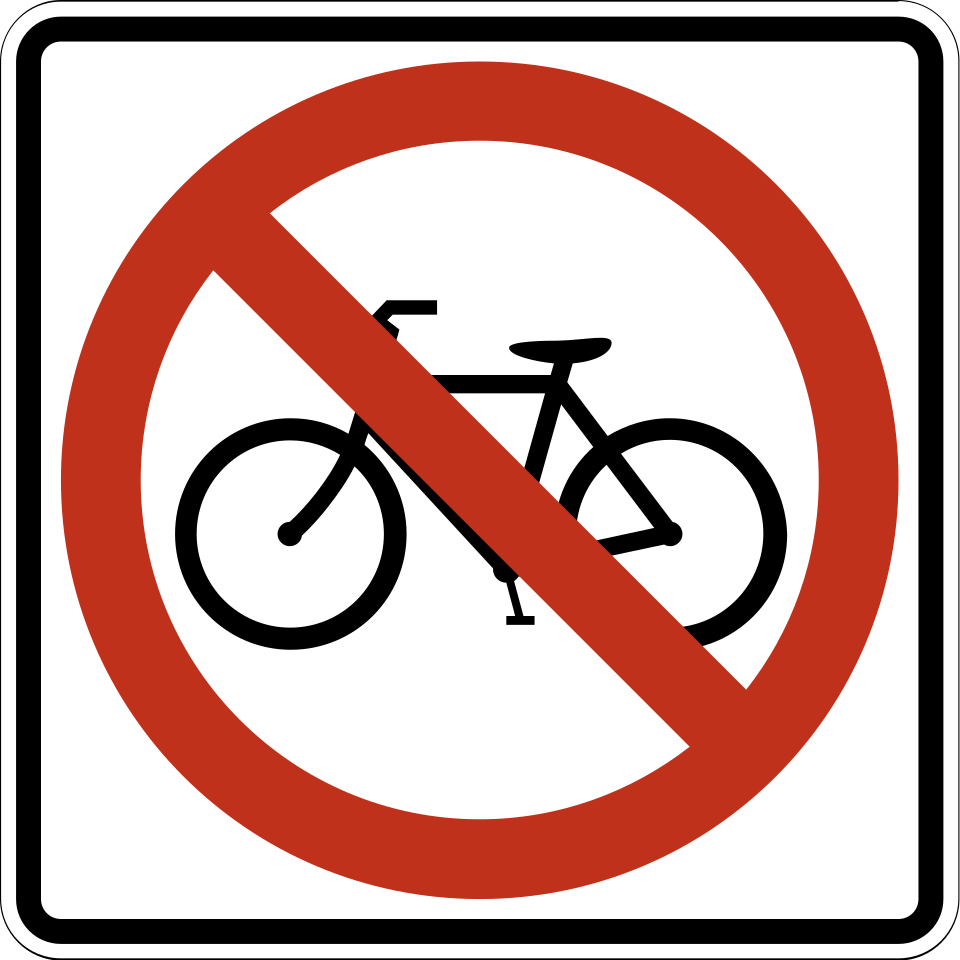
Understanding the No Bicycles Road Sign: A Guide for Learner Drivers
For new drivers navigating the complex web of road rules, recognizing regulatory signs is a fundamental skill that ensures safety for everyone on the road. Among these, the "No Bicycles" sign stands out as a critical indicator of traffic separation. Visually, this sign is a white rectangle featuring a black bicycle symbol with a red circle and a diagonal slash running through it. The red circle and slash are the universal symbols for prohibition, instantly communicating that the specific activity depicted—in this case, bicycling—is forbidden in the area. Unlike warning signs which are typically yellow and diamond-shaped, or guide signs which are often green or blue, this sign is strictly regulatory. Its primary color scheme of black, white, and red demands immediate attention and compliance. For a learner driver, understanding this sign is not just about passing a written test; it is about recognizing zones where high-speed motor vehicles and vulnerable cyclists cannot safely coexist, such as limited-access highways, tunnels, or specific bridge sections.
What it means
The formal definition of the "No Bicycles" sign is straightforward yet absolute: it prohibits the operation of bicycles on the roadway, shoulder, or path where the sign is posted. In the context of the Manual on Uniform Traffic Control Devices (MUTCD), this falls under the category of regulatory signs, specifically designated to inform road users of specific laws, regulations, or restrictions. While the MUTCD does not assign a single unique alphanumeric code to every variation of this sign in the same way it does for speed limits (R2-1), it is generally categorized under the R5 series (Prohibitory Signs) or R9 series (Bicycle Regulations), often utilizing the standard R5-1 or R9-1 plaque design depending on the specific jurisdiction and context.
When a driver encounters this sign, the required action is to ensure that no bicycles are present on the roadway ahead and to be aware that cyclists are legally barred from entering that specific section of the road. For the driver, this implies a change in traffic dynamics. You should not expect to see cyclists sharing the lane or using the shoulder. However, this does not grant the driver carte blanche to ignore safety. The sign indicates a separation of traffic modes, often due to high speeds, narrow lanes, or hazardous conditions like steep grades or poor visibility. The driver must remain vigilant, as a cyclist might be attempting to enter the prohibited zone, or the sign might be placed at the entrance of a tunnel or bridge where cyclists are not permitted to enter from the other side. The sign serves as a legal boundary; crossing it on a bicycle is a traffic violation, and driving a vehicle into a zone where cyclists are prohibited is generally not an issue for the motorist, but the driver must respect the intent of the separation.
Where you'll see it
The placement of the "No Bicycles" sign is strategic and dictated by safety engineering principles. You will most commonly encounter this sign at the entrance to limited-access highways, freeways, and expressways. These roads are designed for high-speed motor vehicle traffic, and the presence of a bicycle moving at 10 to 15 miles per hour creates a dangerous speed differential that can lead to catastrophic accidents. Consequently, the sign is posted at on-ramps and at the beginning of the highway segment to clearly delineate the boundary where bicycles are excluded.
Beyond freeways, this sign frequently appears at the entrances to tunnels, long bridges, and specific sections of mountain roads. In tunnels, visibility is often reduced, ventilation is limited, and there is no shoulder for a cyclist to pull over if they encounter mechanical issues. Similarly, on narrow bridges or steep mountain passes, the lack of space and the potential for high winds or falling rocks make the environment unsuitable for cyclists. You might also see these signs on specific segments of urban arterials where traffic flow is heavy and lane width is insufficient to accommodate a bicycle safely alongside moving cars. In some jurisdictions, the sign may be accompanied by a supplementary plaque stating "Except for Maintenance" or "Except for Emergency," clarifying that the prohibition applies to general public use but allows for authorized personnel.
What to do when you see it
When a learner driver sees the "No Bicycles" sign, the immediate cognitive task is to recognize the traffic environment change. The first step is to mentally note that the road ahead is a motor-vehicle-only zone. This means you should not be looking for cyclists in your mirrors or scanning the shoulder for a bike lane, as one does not legally exist in this section. However, this should not lead to complacency. Drivers must understand that while the sign prohibits entry, it does not guarantee that no one is already there. A cyclist might have entered from a side street before the sign was posted, or they might be attempting to cross the barrier illegally.
Furthermore, drivers should be prepared for the possibility of emergency situations. If a cyclist is seen in a prohibited zone, the driver's responsibility is to slow down, increase following distance, and pass with extreme caution, even though the cyclist is technically in violation of the law. The sign also serves as a reminder to the driver to check their own vehicle for any cargo or passengers that might be on a bicycle, such as a bike rack on the roof, ensuring that the vehicle itself is not inadvertently transporting a bicycle into a restricted area if local laws prohibit that specific configuration. Finally, drivers should be aware that the sign often marks the beginning of a zone with different speed limits or lane usage rules, so adjusting speed and driving behavior accordingly is essential.
Common pitfalls
Learner drivers often fall into the trap of assuming that "No Bicycles" means the road is completely empty of non-motorized traffic. This is a dangerous misconception. While the sign legally prohibits bicycles, human error and illegal behavior occur. A common pitfall is failing to scan the road ahead for a cyclist who may have entered the zone illegally or is unaware of the sign. Another mistake is confusing this sign with a "Bike Lane" sign. Some new drivers see the bicycle symbol and assume it indicates a designated lane for bikes, failing to recognize the red circle and slash which negates the symbol entirely. This confusion can lead to drivers expecting a bike lane where there is none, or conversely, driving aggressively into a space they think is for cars when a cyclist is actually present.
Additionally, learners sometimes overlook the context of the sign. They may see the sign and assume it applies only to the immediate lane, not realizing it often applies to the entire roadway, including shoulders and emergency lanes. In some cases, drivers might also confuse the "No Bicycles" sign with the "No Trucks" or "No Motorcycles" signs, leading to confusion about which vehicle types are restricted. It is crucial to memorize the specific symbol: a bicycle with a red slash. Finally, a significant pitfall is the assumption that the sign is merely a suggestion. In many jurisdictions, entering a restricted highway on a bicycle is a serious infraction, and drivers who fail to respect the separation of traffic modes may contribute to accidents that could have been avoided with proper vigilance.
Permit-test context
In the context of a driver's permit test, the "No Bicycles" sign is a frequent subject of multiple-choice questions and image identification exercises. Examiners aim to ensure that new drivers can instantly recognize the sign and understand its legal implication. A typical question might show an image of the sign and ask, "What does this sign indicate?" with options like "Bicycles must yield," "Bicycles are allowed," or "Bicycles are prohibited." The correct answer is always the prohibition option. Another common test scenario involves a situational question: "You are approaching a tunnel with a 'No Bicycles' sign. What should you do?" The expected answer involves recognizing that cyclists are not allowed, but the driver must still drive defensively in case a cyclist is present.
Test takers may also be asked to identify the sign among a group of other regulatory signs, such as "No U-Turn," "No Left Turn," or "No Parking." The key to answering these questions correctly is to focus on the shape and color: a white rectangle with a black symbol and a red prohibition circle. The test may also probe the driver's understanding of the sign's placement, asking where such a sign is most likely to be found (e.g., at the entrance to a freeway). Understanding the "why" behind the sign—safety and traffic separation—is often the underlying concept being tested, even if the question is purely about identification. Mastery of this sign demonstrates a commitment to understanding the rules that govern different types of road users, a core competency for any licensed driver.