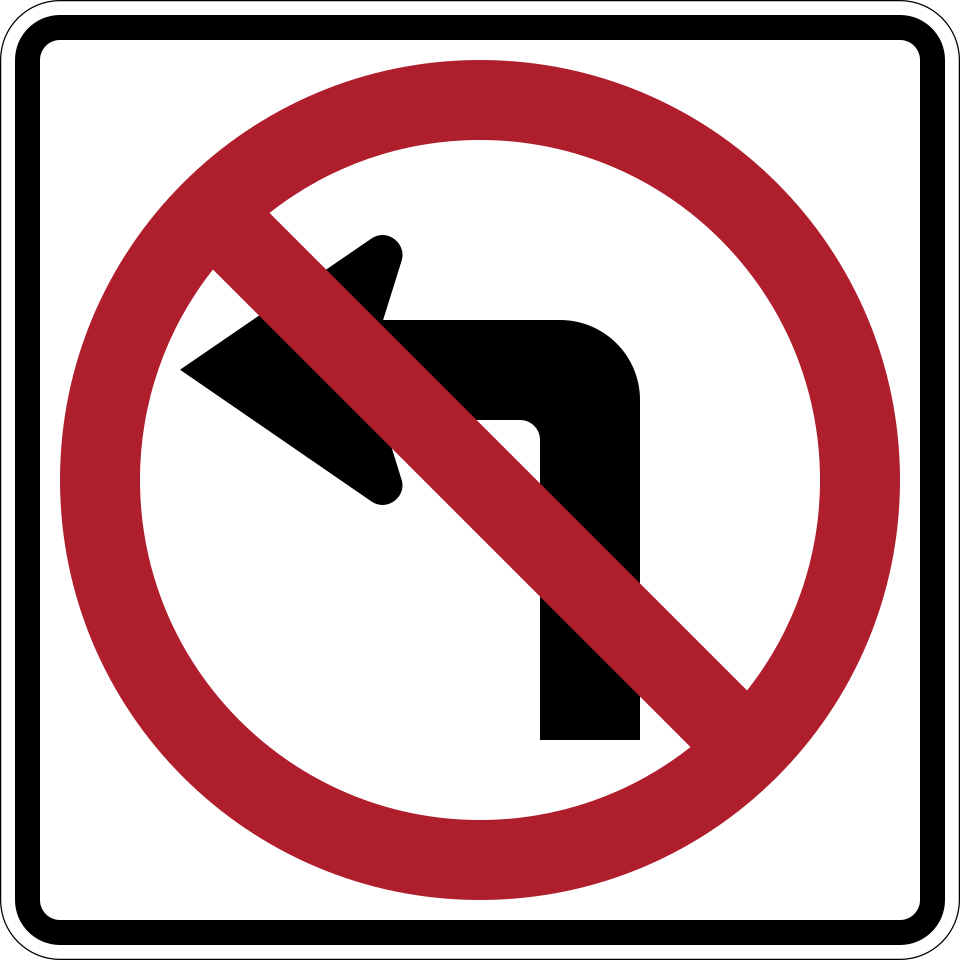
Mastering the No Left Turn Sign: A Comprehensive Guide for Learner Drivers
For any new driver navigating the complex web of American roadways, the ability to instantly recognize and react to regulatory signage is paramount. Among the most critical of these is the No Left Turn sign. Visually, this sign is unmistakable: it features a square white background with a black border, displaying a black arrow pointing to the left that is crossed out by a bold red diagonal slash. This universal symbol serves as a strict prohibition, communicating that making a left-hand turn at the upcoming intersection or from the current lane is legally forbidden. Unlike warning signs that suggest caution, or guide signs that offer direction, this regulatory sign demands immediate compliance. Failure to adhere to its instruction can result in traffic citations, dangerous conflicts with oncoming traffic, and in worst-case scenarios, severe collisions. For learner drivers, understanding the nuances of this sign is not just about passing a written exam; it is about developing the situational awareness required to drive safely in an environment where traffic flow is meticulously managed.
What It Means
Formally defined by the Manual on Uniform Traffic Control Devices (MUTCD), the No Left Turn sign is a regulatory device designated as R3-2. Its primary function is to prohibit drivers from executing a left turn at a specific location. The meaning is absolute: there are no exceptions for convenience, urgency, or local knowledge. When a driver encounters this sign, the legal requirement is to continue straight through the intersection or, if traffic patterns allow, to make a right turn or a U-turn (unless a separate sign prohibits U-turns as well). The sign is often accompanied by supplementary plaques that clarify the scope of the prohibition. For instance, a plaque reading "ALL DAY" indicates the restriction is permanent, while "7 AM - 9 AM" suggests the ban is only in effect during peak traffic hours. In some jurisdictions, you may also see "EXCEPT BUSES" or "EXCEPT EMERGENCY VEHICLES," which carve out specific exemptions for public transit or first responders. However, for the general motorist and the learner driver, the default assumption must always be that the turn is strictly off-limits. The sign is designed to prevent drivers from turning across lanes of oncoming traffic when the intersection geometry, traffic volume, or visibility makes such a maneuver unsafe. It is a command that overrides a driver's natural instinct to take the shortest path to a destination.
Where You'll See It
The placement of the No Left Turn sign is strategic and governed by strict engineering standards to ensure maximum visibility and reaction time. You will most commonly encounter this sign at intersections where a left turn would create a conflict with high-speed oncoming traffic or where the road layout makes a safe turn impossible. Typical contexts include:
- Divided Highways: When approaching a median, you will often see this sign on the left side of the road or on the median itself, indicating that you cannot cross the median to turn left into a side street or driveway.
- One-Way Streets: If you are driving on a one-way street and approach an intersection where the cross street is also one-way but moving in the opposite direction, a No Left Turn sign will prevent you from turning against the flow of traffic.
- Complex Intersections: In areas with multiple lanes, the sign may be mounted on overhead mast arms or placed on the right-hand post to indicate that the leftmost lane is a dedicated through-lane or a right-turn-only lane, effectively banning left turns from that position.
- Traffic Calming Zones: In residential neighborhoods or school zones, these signs are used to prevent cut-through traffic, forcing drivers to use designated arterial roads instead of weaving through local streets.
What to Do When You See It
Upon spotting the No Left Turn sign, a learner driver must initiate a specific sequence of actions to ensure safety and compliance. First, scan the environment. Confirm the sign's location and check for any supplementary plaques that might limit the restriction to specific times or vehicle types. Second, adjust your lane position. If you are currently in the leftmost lane and the sign prohibits a left turn, you must signal your intention to change lanes to the right, provided it is safe to do so. Do not wait until you are at the stop line to realize you are in the wrong lane; this often leads to last-minute swerving or stopping in the intersection, both of which are dangerous. Third, plan your route. If your intended destination requires a left turn that is now prohibited, you must immediately calculate an alternative route. This might involve driving straight through the intersection, making a right turn, and then executing a U-turn at a later, legal location, or taking a different street entirely. Fourth, maintain your course. Once you have decided on your path, commit to it. Do not hesitate at the intersection, as hesitation confuses other drivers and disrupts traffic flow. Finally, execute the maneuver safely. If you are turning right or going straight, ensure you check your mirrors and blind spots, signal appropriately, and proceed with caution. The key is to treat the sign as a hard constraint that requires proactive route planning rather than a reactive obstacle.
Common Pitfalls
Learner drivers frequently stumble over the No Left Turn sign due to a combination of anxiety, lack of experience, and misinterpretation of the road environment. One of the most common errors is ignoring the sign until it is too late. New drivers often focus so intently on the steering wheel or the car ahead that they miss the sign until they are already in the intersection. This results in either making an illegal turn or stopping abruptly in the middle of the road, causing a traffic jam or a rear-end collision. Another frequent mistake is confusing the sign with a "No U-Turn" sign. While both signs use a red slash, the arrow direction is different. A No Left Turn sign does not necessarily prohibit a U-turn, although in many cases, if you cannot turn left, you cannot legally complete a U-turn either. However, assuming a U-turn is automatically allowed without checking for a separate prohibition is a dangerous assumption. Additionally, learners often fail to recognize the sign's placement on the median. In divided highway scenarios, the sign is often mounted on the concrete barrier or a post in the center of the road. Drivers approaching from the right side of the road may not expect to see a regulatory sign in the center, leading them to attempt a turn across the median. Finally, some drivers mistakenly believe that if there is no oncoming traffic, the rule does not apply. This is a critical error; regulatory signs are legal mandates, not suggestions based on current traffic conditions. The prohibition stands regardless of how empty the road appears.
Permit-Test Context
On the written permit test, the No Left Turn sign is a staple question designed to assess a candidate's knowledge of regulatory signs and their ability to interpret visual cues. Questions typically appear in two formats: image recognition and scenario-based application. In an image recognition question, you will be shown a picture of the sign and asked to select the correct meaning from a list of options. The distractors often include "Left turn only," "Left turn yield," or "No U-turn," testing your ability to distinguish between similar-looking symbols. In scenario-based questions, you might be presented with a situation: "You are approaching an intersection and see a No Left Turn sign. You need to go to a destination on the left side of the street. What should you do?" The correct answer will always involve continuing straight or finding an alternative legal route, such as a U-turn at a designated location. Test-takers must also be aware of the nuances of supplementary plaques. A question might ask, "What does a No Left Turn sign with a '7 AM - 9 AM' plaque mean?" The correct response is that the restriction is temporary and only applies during those specific hours. Understanding the sign's definition, its placement, and the required driver action is essential for passing the exam and, more importantly, for becoming a safe, law-abiding driver.