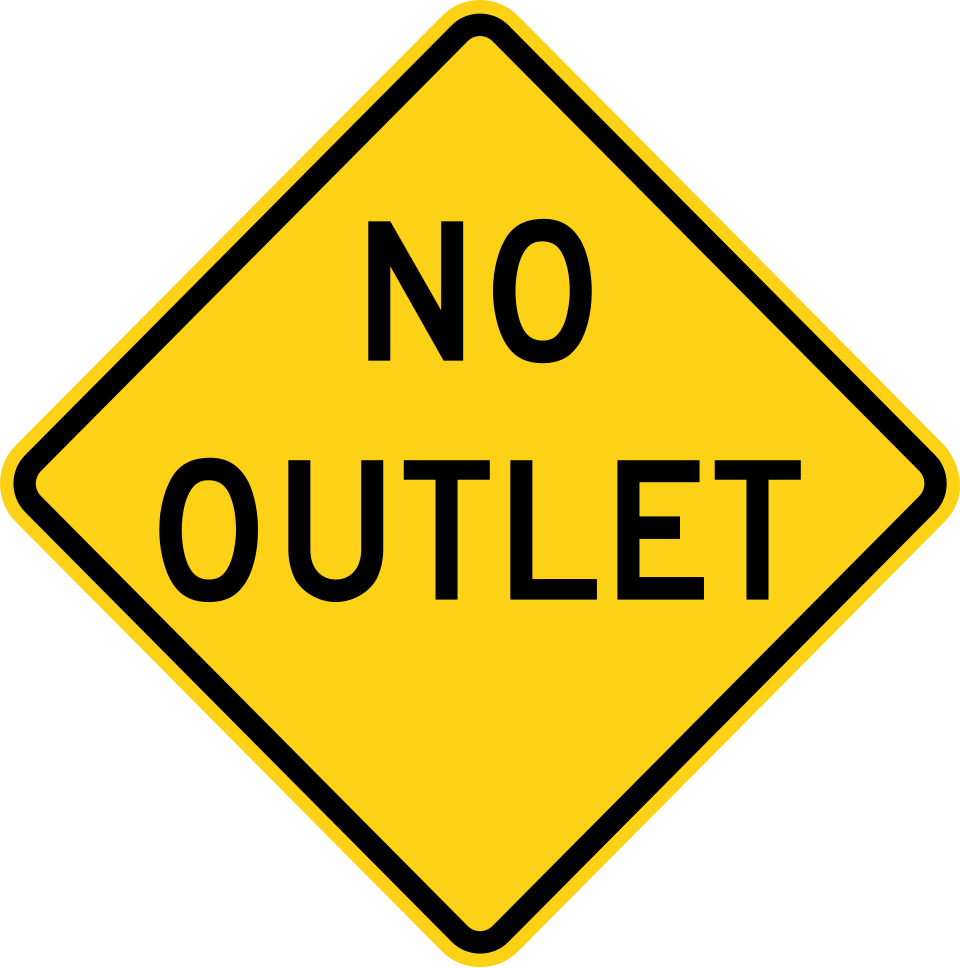
The No Outlet Road Sign: A Comprehensive Guide for Learner Drivers
For new drivers navigating the complex web of residential streets and rural byways, the No Outlet road sign is a critical piece of visual communication. This sign is a white square or rectangle featuring a black border, with a black arrow pointing upward that terminates in a solid black horizontal bar, often accompanied by the text "NO OUTLET" in bold black capital letters. Unlike warning signs that use yellow diamonds to alert drivers to immediate hazards, the No Outlet sign is a regulatory and informational marker designed to manage traffic flow and prevent drivers from entering dead-end streets. Its primary function is to inform motorists that the road ahead does not connect to another through street, meaning there is no exit other than the one used for entry. Recognizing this sign early is essential for learner drivers to avoid unnecessary U-turns, wasted fuel, and the potential stress of navigating tight spaces in unfamiliar neighborhoods.
What It Means
Formally, the No Outlet sign indicates that the roadway ahead is a cul-de-sac, a dead end, or a court that does not provide a through route to another street. In the context of the Manual on Uniform Traffic Control Devices (MUTCD), while the specific "No Outlet" sign is often categorized under informational signs (Series D) rather than strict regulatory signs (Series R), it carries significant weight in traffic management. It serves as a definitive statement that the path forward is a dead end. For the driver, the required action is one of awareness and planning. Upon seeing this sign, a driver must understand that continuing straight will eventually lead to a turnaround point, such as a cul-de-sac bulb or a T-intersection where a U-turn or three-point turn is necessary to return to the main road. It does not mean the road is closed to traffic; rather, it means the road is not a shortcut. Drivers should not expect to find an alternative exit on the other side of the block. This distinction is vital for navigation, especially when using GPS systems that might occasionally suggest a route through a dead-end street to save a few seconds, which can be counterproductive if the driver is unfamiliar with the area.
Where You'll See It
The placement of the No Outlet sign is strategic and typically occurs well before the road actually ends. You will most commonly encounter this sign at the entrance of residential subdivisions, rural housing developments, or specific apartment complexes. It is usually mounted on a post on the right-hand side of the road, positioned at a height that is easily visible to drivers in passenger vehicles. In some jurisdictions, you may also see a smaller, supplementary plaque below the main sign indicating the distance to the dead end (e.g., "1/4 MILE"). This is particularly common on longer dead-end roads where the turnaround point is far from the entrance. Additionally, these signs are frequently found in areas undergoing construction or temporary road closures where a through street has been blocked off, effectively turning a through road into a dead end for the duration of the work. In rural settings, they may mark the end of a gravel road that leads to a private driveway or a scenic overlook with no exit. For learner drivers, spotting these signs early is a key part of defensive driving, as it allows ample time to decide whether to enter the street or turn around immediately.
What to Do When You See It
When a learner driver encounters a No Outlet sign, the immediate response should be a mental reassessment of the current route. If the driver's destination is located within that specific street, they may proceed with caution, keeping in mind that they will need to perform a turn-around maneuver at the end. However, if the driver is merely passing through or looking for a shortcut, the correct action is to turn around before entering the street. This prevents the frustration of driving to the end of the road, performing a difficult U-turn in a narrow space, and driving back out. If a driver has already entered the street and missed the sign, they should continue to the end of the road safely, looking for a designated turnaround area or a wide enough space to execute a three-point turn. It is crucial to signal intentions clearly to other drivers and pedestrians, especially in residential areas where children or pets might be present. Drivers should also be prepared for other vehicles that may be attempting to exit the dead end, requiring them to yield or pull over to allow oncoming traffic to pass if the road is narrow. The key takeaway is to treat the sign as a "stop and think" moment rather than a "stop and turn" command, unless the driver is certain they do not belong there.
Common Pitfalls
Learner drivers often fall into several traps when dealing with No Outlet signs. One of the most common mistakes is confusing the No Outlet sign with a "Road Closed" sign. While both indicate that the road does not continue, a "Road Closed" sign (often a red and white barricade or sign) means the road is impassable due to construction, damage, or legal restriction, whereas a No Outlet sign simply means the road ends but is open for access to properties along it. Another pitfall is ignoring the sign and assuming the GPS is correct. Modern navigation systems sometimes route drivers through dead-end streets to avoid traffic, but a learner driver who blindly follows the GPS without recognizing the physical sign may find themselves stuck in a cul-de-sac with no easy way out. Additionally, some drivers panic when they realize they have entered a dead end, leading to erratic driving maneuvers, such as sudden braking or attempting a U-turn in an unsafe location. Finally, failing to check for oncoming traffic before turning around in a cul-de-sac is a significant safety risk. Learners must remember that the sign is a warning to plan ahead, not a signal to stop immediately.
Permit-Test Context
On the written permit test, the No Outlet sign is frequently used to test a candidate's understanding of road signs and their ability to interpret traffic scenarios. Questions may ask the driver to identify the meaning of the sign from a list of options, often including distractors like "Road Closed," "One Way," or "Detour." A typical question might present a scenario: "You see a sign with a black arrow ending in a bar and the words 'NO OUTLET.' What should you do?" The correct answer would be to recognize that the road does not connect to another street and to plan for a turnaround. Some tests may also include questions about the appropriate action when entering a dead-end street, such as yielding to oncoming traffic or performing a three-point turn safely. It is important for learners to memorize the visual characteristics of the sign: the white background, black border, and the specific arrow symbol. Understanding the difference between informational signs like this one and regulatory or warning signs is a key component of passing the written exam. Furthermore, test-takers should be aware that while the MUTCD provides the national standard, state-specific variations in wording or sign design may exist, so reviewing the local driver's handbook is always recommended.