Mastering the No Right Turn Sign: A Comprehensive Guide for Learner Drivers
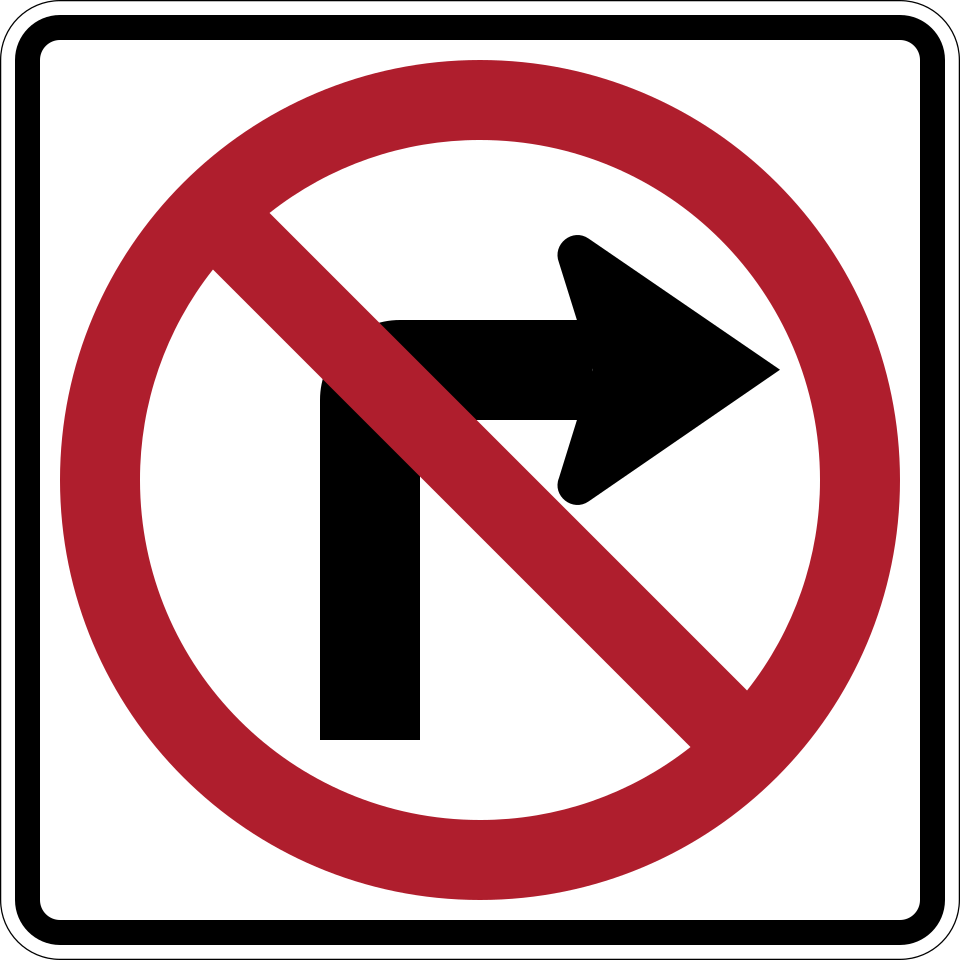
For every new driver navigating the complex web of road rules, the "No Right Turn" sign stands as a critical regulatory marker designed to prevent dangerous maneuvers and maintain traffic flow. Visually, this sign is unmistakable: it features a black right-pointing arrow inside a red circle with a diagonal red slash running through it, all set against a white square or rectangular background. The red circle and slash are the universal symbols for prohibition, instantly communicating that the action depicted by the arrow is strictly forbidden. Unlike warning signs that use yellow diamonds or guide signs that use green or blue, this sign belongs to the regulatory category, meaning it carries the full weight of the law. Understanding this sign is not merely about avoiding a ticket; it is about recognizing when a specific turn would disrupt the safety of an intersection, conflict with one-way traffic, or violate a specific traffic pattern designed to protect pedestrians and other vehicles.
What it means
Formally, the "No Right Turn" sign (designated as R3-1 in the Manual on Uniform Traffic Control Devices, or MUTCD) is a regulatory sign that prohibits all vehicles from making a right turn at the intersection where the sign is posted. The definition is absolute: once a driver approaches this sign, the option to turn right is legally removed until the driver has passed the intersection or reached a location where a right turn is permitted. The sign does not suggest a "do not turn unless you have a green arrow" or "turn only if clear"; it is a flat prohibition. The driver action required is immediate and decisive. Upon seeing the sign, a driver must maintain their current lane or move to a lane that allows for a straight-through movement or a left turn, depending on the specific intersection layout. Ignoring this sign constitutes a traffic violation, often classified as an improper turn or failure to obey a traffic control device, which can result in fines, points on a driving record, and, more importantly, a significant risk of collision. The sign is often accompanied by a supplementary plaque reading "WHEN FLASHING" or specific time restrictions, but in its standard form, the prohibition applies at all times.
Where you'll see it
Learner drivers will encounter the "No Right Turn" sign in a variety of specific contexts where a right turn poses a safety hazard or logistical impossibility. One of the most common locations is at intersections leading onto one-way streets where traffic flows only to the left. In these scenarios, turning right would mean driving directly into oncoming traffic, a catastrophic error the sign is designed to prevent. You will also frequently see this sign at intersections where a right turn would force vehicles onto a highway ramp in the wrong direction, or into a restricted area such as a private driveway, a school zone during dismissal times, or a construction zone with altered traffic patterns. Another typical placement is at intersections with complex channelization, where a right turn might cut across a dedicated left-turn lane or a pedestrian refuge island, creating a blind spot for other drivers. Furthermore, in dense urban environments, this sign is often used to manage traffic flow during peak hours, preventing congestion that would result from vehicles turning right into a gridlocked side street. It is crucial to note that these signs are typically mounted on the right-hand side of the road, often on a post at the corner, but they may also be suspended overhead or placed on the left side of the road if the intersection is wide or if the view from the right is obstructed.
What to do when you see it
When a learner driver spots the "No Right Turn" sign, the reaction must be a seamless integration of observation, decision-making, and vehicle control. The first step is early recognition. As you approach an intersection, scan for the sign well before you need to commit to a lane. If you see the sign, immediately verify your current lane. If you are in the right-most lane and it is marked for right turns only, you are now in a dilemma. You must signal your intention to change lanes to the left, check your mirrors and blind spots, and merge into a lane that permits straight-through or left-turn traffic, provided it is safe to do so. If you are already too close to the intersection to change lanes safely, you must proceed straight through the intersection, even if your original destination was to the right. It is a fundamental rule of driving that it is better to miss a turn and circle back than to force an illegal maneuver. Once you have passed the intersection, you can safely navigate to your destination via an alternate route. Remember to always use your turn signals to communicate your intent to other drivers, even when you are correcting your path after seeing a prohibition sign. The key is to remain calm and avoid sudden, erratic movements that could surprise other road users.
Common pitfalls
Learner drivers often fall into several traps when encountering the "No Right Turn" sign. The most dangerous pitfall is the "last-second panic." A driver may be cruising along, distracted or focused on navigation, and suddenly realize at the last moment that they cannot turn right. This often leads to abrupt lane changes, slamming on brakes, or attempting to squeeze through an intersection illegally. Another common error is misinterpreting the sign's scope. Some drivers believe the sign only applies to large vehicles or specific times of day, failing to notice a small "WHEN FLASHING" plaque or a time-range plaque below the main sign. It is vital to read the entire sign assembly. Additionally, learners sometimes confuse the "No Right Turn" sign with a "Right Turn Only" sign, which has a black arrow pointing right without the red slash. This confusion can lead to hesitation or incorrect lane positioning. Another frequent mistake is assuming that if there is no police officer present, the rule can be ignored. Regulatory signs are enforced by law regardless of enforcement presence. Finally, some drivers attempt to make a "U-turn" immediately after the intersection to correct their mistake, not realizing that U-turns may also be prohibited at that specific location, leading to a second violation.
Permit-test context
In the context of a learner's permit written exam, the "No Right Turn" sign is a staple question designed to test a candidate's knowledge of regulatory signs and their ability to apply rules in hypothetical scenarios. You may be asked to identify the sign from a list of images, distinguishing it from similar signs like "No Left Turn" or "No U-Turn." More complex questions will present a driving scenario: "You are approaching an intersection and see a No Right Turn sign. You are in the right lane. What should you do?" The correct answer will always involve proceeding straight or changing lanes safely before the intersection, never forcing the turn. Examiners also look for your understanding of the sign's permanence; questions may ask if the sign applies to all vehicles, and the answer is yes, unless a specific exception is noted on a plaque. Furthermore, the test may include questions about the consequences of violating the sign, reinforcing the legal weight of regulatory signs. It is essential to memorize the visual characteristics of the sign—the red circle, the slash, and the black arrow—as this visual recognition is the first step in safe driving. Practicing with flashcards and taking mock tests that include these specific scenarios will help solidify your understanding and ensure you are prepared for both the written exam and the real-world driving test.