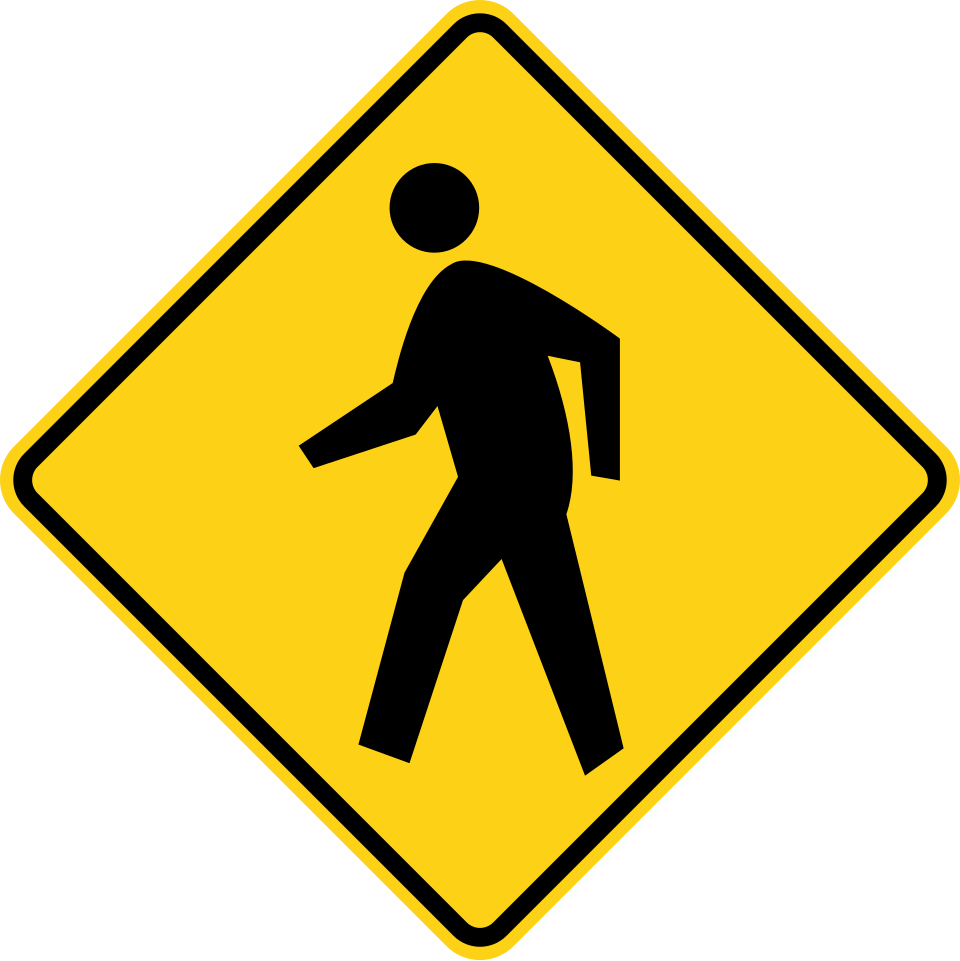
For every learner driver, the road is a canvas of symbols that demand immediate recognition and precise reaction. Among the most critical of these symbols is the Pedestrian Crossing sign. Visually, this sign is distinct and impossible to ignore: it is a diamond-shaped warning sign featuring a bright, fluorescent yellow-green background. At its center, a black silhouette depicts a person walking, often accompanied by a horizontal line representing the crosswalk or a secondary plaque below reading "CROSSWALK." Unlike regulatory signs that are typically rectangular and white, or stop signs that are red octagons, this sign belongs to the warning category, designed to alert drivers to a specific hazard ahead rather than to issue a direct command. Its primary meaning is simple yet vital: pedestrians may be crossing the roadway at this location, and drivers must exercise extreme caution, reduce speed, and be prepared to stop immediately to yield the right-of-way.
What It Means
Formally, the Pedestrian Crossing sign serves as a warning that a designated crosswalk exists at or near the location of the sign. In the context of the Manual on Uniform Traffic Control Devices (MUTCD), while the specific sign is a warning device (Series W11), it is often paired with regulatory signs (Series R1) that legally mandate the yield or stop action. The sign itself does not legally compel a stop if no pedestrians are present, but it legally compels the driver to anticipate the presence of pedestrians. The core definition is the notification of a potential conflict point between vehicular traffic and foot traffic.
For the driver, the required action is a shift in mindset from "cruising" to "scanning." Upon seeing this sign, the driver must immediately scan the roadway, particularly the edges and the crosswalk itself, for any movement. The driver is required to slow down to a speed that allows for a safe stop within the distance they can see to be clear. If a pedestrian is waiting to cross or is already in the crosswalk, the driver must come to a complete stop and yield the right-of-way. Failure to yield is not merely a traffic infraction; it is a severe safety violation that can result in catastrophic injury or death. The sign acts as a precursor, giving the driver the necessary time to react before the pedestrian actually steps into the vehicle's path.
Where You'll See It
Pedestrian crossing signs are strategically placed in areas where the probability of foot traffic intersecting with vehicular traffic is high. You will most commonly encounter these signs in urban and suburban environments, specifically near schools, playgrounds, parks, and shopping centers. These are zones where children, the elderly, and individuals with disabilities frequently traverse the streets. In residential neighborhoods, these signs are often installed at intersections or mid-block locations where there is no traffic signal to control the flow of vehicles.
Furthermore, these signs are frequently found on arterial roads and highways where pedestrian bridges or tunnels are not available, necessitating a ground-level crossing. They are often accompanied by additional pavement markings, such as zebra stripes or two parallel solid white lines, which visually reinforce the sign's message. In many jurisdictions, you will also see these signs paired with flashing beacons (R1-6 or W11-10 series) that activate when a pedestrian pushes a button or is detected by sensors, further emphasizing the need for caution. The placement is rarely random; it is the result of traffic engineering studies that identify high-risk zones for pedestrian-vehicle collisions.
What to Do When You See It
When your eyes catch the fluorescent yellow-green diamond, your first instinct should be to lift your foot off the accelerator and hover it over the brake pedal. This is known as "covering the brake." It reduces reaction time significantly if a pedestrian steps out. Next, perform a comprehensive scan. Look left, right, and left again, but also check the far side of the road, as pedestrians may be crossing from the opposite direction. Do not rely solely on the sign; look for the pedestrians themselves.
If you see a pedestrian waiting at the curb or stepping into the crosswalk, you must come to a complete stop. It is crucial to understand that in many states, the law requires you to stop for pedestrians in the crosswalk on the opposite side of the road as well, to prevent the "right-hook" accident where a driver stops for a pedestrian on their side, but a car in the next lane does not, striking the pedestrian as they cross. Once the pedestrian has safely cleared your lane and the adjacent lanes, you may proceed with caution. Never accelerate aggressively after a pedestrian has passed; wait until they are fully across the street and out of harm's way. Remember, the sign is a warning to be prepared, but the presence of a pedestrian is a command to stop.
Common Pitfalls
Learner drivers often fall into several traps when encountering pedestrian crossing signs. The most dangerous pitfall is the assumption that a crosswalk is only active when a pedestrian is currently walking in it. While the sign is a warning, many drivers fail to slow down if the crosswalk appears empty, missing the opportunity to scan for someone who might be obscured by a parked car or a blind corner. Another common error is the "rolling stop." Drivers may slow down but fail to come to a complete halt when a pedestrian is present, which is illegal and dangerous.
Additionally, learners often fail to yield to pedestrians on the opposite side of the road. They stop for the person on their side but continue driving, assuming the other lanes are clear. This creates a deadly trap for the pedestrian. Another frequent mistake is misinterpreting the sign as a signal to stop immediately regardless of the situation. The sign is a warning, not a stop sign; stopping abruptly when no one is present can cause rear-end collisions. Finally, some drivers become complacent in areas with frequent pedestrian signs, treating them as background noise rather than active hazards, leading to a lack of vigilance.
Permit-Test Context
In the context of the driver's permit written test, the Pedestrian Crossing sign is a staple question. Examiners often ask you to identify the sign by its shape and color, or to describe the correct action to take. You may be presented with a scenario: "You see a yellow diamond sign with a walking person. What should you do?" The correct answer will always involve slowing down, scanning for pedestrians, and being prepared to stop. Be wary of distractors that suggest you should speed up to clear the area, or that you only need to stop if a police officer is present.
Test questions may also focus on the legal definition of yielding. You might be asked, "When must you yield to a pedestrian in a crosswalk?" The answer is typically "Always," regardless of whether there is a traffic signal or not, unless a specific signal indicates otherwise. Understanding the distinction between a warning sign (the diamond) and a regulatory sign (the stop or yield sign) is also a common testing point. The exam aims to ensure you understand that the sign is a proactive safety measure, not a reactive command. Memorizing the visual characteristics and the immediate behavioral response is essential for passing this section of the test and, more importantly, for surviving on the road.