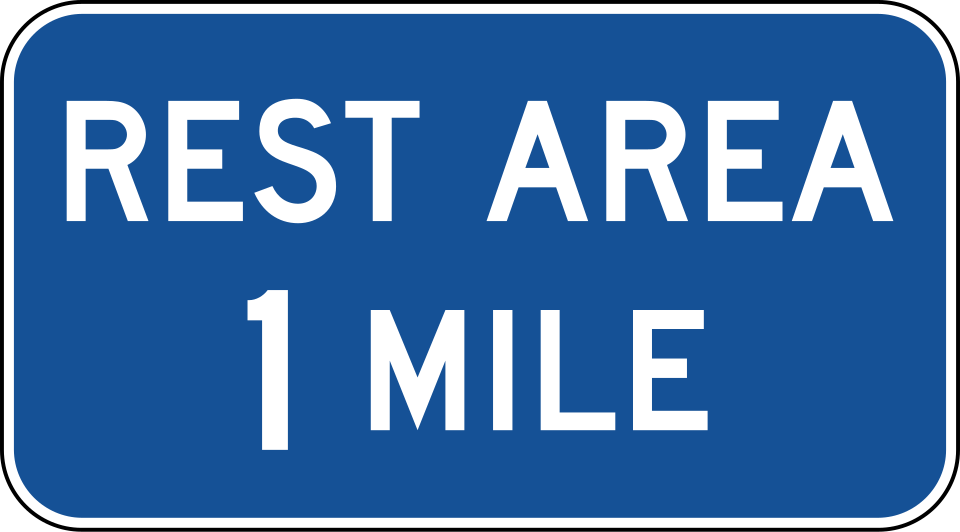
The Rest Area sign is a distinctive guide sign found along highways and interstates, designed to inform drivers of upcoming facilities for fatigue relief, restroom access, and vehicle checks. Visually, it is easily recognizable by its rectangular shape and a specific color scheme: a white symbol or text on a blue background, often accompanied by a green overhead guide sign indicating distance. Unlike regulatory signs that mandate immediate action (like a Stop sign) or warning signs that alert to hazards (like a yellow diamond), the Rest Area sign serves an informational purpose. It signals that a safe location to pull off the roadway is approaching, allowing drivers to rest, stretch, or attend to personal needs without leaving the highway system. For learner drivers, understanding this sign is crucial not only for navigation but for recognizing the legal and safety imperative to take breaks during long trips, a concept heavily emphasized in modern driver education curricula.
What it means
Formally, the Rest Area sign indicates the presence of a designated facility managed by the state or federal transportation department where motorists can temporarily cease driving operations. In the context of the Manual on Uniform Traffic Control Devices (MUTCD), these signs fall under the category of Guide Signs, specifically within the series for Tourist and Service Information (Series G). While the prompt categorizes it under "regulatory" due to its role in enforcing safe driving hours, it is technically an informational guide sign that supports regulatory safety goals.
The primary meaning of the sign is to direct drivers to a location where they can legally and safely exit the flow of traffic. It signifies the availability of amenities such as restrooms, vending machines, picnic tables, and sometimes emergency telephones or pet exercise areas. For the driver, the required action is not an immediate maneuver but a decision-making process. Upon seeing the sign, a driver must evaluate their physical state. If the driver is experiencing fatigue, drowsiness, or the need for a bathroom break, the sign indicates that a safe opportunity to address these needs is imminent. The sign effectively communicates: "A safe place to stop is X miles ahead." It does not require the driver to stop immediately, but it mandates that if a stop is necessary, this is the designated location to do so, rather than pulling over onto the shoulder, which is often illegal and dangerous.
Where you'll see it
Rest Area signs are predominantly located on controlled-access highways, interstates, and major expressways where stopping on the shoulder is prohibited or highly discouraged. You will typically encounter these signs in a sequence. The first sign usually appears 10 to 20 miles before the facility, providing ample warning for long-haul planning. Subsequent signs appear at 5-mile and 1-mile intervals, and finally, a sign is placed at the exit ramp itself. These signs are often mounted on overhead gantries or large metal posts on the right shoulder, ensuring high visibility against the backdrop of the highway.
In addition to the main highway signs, you may see smaller, supplementary plaques below the main symbol indicating specific amenities, such as "Picnic Area," "Information Center," or "Emergency Phone." In some states, these signs are also found on secondary highways, though the facilities may be more basic. The placement is strategic; they are positioned well before the exit ramp to allow drivers to merge safely into the right lane. You will rarely see a Rest Area sign on city streets or residential roads, as these facilities are designed for through-traffic on high-speed roadways. The consistency of their placement—always on the right side of the road in right-hand traffic countries—helps learners develop a pattern recognition skill that is vital for highway driving.
What to do when you see it
When a learner driver spots a Rest Area sign, the immediate reaction should be a mental check of their physical condition and vehicle status. If the driver feels tired, the correct action is to signal, check mirrors and blind spots, and merge smoothly into the right lane to prepare for the exit. It is critical to begin this process early, as highway exits often require significant speed reduction and lane changes. If the driver is not tired, the sign serves as a reference point for future stops; the driver might note the distance and plan to return later if fatigue sets in.
Upon entering the rest area, the driver must adhere to specific rules. Unlike a parking lot, rest areas are not for overnight camping in many jurisdictions, nor are they for extended stops exceeding a certain time limit (often 2 to 4 hours). The driver should pull into a designated parking stall, turn off the engine, and engage the parking brake. If the facility includes a restroom, the driver should exit the vehicle and use the facilities. If the driver is simply stretching, they should remain within the designated pedestrian zones and never walk on the highway or the exit/entrance ramps. Crucially, when leaving the rest area, the driver must treat the exit ramp as a merge point, accelerating to match the speed of highway traffic before merging, rather than entering at a crawl. This ensures the safety of the driver and the flow of traffic.
Common pitfalls
Learner drivers often make several critical errors when encountering Rest Area signs. The most dangerous mistake is ignoring the sign when fatigued. Many new drivers believe they can "push through" the fatigue, leading to micro-sleeps and accidents. The sign is a warning that a safe alternative exists, and ignoring it in favor of pulling over on the shoulder is a violation of traffic laws in most states. Another common pitfall is improper lane changing. Drivers often wait until the last second to see the sign and then make an abrupt, unsafe lane change across multiple lanes to reach the exit. This can cause rear-end collisions or force other drivers to brake suddenly.
Additionally, learners often misunderstand the purpose of the facility. Some may treat the rest area as a picnic spot for hours or a place to sleep overnight, which can lead to citations for trespassing or illegal camping. Others may fail to accelerate properly when re-entering the highway, causing a speed differential hazard. Finally, some drivers confuse Rest Area signs with Service Area signs (which often include gas stations and restaurants). While the actions are similar, Service Areas are commercial and may have different fee structures or traffic patterns. Confusing the two can lead to unexpected costs or confusion about the availability of fuel.
Permit-test context
On the written permit test, the Rest Area sign is frequently used to assess a candidate's understanding of safe driving practices and sign recognition. Questions may ask, "What should you do if you see a Rest Area sign and feel drowsy?" The correct answer is invariably to exit the highway and rest. Test questions may also present a scenario where a driver is approaching a rest area but misses the exit. The correct response is to continue to the next exit and return, never to back up or cross the median. Furthermore, the test often includes questions about the meaning of the blue and white color scheme. Candidates must know that blue indicates motorist services and guide information, distinguishing it from green (directions) or brown (recreational/cultural sites). Some tests may include a visual identification question, asking the driver to select the correct image of a Rest Area sign from a group of similar-looking signs. Understanding the nuances of this sign demonstrates that the learner prioritizes safety and understands the infrastructure designed to support long-distance travel.