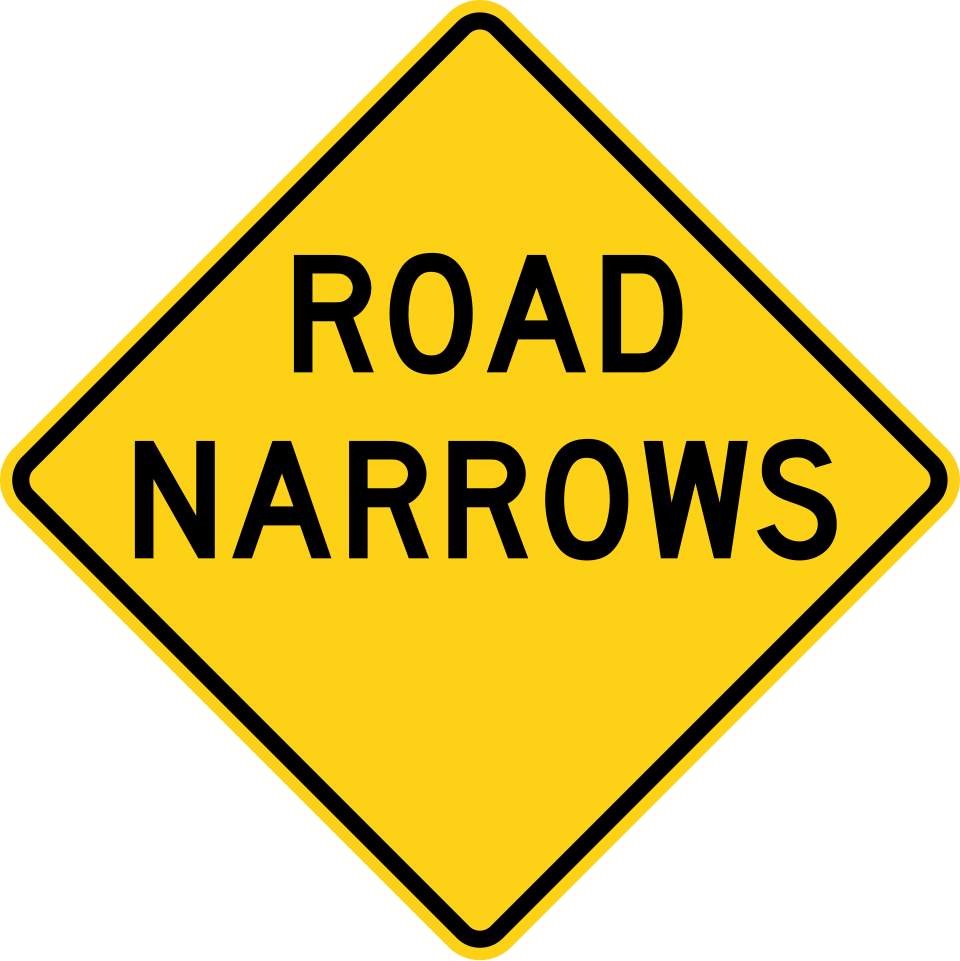
Mastering the Road Narrows Sign: A Guide for New Drivers
For learner drivers navigating the complexities of the road, recognizing and reacting appropriately to warning signs is a fundamental skill that ensures safety for everyone. Among the most critical of these is the "Road Narrows" sign. Visually, this sign is distinct and impossible to miss when you know what to look for: it is a diamond-shaped sign with a yellow background and black borders, featuring a black graphic that depicts a wide roadway at the top tapering into a narrower passage at the bottom. Unlike regulatory signs that are typically white rectangles or red octagons, this yellow diamond serves as a cautionary signal, alerting drivers that the available lane width is about to decrease significantly. It does not legally mandate a stop or a specific speed, but it demands heightened attention and a proactive adjustment in driving behavior. Understanding this sign is not just about passing a permit test; it is about preventing sideswipes, collisions with oncoming traffic, and getting stuck in tight spots where maneuvering becomes impossible.
What It Means
Formally, the Road Narrows sign (designated as W5-3 in the Manual on Uniform Traffic Control Devices, or MUTCD) indicates that the roadway ahead will become narrower than the current section. This reduction in width can occur due to various infrastructure changes, such as the removal of a travel lane, the merging of two lanes into one, the approach to a bridge or tunnel with restricted width, or the narrowing of shoulders. The sign is classified as a warning sign, meaning its primary function is to provide advance notice of a condition that requires the driver to slow down and prepare for a change in the driving environment.
When a driver encounters this sign, the required action is immediate and deliberate. You must reduce your speed to a level that allows for safe navigation through the narrowed section. Crucially, you must also check your mirrors and blind spots to ensure there is no oncoming traffic or vehicles in adjacent lanes that might be affected by the narrowing. If the road narrows to a single lane for two-way traffic, the sign often appears in conjunction with other signs indicating which side has the right-of-way, or it may imply that drivers must yield to oncoming traffic if the gap is too tight for two vehicles to pass simultaneously. The core meaning is a call for caution: the margin for error is shrinking, and your vehicle's position on the road must be precise.
Where You'll See It
The Road Narrows sign is strategically placed in locations where the physical geometry of the road changes abruptly. One of the most common scenarios is the approach to older bridges. Many bridges built decades ago were constructed with narrower lanes and shoulders than modern highways, necessitating a warning before drivers enter the structure. Similarly, tunnels often have strict width limitations, and this sign will appear well before the tunnel entrance to allow wide vehicles, such as trucks or buses, to assess if they can fit or if they need to take an alternate route.
You will also frequently encounter this sign in rural areas where a two-lane highway transitions into a section with no shoulders, or where a lane is closed for construction or maintenance. In urban environments, it might appear where a multi-lane road funnels into a single lane due to a median barrier or a traffic island. Another typical placement is at the end of a passing zone where the road widens again, or conversely, where a passing zone ends and the road narrows back to a single lane in each direction. The sign is always placed at a distance sufficient to give drivers time to react, usually several hundred feet before the actual narrowing begins, depending on the speed limit of the road.
What to Do When You See It
Upon spotting the yellow diamond with the narrowing road graphic, your first instinct should be to lift your foot off the accelerator and begin a smooth, controlled deceleration. Do not slam on the brakes, as this could cause a rear-end collision, especially if traffic behind you is moving at a higher speed. Instead, ease off the gas and let your vehicle slow down naturally, using your brakes gently if necessary to reach a safe speed for the upcoming constriction.
Next, perform a comprehensive visual scan. Check your side mirrors and look over your shoulder to see if there are vehicles in the lane that might be disappearing or merging. If the road narrows to a single lane for two-way traffic, you must be prepared to yield. Look for oncoming vehicles and determine if there is enough space for both cars to pass safely. If the gap is too narrow, you must pull over to the right as far as possible and wait for the oncoming traffic to clear before proceeding. If you are driving a large vehicle, such as an RV or a truck with a trailer, you may need to take up more of the lane to navigate the turn or the narrow section safely. In such cases, do not be afraid to occupy the center of the lane temporarily to ensure your vehicle clears the obstacles, but always signal your intentions clearly to other drivers.
Common Pitfalls
Learner drivers often make several critical mistakes when encountering the Road Narrows sign. The most common error is failing to adjust speed. Many new drivers see the sign, acknowledge it mentally, but continue driving at the same speed, only to realize too late that they cannot safely pass an oncoming car or that their vehicle is too wide for the gap. This lack of proactive speed reduction is a leading cause of sideswipe accidents in narrow sections.
Another frequent pitfall is misinterpreting the sign as a regulatory instruction to stop. Some students panic, thinking the sign means the road is closed or that they must halt immediately. It is vital to remember that this is a warning sign, not a stop sign. Stopping abruptly in the middle of a narrowing lane can create a dangerous obstruction for other drivers. Conversely, some drivers ignore the sign entirely, assuming the road will widen again quickly. This complacency is dangerous, as the narrow section may extend for a significant distance, requiring sustained caution.
Additionally, learners often fail to check their blind spots before entering a narrowed lane. If a lane is merging or disappearing, a driver might drift into the path of a vehicle that was previously in the adjacent lane. Without a proper shoulder check, a collision is almost inevitable. Finally, some drivers hesitate too long at the entrance to a narrow bridge or tunnel, causing a backup of traffic. The key is to assess the situation early, slow down, and proceed with confidence once the path is clear.
Permit-Test Context
On the written permit test, the Road Narrows sign is a staple question designed to test your ability to recognize warning signs and understand the appropriate response. You will likely be shown an image of the sign and asked to identify its meaning from a list of options. Common distractors include "Road Closed," "Lane Ends," or "Yield to Oncoming Traffic." While "Lane Ends" is related, the specific definition of the Road Narrows sign is that the roadway width is decreasing, which may or may not involve a lane ending. It is crucial to read the question carefully.
Scenario-based questions may also appear. For example, the test might describe a situation where you are approaching a bridge and see this sign, then ask what you should do. The correct answer will almost always involve reducing speed and checking for oncoming traffic. The test may also ask about the color and shape of the sign to ensure you can identify it visually. Remember, the yellow diamond shape is the universal indicator for a warning, and the specific graphic inside dictates the nature of the hazard. Mastering this sign is essential for passing the exam and, more importantly, for developing the defensive driving habits necessary for a lifetime of safe travel.