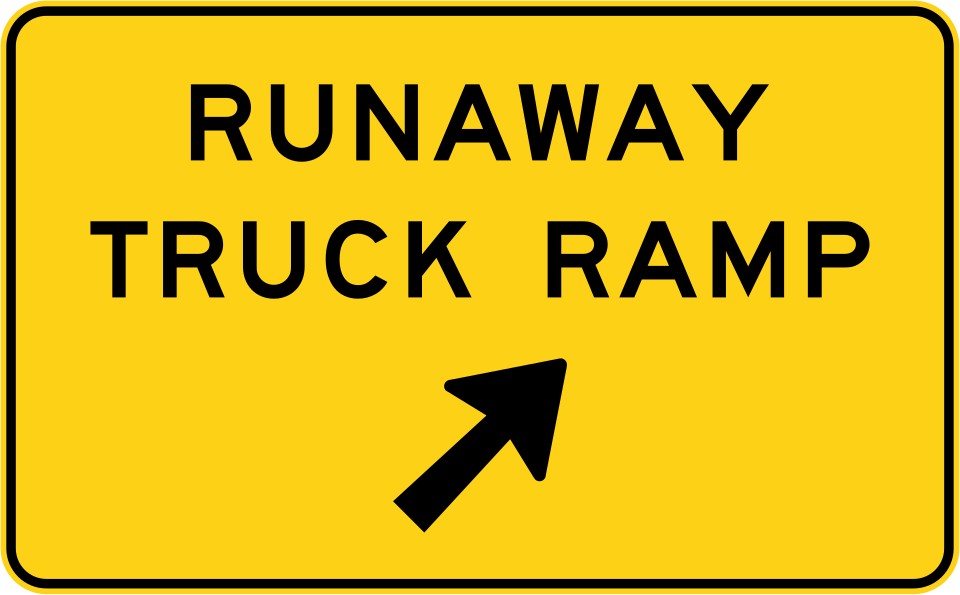
If you are studying for your driving permit or preparing for your road test, you have likely encountered a vast array of road signs, each with a specific color, shape, and meaning. Among these, the Runaway Vehicle Ramp sign stands out as a critical safety device designed to save lives in emergency situations. This sign is typically a rectangular white sign with black lettering and a black border, often accompanied by a diagrammatic arrow pointing diagonally upward to indicate the ramp's location. Unlike standard regulatory signs that dictate speed limits or right-of-way, this sign serves as a warning and instruction for a specific, high-stakes scenario: a vehicle with failing brakes. It belongs to the category of regulatory and warning signage, specifically intended to guide drivers who have lost control of their braking system toward a safe escape route. Recognizing this sign instantly and knowing exactly how to react can mean the difference between a minor incident and a catastrophic crash, making it an essential topic for every learner driver to master.
What it Means
Formally, the Runaway Vehicle Ramp sign indicates the presence of a designated emergency escape ramp located on a steep downgrade. These ramps are engineered specifically for heavy trucks, buses, and other large vehicles that may experience brake failure while traveling down a mountain or a long, steep hill. The sign itself does not merely suggest a detour; it acts as a directive for drivers in a life-threatening emergency. When a driver sees this sign, it means that a safe, controlled stopping area is immediately available ahead, usually marked by a separate, more specific sign pointing to the ramp entrance.
For a learner driver, the primary action required upon seeing this sign is heightened situational awareness. You must understand that this infrastructure exists because the road grade is steep enough to cause brake fade or failure in heavy vehicles. While you, driving a standard passenger car, are unlikely to need to use the ramp, you must be prepared to yield to any vehicle attempting to enter it. If you are driving a large vehicle or a heavily loaded truck, the sign serves as a critical reminder to check your brakes before descending and to know exactly where the ramp is located in case of an emergency. The sign effectively communicates: "If your brakes fail, do not panic; a safe path is available here." It transforms a potential disaster into a manageable event by providing a clear, pre-engineered solution.
Where You'll See It
Runaway Vehicle Ramp signs are exclusively found in specific geographical and topographical contexts. You will almost never see these signs on flat highways, city streets, or gentle rolling hills. Instead, they are a staple of mountainous regions, particularly in states with significant elevation changes such as California, Colorado, Utah, Wyoming, and the Pacific Northwest. These signs are strategically placed on steep downgrades, often preceding a long, winding descent where heavy commercial traffic is common.
The placement is deliberate and follows a strict pattern. You will typically see a series of signs leading up to the ramp. The first sign might be a warning sign indicating a steep grade (e.g., "6% Grade" or "Trucks Use Low Gear"). Further down the hill, you will see the specific "Runaway Truck Ramp" sign, often accompanied by a diagram showing the ramp's location relative to the main roadway. These signs are usually mounted on the right shoulder, facing traffic, and are often illuminated or retro-reflective to ensure visibility in poor weather conditions, such as heavy rain, fog, or snow, which are common in mountain passes. In some jurisdictions, you may also see distance markers (e.g., "Ramp 1 Mile Ahead") to give drivers ample time to prepare if they feel their brakes are overheating.
What to Do When You See It
For the vast majority of learner drivers operating passenger vehicles, the correct action upon seeing a Runaway Vehicle Ramp sign is to simply acknowledge its presence and continue driving with caution. You do not need to turn into the ramp. However, your driving behavior should adjust to the environment. If you see this sign, you should be hyper-aware of large trucks around you. If a truck appears to be struggling, swerving, or emitting smoke from its wheels, be prepared to slow down or move over to give them space. Do not attempt to pass a truck that is slowing down unexpectedly on a steep grade; they may be using engine braking or preparing to enter the ramp.
If you are driving a heavy vehicle or a vehicle with a trailer, the protocol changes significantly. Before descending a steep grade marked by these signs, you must shift to a lower gear to use engine braking, reducing the reliance on your service brakes. If you feel your brakes becoming soft, smelling burning, or losing effectiveness, do not wait until you are out of control. As soon as you see the sign indicating the ramp is near, signal your intention, check your mirrors, and steer into the ramp. The ramp is designed with a gravel bed or an upward slope to safely decelerate a vehicle without the use of brakes. Once inside, do not attempt to stop the vehicle using the brakes; let the ramp's resistance bring you to a halt. After stopping, you must call for emergency assistance and do not attempt to drive out of the ramp under your own power.
Common Pitfalls
Learner drivers often make several critical mistakes regarding runaway vehicle ramps. The most common error is confusion about who the ramp is for. Many new drivers assume that because they see the sign, they should turn into it, or conversely, that they should ignore it completely because "it's only for trucks." The truth is a middle ground: it is primarily for trucks, but passenger cars must be aware of it. Another pitfall is failing to recognize the sign in time. Because these signs are often placed in remote, scenic areas, drivers may be distracted by the view and miss the sign until it is too late to react if an emergency arises.
Additionally, some drivers mistakenly believe that if they see a truck entering a ramp, they should follow it or stop to watch. This is dangerous. If a truck is entering a ramp, the road ahead may be blocked, or debris may be scattered. Drivers should never enter a runaway ramp unless their brakes have completely failed. Using the ramp unnecessarily can cause significant damage to the vehicle and the ramp infrastructure, and it blocks the escape route for other drivers who may genuinely need it. Finally, a common misconception is that the ramp is a shortcut or a scenic overlook. It is a safety device, not a destination, and entering it without cause is a violation of traffic laws in many jurisdictions.
Permit-Test Context
On your driving permit test, questions about the Runaway Vehicle Ramp sign are designed to test your understanding of emergency procedures and your ability to interpret regulatory signage. You may be shown an image of the sign and asked what it indicates, or you may be presented with a scenario: "You are driving down a steep mountain road and see a sign for a runaway truck ramp. What should you do?" The correct answer will always involve recognizing the sign as an emergency escape route for brake failure and understanding that you should not use it unless absolutely necessary.
Test questions may also ask about the appropriate gear selection when approaching such a sign. For example, "When approaching a steep downgrade with a runaway ramp sign, what gear should a heavy vehicle use?" The answer is a lower gear to maximize engine braking. You might also be asked about the meaning of the sign's color and shape. Remember, the white rectangular shape with black text is a regulatory sign, meaning it conveys a rule or instruction. Understanding that this sign is part of a larger safety system on mountain roads is key to passing this section of the test. The examiners want to ensure you are not just memorizing signs, but understanding the physics of driving on steep grades and the importance of these safety features.