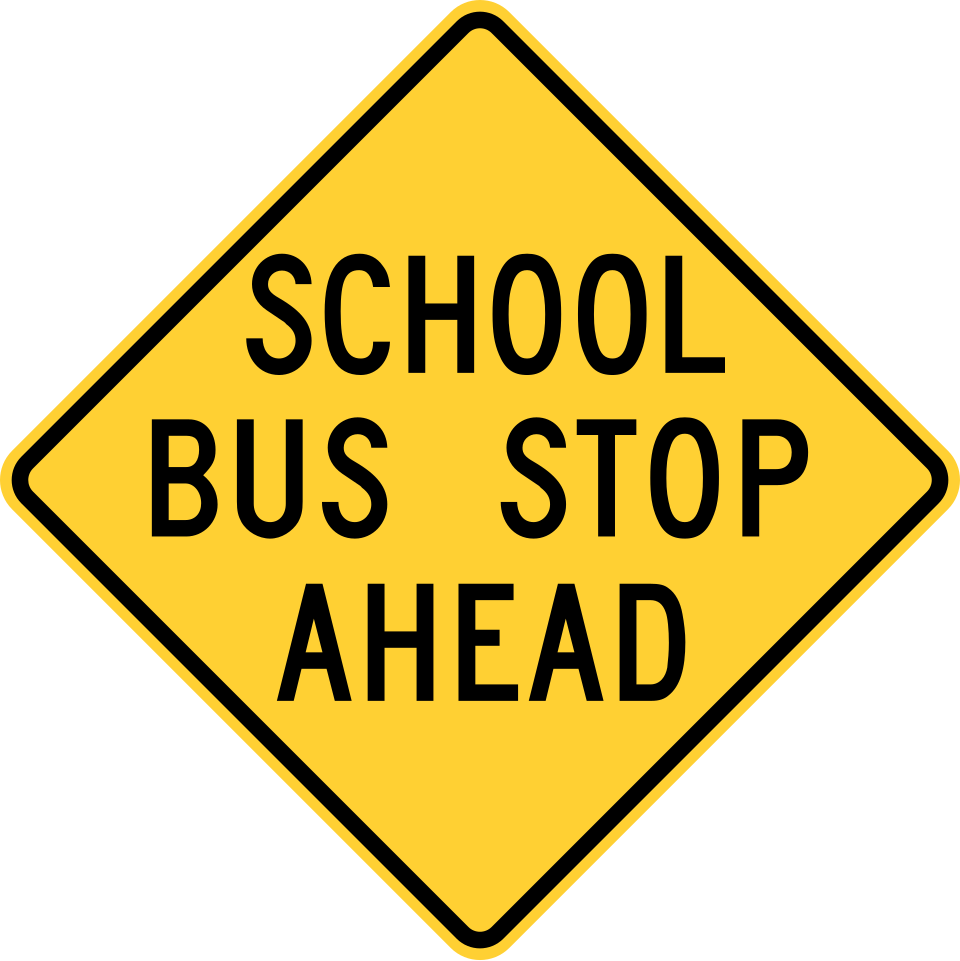
The School Bus Stop Ahead sign is a critical visual cue in the American road network, designed to protect the most vulnerable road users: children. Visually, this sign is distinct and unmistakable, featuring a bright yellow-green background with a black border and a black silhouette of a school bus. The sign is rectangular, oriented horizontally, and often includes the text "SCHOOL BUS STOP AHEAD" or simply the bus icon depending on the specific jurisdiction and MUTCD variation. Unlike the flashing red lights of an active stop, this sign serves as a pre-warning, alerting drivers that a school bus is likely to stop shortly to load or unload passengers. For learner drivers, understanding this sign is not merely about passing a written exam; it is about developing the situational awareness required to prevent tragic accidents. The sign falls under the category of warning signs, though its implications often trigger regulatory actions (stopping) once the bus activates its signals. Recognizing the yellow-green hue and the bus icon immediately should trigger a mental checklist: slow down, scan the road edges, and prepare to stop.
What It Means
Formally, the School Bus Stop Ahead sign (often designated as W7-3 in the Manual on Uniform Traffic Control Devices, or MUTCD) is a warning sign. Its primary definition is to notify approaching motorists that a school bus is stopped or is about to stop ahead on the roadway to pick up or discharge school children. It is important to distinguish this sign from the actual stop signal of the bus itself. The sign does not legally mandate an immediate stop on its own; rather, it mandates a reduction in speed and heightened alertness. It tells the driver, "Be prepared to stop."
The driver action required upon seeing this sign is immediate and deliberate. First, the driver must ease off the accelerator to reduce speed. Second, the driver must scan the right side of the road (or the left, if it is a one-way street) for the presence of a school bus. Third, the driver must be ready to bring the vehicle to a complete halt if the bus extends its stop arm and activates its flashing red lights. In many jurisdictions, the presence of this sign also implies that passing a stopped school bus in the immediate vicinity is prohibited once the bus signals, but the sign itself is the precursor to that legal requirement. It serves as the bridge between normal driving conditions and the high-stakes environment of a school bus stop zone.
Where You'll See It
The placement of the School Bus Stop Ahead sign is strategic and governed by safety engineering principles. You will typically encounter this sign in residential neighborhoods, near school zones, and along rural roads where school buses make frequent stops. It is almost always placed on the right-hand side of the road, facing oncoming traffic, at a distance that provides sufficient reaction time for a driver traveling at the posted speed limit. The MUTCD recommends specific placement distances based on speed; for example, on a road with a 35 mph speed limit, the sign might be placed 100 to 200 feet before the anticipated bus stop location. However, in practice, you may see it placed further back if the road has limited visibility due to curves, hills, or vegetation.
These signs are frequently paired with other warning devices. You might see them accompanied by a plaque reading "WHEN FLASHING" or "STOP AHEAD." In some advanced installations, the sign may be integrated with a dynamic message sign that activates only when a bus is actually stopped. They are also commonly found in conjunction with "School Crossing" signs (W11-2) and flashing yellow lights, creating a layered safety system. Learner drivers should pay special attention to these signs in areas with high pedestrian activity, particularly during morning and afternoon school hours. The sign is rarely found on highways or freeways where school buses do not make stops, making its presence a clear indicator that you are entering a zone where children may be present and vehicles are stopping frequently.
What to Do When You See It
When your eyes catch the yellow-green rectangle with the bus icon, your driving behavior must shift instantly. The first step is to check your speed. If you are driving at or near the speed limit, you should begin to decelerate gently. Abrupt braking can be dangerous if traffic is close behind you, so smooth, controlled slowing is key. Next, move your eyes to the side of the road. Look for the distinctive shape of a school bus, its yellow color, and any flashing lights. Even if you do not see a bus immediately, the sign indicates one is imminent or stopped just out of view.
Prepare your foot to move from the gas pedal to the brake pedal. This is known as "covering the brake." By hovering your foot over the brake, you reduce reaction time should the bus suddenly extend its stop arm. Scan the sidewalks and grassy areas for children. Children are unpredictable; they may run into the street without looking, or they may be obscured by the bus itself. If you see the bus stop and its red lights begin to flash, you must come to a complete stop. Remember that on a two-lane road, traffic in both directions must stop. On a divided highway, rules may vary, but the School Bus Stop Ahead sign usually implies a need for extreme caution regardless of the road configuration. Do not proceed until the bus retracts its stop arm and the red lights cease flashing.
Common Pitfalls
Learner drivers often make several critical mistakes regarding the School Bus Stop Ahead sign. The most dangerous error is ignoring the sign because no bus is immediately visible. Drivers may think, "I don't see a bus, so I don't need to slow down." This is a fatal assumption. The sign warns of a stop that is happening just around a blind corner or behind a parked car. Another common pitfall is failing to distinguish between the warning sign and the actual stop signal. Some drivers stop immediately upon seeing the sign, causing a rear-end collision with traffic behind them. The sign means "prepare to stop," not "stop now." Conversely, other drivers wait until they see the red lights before reacting, which may be too late if the bus is obscured.
Additionally, learners often forget to check for children. They focus entirely on the bus and the road ahead, neglecting the sidewalks where children might be waiting to cross. In rural areas, drivers may become complacent, assuming that low traffic volume means it is safe to speed past a bus stop. This is incorrect; children in rural areas may be more likely to dart into the road. Finally, some drivers fail to understand the legal implications of passing a stopped bus in the zone marked by this sign. Even if the bus is not yet flashing, passing a bus that is clearly loading or unloading in a zone marked by this sign can result in severe penalties and is a major safety violation.
Permit-Test Context
On the written permit test, the School Bus Stop Ahead sign is a frequent subject of multiple-choice questions. Examiners often present an image of the sign and ask what action the driver should take. The correct answer is almost always "Slow down and prepare to stop." Be wary of distractors like "Stop immediately" or "Speed up to clear the area." The test may also ask about the color of the sign; remember that while stop signs are red, warning signs like this are yellow or yellow-green. Another common question type involves scenarios: "You see a school bus stop ahead sign, but no bus is visible. What should you do?" The answer is to remain alert and reduce speed, as the bus may be just out of sight. Understanding the nuance between a warning sign and a regulatory sign is crucial for scoring high on the test and, more importantly, for safe driving on the road.