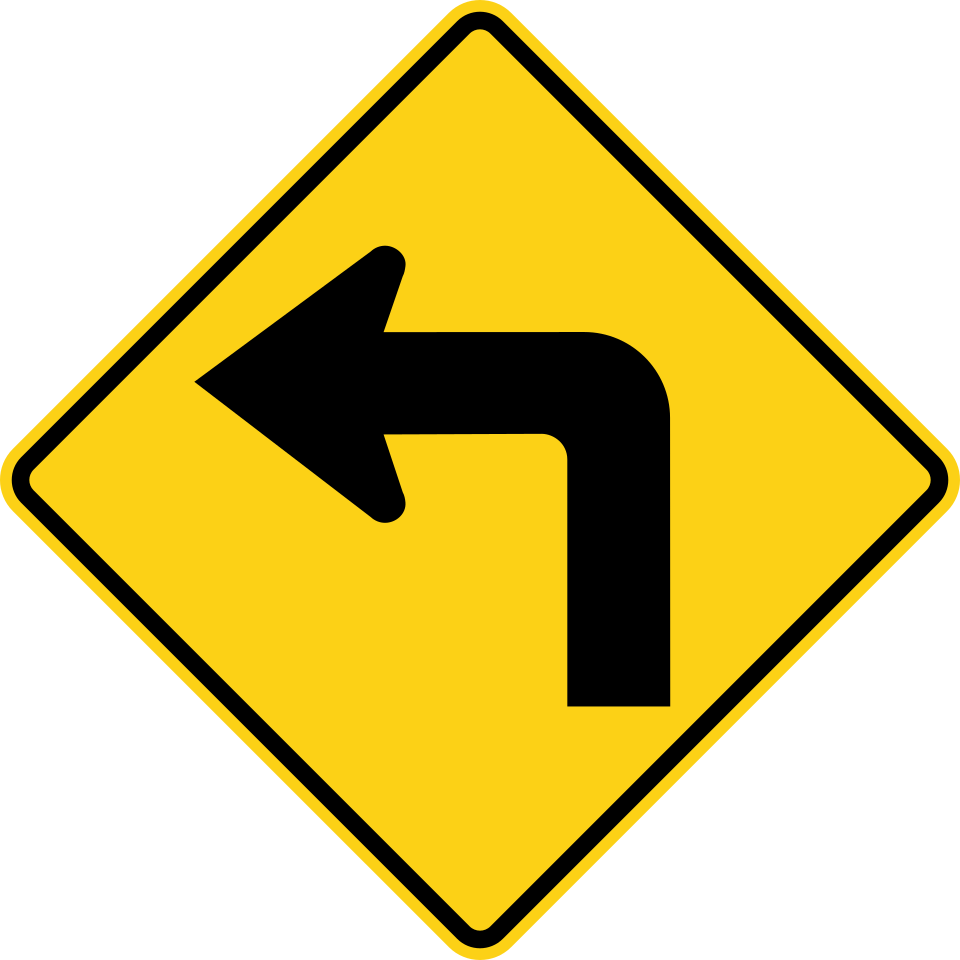
Mastering the Sharp Curve Warning Sign: A Guide for New Drivers
For every learner driver, the road is a series of visual puzzles where the wrong guess can lead to a collision. Among the most critical of these visual cues is the Sharp Curve warning sign. Distinctive for its diamond shape and high-visibility yellow background with a black border, this sign features a bold black arrow that bends sharply, often accompanied by a supplementary plaque indicating the recommended safe speed. Unlike regulatory signs that command immediate obedience (like a Stop sign), the Sharp Curve sign is a warning sign, designed to alert you to a change in the road geometry that requires immediate adjustment of your driving behavior. It signals that the road ahead turns at a degree so severe that maintaining your current speed could result in a loss of vehicle control. Recognizing this sign, understanding its implications, and reacting with the appropriate caution are fundamental skills tested on every learner's permit exam and essential for safe driving on public roads.
What It Means
Formally, the Sharp Curve sign (technically designated as the W1-1 symbol in the Manual on Uniform Traffic Control Devices, or MUTCD) indicates that the roadway ahead curves at an angle of 45 degrees or more. While the MUTCD does not strictly define "sharp" by a single degree in all contexts, the visual representation of the arrow is the key indicator: a tight, acute bend rather than a gentle sweep. The sign serves as a critical advance warning that the centerline of the road will deviate significantly from your current path.
The primary driver action required upon seeing this sign is to reduce speed before entering the curve. This is not a suggestion but a physical necessity dictated by the laws of physics. As a vehicle travels through a curve, centrifugal force pushes the car outward. The sharper the curve and the faster the speed, the greater this force becomes. If the friction between the tires and the road cannot counteract this force, the vehicle will skid or roll over. Therefore, the sign mandates that you slow down to a speed where you can maintain traction and stay within your lane. In many jurisdictions, a supplementary plaque (W1-1a) is mounted below the main sign, displaying a specific advisory speed (e.g., "25 MPH"). While this speed is technically advisory rather than a legal limit, ignoring it in adverse conditions or with a heavy load is a common cause of accidents and is often cited as a failure to drive with due care.
Where You'll See It
The placement of the Sharp Curve sign is governed by strict engineering standards to ensure drivers have adequate time to react. You will typically encounter this sign on two-lane rural highways, winding mountain roads, and the approaches to sharp turns in suburban areas where the curvature is not immediately obvious from a distance. The sign is almost always placed on the right-hand side of the road, facing the driver, at a distance calculated based on the approach speed and the severity of the curve. This distance is known as the "stopping sight distance" or "decision sight distance," ensuring that even a driver traveling at the posted speed limit has enough time to perceive the sign, process the information, and begin braking before the curve begins.
In addition to the primary sign, you may see a series of these signs. A "Chevron Alignment" sign (W1-8), which features a large black arrow on a yellow background pointing in the direction of the turn, is often placed at the apex of the curve or at intervals along a long, winding section of road to reinforce the direction of the turn. You might also see the Sharp Curve sign paired with a "Road Narrows" sign or a "No Passing Zone" sign (the pennant-shaped yellow sign), as sharp curves often eliminate the visibility required for safe passing. In construction zones, temporary orange versions of these signs may appear, indicating that a temporary sharp curve has been created due to lane shifts or detours.
What to Do When You See It
When you spot the Sharp Curve sign, your reaction must be immediate and methodical. The first step is to lift your foot off the accelerator and begin to brake gently. It is crucial to slow down before you enter the curve, not while you are already turning. Braking hard while in a curve can shift the vehicle's weight forward, reducing traction on the rear tires and potentially causing a spin or a slide. Once you have reduced your speed to a safe level—ideally matching the advisory speed if one is posted—maintain a steady speed through the curve. Do not accelerate until you can see the road straightening out ahead.
Positioning is equally important. As you approach a sharp curve, especially a left-hand curve, move your vehicle slightly toward the center of your lane (without crossing the centerline) to improve your line of sight. This technique, often called "setting up" for the turn, allows you to see further around the bend and react to any oncoming traffic or obstacles. Keep your eyes focused on the exit of the curve, not on the immediate ground in front of your bumper. Your hands should be firm on the wheel, making smooth, controlled steering inputs. Avoid sudden jerks of the steering wheel, as these can upset the vehicle's balance. Finally, be hyper-aware of the road surface. Sharp curves are often prone to pooling water, oil accumulation, or loose gravel, all of which reduce traction and require even lower speeds.
Common Pitfalls
Learner drivers frequently make several critical errors when encountering the Sharp Curve sign. The most dangerous mistake is underestimating the severity of the turn. Because the sign is a warning and not a command, some drivers assume they can "make it" at their current speed. This is a fatal miscalculation; the physics of the curve do not care about your confidence. Another common error is braking too late. Drivers often wait until they are already in the curve to hit the brakes, which leads to weight transfer issues and loss of control. Conversely, some drivers brake so aggressively before the curve that they lose momentum and struggle to navigate the turn smoothly, potentially stalling a manual transmission vehicle or causing rear-end collisions from following traffic.
Additionally, learners often fail to scan the entire curve. They may focus solely on the sign and the immediate road, missing a slow-moving truck, a cyclist, or a car that has crossed the centerline. Another pitfall is ignoring the advisory speed plaque. While the posted speed limit might be 55 mph, the advisory speed for a sharp curve might be 25 mph. Driving at 45 mph through a 25 mph curve is a recipe for disaster. Finally, some drivers fail to adjust for weather conditions. A curve that is safe at 30 mph on a dry day may require 15 mph in rain or snow, yet the sign remains the same. Failing to adjust speed for conditions is a leading cause of curve-related accidents.
Permit-Test Context
On your learner's permit written test, the Sharp Curve sign is a guaranteed topic. Questions will typically ask you to identify the sign's meaning, the correct action to take, or the specific shape and color. You must memorize that it is a yellow diamond with a black arrow. A common test question might present a scenario: "You see a yellow diamond sign with a sharp arrow and a plaque reading '25 MPH'. What should you do?" The correct answer is always to slow down to 25 mph before entering the curve. Be wary of distractors like "maintain speed and steer carefully" or "brake hard while in the curve."
Tests may also include questions about the difference between a "Curve" sign (gentler turn) and a "Sharp Curve" sign (tighter turn), though the distinction is often subtle in multiple-choice formats. The key is to recognize that any curve sign requires speed reduction. You might also be asked about the placement of the sign, with the correct answer being "in advance of the curve." Understanding that the sign is a warning (yellow) and not a regulatory (white/red) sign is also a frequent testing point. Remember, the sign warns of a hazard; it does not legally mandate a specific speed, but failing to adjust speed to the conditions is a violation of the "basic speed law" in most states.