Mastering the Slippery When Wet Sign: A Guide for New Drivers
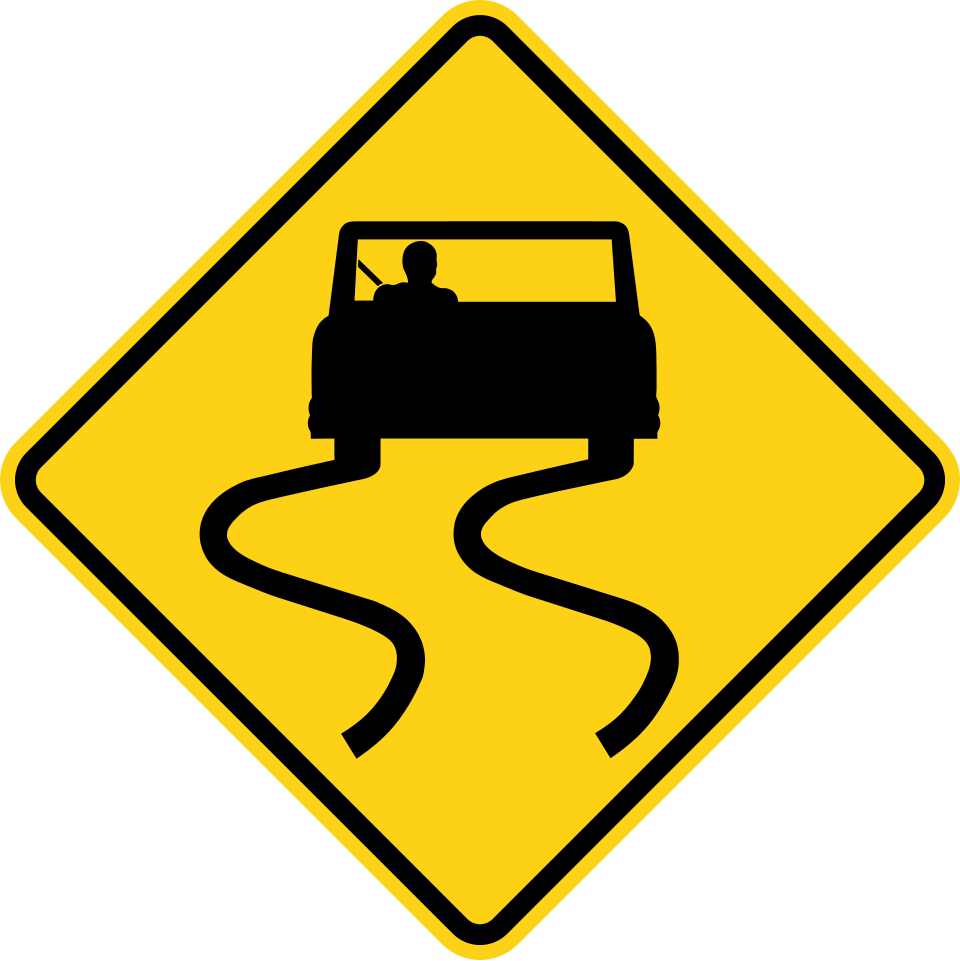
For every learner driver navigating the road for the first time, recognizing and reacting to warning signs is a critical skill that separates a safe motorist from a dangerous one. Among the most vital of these is the "Slippery When Wet" sign. Visually, this sign is instantly recognizable: it is a diamond-shaped plaque with a bright yellow background and black borders, featuring a black graphic of a car with wavy skid marks trailing behind it, often accompanied by the text "SLIPPERY WHEN WET" in bold black letters. Unlike regulatory signs that are typically red and white or rectangular, this yellow diamond serves as a specific warning to alert drivers to a change in road conditions that may not be immediately obvious. Its primary meaning is to warn motorists that the pavement surface in the immediate vicinity loses significant traction when exposed to moisture, such as rain, sleet, or melting snow. Understanding this sign is not merely about memorizing a symbol for a test; it is about understanding the physics of friction and the life-saving necessity of adjusting speed and following distance before a skid occurs.
What it means
The formal definition of the "Slippery When Wet" sign is a warning that the road surface ahead has a reduced coefficient of friction when wet, creating a hazard for vehicles traveling at normal speeds. In the context of the Manual on Uniform Traffic Control Devices (MUTCD), this sign is classified as a warning sign (Series W), specifically designated as W8-5. While often colloquially grouped with regulatory signs due to the mandatory nature of slowing down, it is technically a warning sign because it alerts to a condition rather than dictating a specific rule like a stop or yield sign. However, the driver action required is effectively regulatory in nature: you must reduce your speed and increase your following distance before entering the zone indicated by the sign.
The physics behind this sign are rooted in the interaction between tires and pavement. Under dry conditions, rubber tires grip the asphalt through friction. However, when water is introduced, a layer of fluid can form between the tire and the road surface. If the water depth exceeds the tire's ability to channel it away, the vehicle may experience hydroplaning, where the tires lose contact with the road entirely and ride on a film of water. Even without full hydroplaning, wet asphalt, concrete, or gravel can become significantly slicker, especially during the first few minutes of rainfall when oil and dust on the road surface mix with water to create a slippery emulsion. The sign serves as a proactive indicator that the road geometry or surface material is particularly prone to this loss of traction, demanding that the driver anticipate a need for longer stopping distances and gentler steering inputs.
Where you'll see it
Learner drivers should be hyper-aware of the specific environments where the "Slippery When Wet" sign is typically deployed. These signs are rarely placed arbitrarily; they are installed by traffic engineers based on historical accident data or specific road characteristics that exacerbate wet-weather hazards. You will most commonly encounter this sign on rural highways and interstates where the road surface is older or composed of materials that become exceptionally slick when wet, such as certain types of polished stone or concrete. It is also frequently found on steep grades, both uphill and downhill. On a downgrade, the combination of gravity and reduced friction can make it difficult to control speed without locking up brakes, while on an upgrade, traction loss can cause a vehicle to slide backward or fail to clear an intersection.
Another common placement is on curves, particularly those with a sharp radius. When a vehicle enters a curve, centrifugal force pushes it outward; if the road is wet, the tires may not generate enough lateral friction to counteract this force, leading to a run-off-road crash. Consequently, you will often see the "Slippery When Wet" sign paired with a curve warning sign (W1-2) or a chevron alignment sign. Additionally, these signs are common near bridges and overpasses. Bridges are unique because they are exposed to air on both the top and bottom surfaces, causing them to freeze before the ground roads in winter and dry out slower in rain. This thermal difference means a bridge can be icy or slick while the rest of the highway is dry, making the sign a crucial warning for drivers transitioning from a warm road to a cold, wet bridge.
What to do when you see it
Upon spotting the "Slippery When Wet" sign, the immediate and correct response is to adjust your driving behavior before the road conditions actually change. The first and most critical action is to reduce your speed. Do not wait until you feel the car sliding; by then, it is often too late to regain control. Slowing down increases the tire's ability to displace water and maintains the necessary friction for steering and braking. A good rule of thumb is to reduce your speed by at least 5 to 10 miles per hour below the posted limit if it is raining, or significantly more if the rain is heavy. This reduction in kinetic energy directly correlates to a shorter stopping distance.
Secondly, you must increase your following distance. The standard "three-second rule" for dry conditions should be doubled to a "six-second rule" or more when this sign is present. This extra space provides a buffer zone, allowing you more time to react if the vehicle ahead suddenly brakes or loses control. Furthermore, you should avoid sudden maneuvers. This means no hard braking, no sharp steering inputs, and no rapid acceleration. If you need to slow down, apply the brakes gently and early. If you must steer around an obstacle, do so smoothly and gradually. Finally, ensure your headlights are on. While the sign itself does not mandate lights, the conditions it warns of (rain) usually require them for visibility. Using low beams helps you see the road and, more importantly, makes your vehicle visible to others who may also be struggling with traction.
Common pitfalls
One of the most dangerous misconceptions learner drivers have is believing that the sign only applies when it is currently raining. This is a fatal error. The sign warns that the road will be slippery when wet, meaning the hazard exists the moment the first drop of rain falls. Many accidents occur because drivers maintain highway speeds during the first ten minutes of a rainstorm, unaware that the oil and dust on the road have created a slick layer. Another common pitfall is over-reliance on vehicle technology. While modern cars have Anti-lock Braking Systems (ABS) and Traction Control, these systems are not magic. They cannot overcome the laws of physics; they can only help manage the loss of traction. A driver who trusts ABS to stop instantly on a wet curve is likely to crash.
Learners also frequently fail to adjust their speed early enough. They see the sign, acknowledge it, but continue at their current speed until they actually feel the car sliding. By the time the sensation of reduced traction is felt, the vehicle may already be in a skid. The correct approach is to treat the sign as a command to slow down immediately upon sight, well before entering the hazardous zone. Additionally, some drivers mistakenly believe that four-wheel drive or all-wheel drive protects them from skidding. While these drivetrains help with acceleration and climbing, they offer no advantage in braking or cornering on wet surfaces. A four-wheel-drive vehicle can hydroplane just as easily as a two-wheel-drive car if the speed is too high for the conditions.
Permit-test context
On the written permit test, the "Slippery When Wet" sign is a frequent subject of multiple-choice questions. Examiners often test your knowledge of the sign's meaning, the correct reaction to it, and the specific conditions under which it applies. A typical question might ask, "What should you do when you see a yellow diamond sign with a skidding car?" The correct answer will always involve reducing speed and increasing following distance. Another common variation asks about the timing of the hazard: "When is the road most slippery?" The correct answer is often "During the first few minutes of rainfall," testing your understanding of the oil-water mixture phenomenon.
You may also encounter questions that pair this sign with other scenarios, such as driving on a bridge or a curve. The test may ask, "Why is a bridge more dangerous than the road in winter?" linking the concept of the slippery sign to the specific vulnerability of bridges. It is crucial to memorize the visual description of the sign: yellow diamond, black car, wavy lines. Confusing it with other warning signs, such as the "Loose Gravel" sign (which shows rocks) or the "Falling Rocks" sign, can lead to incorrect answers. Remember that the core concept for the test is anticipation: the sign is a warning to prepare for a loss of control, not a notification that you are already in a skid. Mastering this concept demonstrates to the examiner that you possess the defensive driving mindset required for a real-world license.