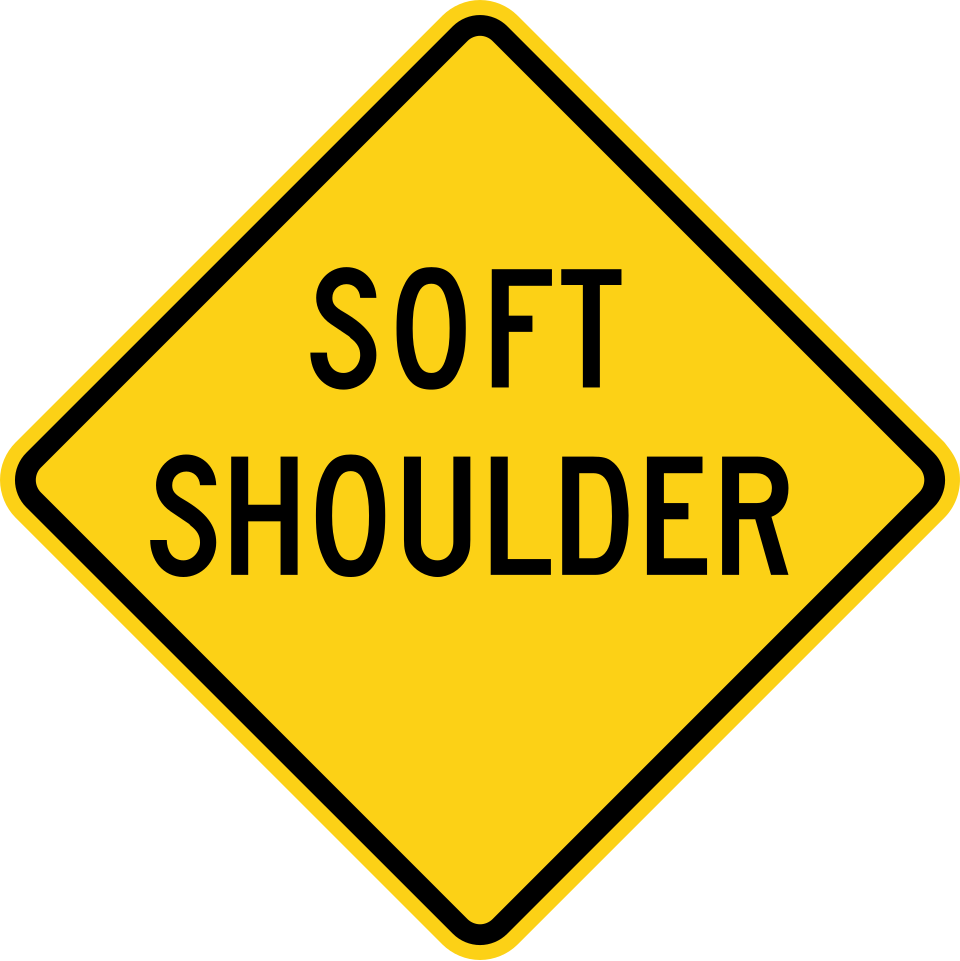
The Soft Shoulder warning sign is a critical visual cue for learner drivers, designed to alert motorists to a specific and potentially hazardous road condition. Visually, this sign is a diamond-shaped plaque featuring a black symbol on a yellow background, adhering to the standard color scheme for warning signs in the United States. The symbol typically depicts a vehicle with its rear wheels sinking into a soft, uneven surface, often accompanied by the text "SOFT SHOULDER" or simply the graphic representation of the hazard. Unlike regulatory signs which use red and white to command immediate action, or guide signs which use green or blue to provide information, the yellow diamond serves as a cautionary signal. It does not legally mandate a stop or a specific speed, but rather warns that the road edge is unstable. For a new driver, recognizing this sign is the first step in preventing a costly and dangerous accident, as driving on a soft shoulder can lead to vehicle loss of control, tire damage, or the vehicle becoming stuck in mud or gravel.
What it means
Formally, the Soft Shoulder sign indicates that the paved surface of the road ends and the unpaved shoulder adjacent to the travel lane is composed of loose material, such as gravel, dirt, sand, or mud, which lacks the structural integrity to support a vehicle's weight. The term "soft" implies that the ground is not compacted enough to bear the load of a standard passenger vehicle, especially at speed. In the context of the Manual on Uniform Traffic Control Devices (MUTCD), this falls under the category of warning signs (Series W), specifically addressing road surface conditions that deviate from the norm. While the MUTCD does not assign a specific alphanumeric code like "W1-1" to this exact text-only sign in all editions (it is often a custom plaque or a variation of the Road Work or Surface Condition series), it is universally recognized as a warning of reduced traction and structural support at the road edge.
For the driver, the required action is one of heightened awareness and caution. The sign serves as a directive to stay strictly within the paved lanes. It implies that the margin for error is significantly reduced; a slight drift to the right or left could result in the tires dropping off the pavement. If a driver does inadvertently leave the paved surface, the sign warns that the immediate recovery of the vehicle may be difficult or impossible without causing damage. The primary meaning is a prohibition against using the shoulder for passing, stopping, or emergency parking, as the ground cannot safely support these maneuvers. It is a signal that the "safe zone" ends at the white fog line.
Where you'll see it
Learner drivers will most frequently encounter the Soft Shoulder sign in rural and semi-rural environments where road maintenance budgets are limited, or where the terrain makes paving the entire width of the road impractical. These signs are common on two-lane highways, country roads, and access roads leading to recreational areas, farms, or construction sites. You will often see them placed in areas with high wind erosion, sandy soil, or regions that experience heavy rainfall which turns dirt shoulders into mud. Additionally, these signs may appear temporarily during road construction projects where the shoulder has been dug up or graded but not yet repaved. In such cases, the sign might be accompanied by other temporary warning signs indicating road work ahead. They are typically mounted on posts at the side of the road, positioned well in advance of the hazardous section to give drivers ample time to adjust their driving behavior. In some jurisdictions, you might also see this sign at the entrance to a specific stretch of road, repeated at intervals to reinforce the warning, particularly if the soft shoulder condition extends for several miles.
What to do when you see it
Upon spotting the Soft Shoulder sign, the immediate response for a learner driver should be to double-check their lane position. Ensure that the vehicle is centered in the lane and that there is a safe buffer between the tires and the road edge. If you are driving at night or in poor weather conditions, the sign serves as a reminder to reduce speed slightly, as the reduced visibility makes it harder to judge the edge of the pavement. The most critical rule is: do not use the shoulder for passing. In many driving scenarios, especially on rural roads, drivers are tempted to use the shoulder to overtake slower vehicles. The Soft Shoulder sign explicitly negates this option; attempting to pass on a soft shoulder is extremely dangerous and can lead to the vehicle sinking or tipping over.
If you find yourself in an emergency situation where you must pull over, and you see this sign, you must proceed with extreme caution. Ideally, you should continue driving until you find a paved turnout, a wide shoulder, or a designated parking area. If you are forced to stop on the soft shoulder, do so slowly and gently. Avoid sudden braking or sharp steering inputs, as these can cause the tires to dig in. Once stopped, turn on your hazard lights immediately. If the vehicle becomes stuck, do not attempt to accelerate aggressively, as this will only dig the tires deeper. Instead, seek assistance or wait for a tow truck. For learner drivers, the lesson is clear: the shoulder is not a part of the drivable road in these conditions. Treat the edge of the pavement as a hard boundary that should not be crossed under any normal driving circumstances.
Common pitfalls
One of the most common mistakes learner drivers make when encountering a Soft Shoulder sign is underestimating the severity of the hazard. New drivers often assume that because the shoulder looks flat and dry, it can support a car. They may fail to realize that the top layer of dirt or gravel can be deceptive, hiding deep mud or loose sand beneath. Another frequent error is the failure to maintain a safe distance from the edge. In an attempt to avoid oncoming traffic or to give space to a large truck, a learner might drift too close to the shoulder, inadvertently triggering the hazard. Additionally, some drivers mistakenly believe that the sign only applies to heavy trucks or off-road vehicles, failing to recognize that standard passenger cars are equally susceptible to getting stuck or losing control. A dangerous pitfall is the attempt to "correct" a drift by jerking the steering wheel back onto the pavement. If a tire drops onto a soft shoulder, the sudden difference in traction can cause the vehicle to pull sharply. Overcorrecting can lead to a rollover or a collision with oncoming traffic. The correct technique is to grip the wheel firmly, slow down gradually, and steer gently back onto the pavement only when the vehicle has slowed to a safe speed.
Permit-test context
In the context of a driver's permit written test, the Soft Shoulder sign is a frequent topic of inquiry. Questions may ask you to identify the meaning of the sign, often presenting the diamond-shaped yellow sign with the vehicle graphic or text. You might be asked, "What should you do when you see a Soft Shoulder sign?" The correct answer will always involve staying in the lane and avoiding the shoulder. Test questions may also present a scenario: "You need to pass a slow-moving vehicle, but you see a Soft Shoulder sign. What is the correct action?" The answer is to wait behind the vehicle until it is safe to pass within the lane or until the hazard ends. Another common test format involves identifying the sign among other warning signs, such as the "Slippery When Wet" or "Road Work" signs. It is crucial for learners to memorize the visual characteristics: yellow diamond, black symbol, and the specific text. Furthermore, the test may include questions about the consequences of ignoring the sign, reinforcing the idea that driving on a soft shoulder is a violation of safe driving practices and can lead to vehicle damage or accidents. Understanding this sign demonstrates a driver's ability to read the road environment and anticipate hazards beyond the immediate lane.