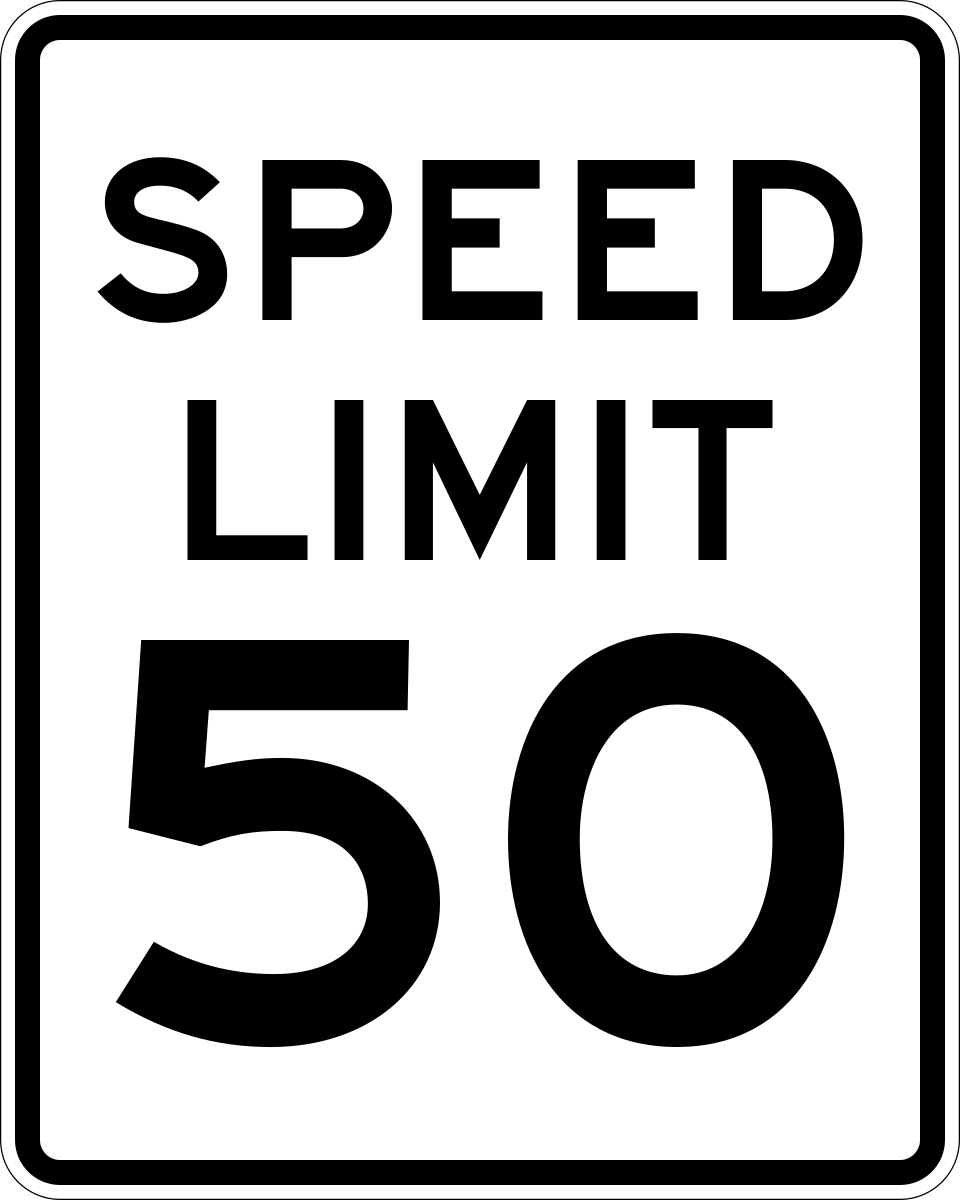
The Speed Limit sign is arguably the most ubiquitous and critical regulatory sign a new driver will encounter on American roadways. Visually, it is unmistakable: a vertical rectangle with a stark white background and bold, black lettering. The sign typically displays the words "SPEED LIMIT" at the top, followed by a large numerical value indicating the maximum legal speed in miles per hour (mph). In some jurisdictions, you may also see the metric equivalent in kilometers per hour, though the standard in the United States remains miles per hour. As a regulatory sign, its meaning is absolute and non-negotiable; it establishes the maximum safe speed for the specific roadway section under ideal conditions. For a learner driver, understanding this sign is not merely about avoiding a traffic ticket; it is the foundational element of defensive driving, ensuring that your vehicle's speed matches the road design, traffic flow, and environmental safety requirements.
What It Means
Formally, the Speed Limit sign (R2-1 in the Manual on Uniform Traffic Control Devices, or MUTCD) defines the maximum lawful speed at which a vehicle may travel on a specific stretch of road. It is important to understand that this number represents the maximum limit, not a recommended or target speed. The legal definition implies that driving faster than the posted number is a violation of the law, regardless of whether traffic is moving faster or the weather is perfect. However, the sign also carries an implicit legal doctrine known as the "basic speed law," which exists in every state. This law dictates that even if you are driving below the posted limit, you can still be cited for speeding if your speed is unsafe for current conditions, such as heavy rain, fog, ice, or heavy congestion.
For the driver, the required action is immediate and continuous compliance. Upon seeing the sign, the driver must adjust their vehicle's speed to be at or below the posted number. This is not a suggestion to accelerate to that speed; rather, it is a ceiling. If you are traveling at 60 mph and see a sign indicating a limit of 55 mph, you must decelerate immediately. Conversely, if you are traveling at 45 mph in a 55 mph zone, you are legally compliant, though you must ensure you are not impeding the normal and reasonable flow of traffic. The sign serves as the primary communication tool from the Department of Transportation to the driver, establishing the legal framework for safe travel speeds based on engineering studies of the road's geometry, sight distance, and accident history.
Where You'll See It
Speed Limit signs are strategically placed to ensure maximum visibility and compliance. You will typically see the first sign at the beginning of a new speed zone, often at the city or county line, or immediately after a change in road classification, such as transitioning from a highway to a residential street. These signs are mounted on posts on the right-hand side of the roadway, facing the driver. In divided highways or multi-lane roads, you may also see them on the median or on the left side to ensure they are visible to all lanes of traffic.
Placement is governed by strict guidelines to prevent confusion. For instance, if the speed limit changes, a new sign is placed well in advance of the change, often accompanied by a "Reduced Speed Ahead" warning sign (W13-1) to give drivers time to slow down safely. You will frequently see these signs in conjunction with other regulatory signs, such as "No Passing" zones or school zone flashing beacons. In school zones, the standard Speed Limit sign is often accompanied by a plaque reading "SCHOOL" and "WHEN CHILDREN PRESENT," indicating that the limit is lower only during specific hours. Similarly, in construction zones, temporary orange Speed Limit signs replace the standard white ones, often accompanied by fines that are doubled for violations. Understanding the context of where these signs appear helps a learner driver anticipate speed changes before they happen, rather than reacting at the last second.
What to Do When You See It
When a learner driver spots a Speed Limit sign, the immediate response should be a calm and controlled adjustment of speed. First, glance at the speedometer to determine your current velocity. If you are exceeding the posted limit, gently ease off the accelerator. Avoid slamming on the brakes unless traffic conditions demand it, as sudden braking can surprise drivers behind you and cause rear-end collisions. If you are significantly below the limit, assess the traffic flow; if you are impeding traffic, it may be safe to accelerate to the limit, provided it remains within the posted maximum.
Crucially, the driver must recognize that the posted limit is the ceiling for ideal conditions. If the weather is poor, or if the road is winding and narrow, the "safe" speed may be lower than the sign indicates. A skilled driver uses the sign as a baseline and adjusts downward based on the "basic speed law." Furthermore, drivers must be vigilant for changes. Speed limits are not static; they change as you move from a highway to a suburban area, or as you enter a school zone. Continuous scanning of the roadway for the next Speed Limit sign is essential. In many modern vehicles, the dashboard may display the current speed limit based on GPS data, but this should never replace the driver's visual confirmation of the physical sign, as GPS data can sometimes be outdated or inaccurate.
Common Pitfalls
Learner drivers often fall into several traps regarding Speed Limit signs. The most common mistake is assuming that the posted limit is the "safe" speed regardless of conditions. Many new drivers accelerate to the exact number on the sign even when it is raining heavily or visibility is low. This is a dangerous misconception; the sign sets the legal maximum, not the optimal safety speed. Another frequent error is "speed creep," where a driver gradually accelerates over time without realizing they have exceeded the limit, especially on long, straight stretches of highway where the speedometer reading can be deceptive.
Additionally, learners often fail to notice temporary speed limit changes in construction zones. These zones are marked with orange signs, and the fines are often doubled. Ignoring these signs or failing to slow down in time is a leading cause of accidents in work zones. Some drivers also mistakenly believe that if everyone else is speeding, they are safe to do the same. This is a legal fallacy; the law applies to the individual driver, and the presence of other violators does not absolve you of the responsibility to obey the posted limit. Finally, confusing the "minimum" speed with the "maximum" speed is a rare but serious error, particularly on highways where minimum speed signs (R2-2) exist. The standard white sign with black text is always a maximum limit.
Permit-Test Context
On the written permit test, questions regarding the Speed Limit sign are designed to test your understanding of regulatory compliance and the "basic speed law." You may be asked to identify the sign by its shape and color, or to determine the correct action when the sign is posted. A common test question involves a scenario where the weather is bad: "The speed limit is 55 mph, but it is raining heavily. What should you do?" The correct answer is always to drive slower than the posted limit, as the limit applies only to ideal conditions. Another frequent topic is the distinction between maximum and minimum speed limits, ensuring you know that the standard sign is a maximum cap.
Examiners also look for your knowledge of school zones and construction zones. You might be asked about the meaning of a flashing beacon associated with a speed limit sign, or the penalty for speeding in a construction zone. It is vital to memorize that the Speed Limit sign is a regulatory sign, meaning it carries the force of law, unlike a warning sign which suggests caution. Understanding that the sign indicates the maximum legal speed under ideal conditions is the key to passing this section of the test. Remember, the test is not just about memorizing numbers, but about demonstrating that you understand the relationship between the sign, the law, and safe driving practices.