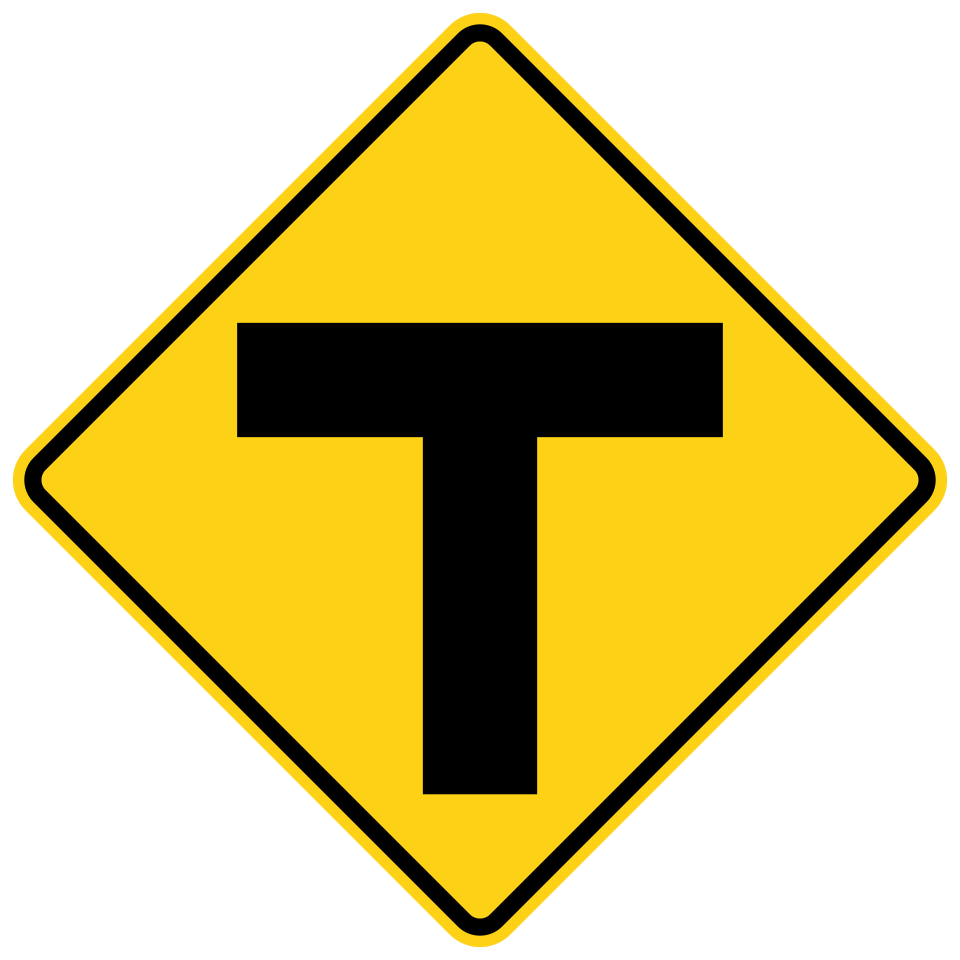
Mastering the T Intersection Sign: A Complete Guide for Learner Drivers
For every new driver navigating the complex web of public roads, recognizing the T Intersection sign is a fundamental milestone in developing safe driving habits. This distinct traffic control device, characterized by a white vertical rectangle with a black "T" symbol centered within it, serves as an early warning system for approaching junctions where your current road terminates. Unlike the red octagon of a stop sign or the yellow diamond of a general warning, the T Intersection sign (technically classified as a warning sign, despite often being grouped with regulatory discussions in learner curricula) is designed to alert you that the road you are traveling on will end soon, forcing you to turn either left or right. Its high-contrast black-on-white or black-on-yellow design ensures visibility in various lighting conditions, acting as a crucial visual cue that demands your immediate attention and preparation for a mandatory change in direction.
What It Means
The formal definition of the T Intersection sign is straightforward yet critical: it indicates that the road you are currently traveling on ends ahead, and you must prepare to turn either left or right. There is no option to continue straight; the roadway physically terminates at a perpendicular road. In the context of the Manual on Uniform Traffic Control Devices (MUTCD), this sign is designated as W2-4. It falls under the category of warning signs, which are typically diamond-shaped and yellow, though the specific T-intersection symbol is often presented on a rectangular plaque or as a standalone symbol depending on the jurisdiction's specific implementation of the MUTCD standards.
For a driver, the meaning extends beyond the geometry of the road. It signifies a loss of right-of-way continuity. When you see this sign, you are being notified that the flow of traffic you are part of is about to be interrupted. You are approaching a point where your vehicle must merge into a cross-traffic stream. This requires you to assess the speed of traffic on the intersecting road, determine which direction offers the safest path, and execute a turn while adhering to all applicable traffic laws, such as yielding to oncoming traffic or stopping at a stop line if one is present. The sign does not dictate whether you must stop or yield; that is determined by additional signage (like a Stop or Yield sign) or the standard rules of the road at that specific intersection. However, the T Intersection sign itself is the primary indicator that a decision point is imminent.
Where You'll See It
T Intersection signs are strategically placed to provide drivers with adequate reaction time. You will typically encounter this sign on the approach to the junction, usually placed 100 to 250 feet before the intersection in urban areas, and further out (up to 500 feet or more) in rural or high-speed environments. The placement is calculated based on the speed limit of the road you are traveling on; the faster the traffic, the earlier the sign must appear to allow for safe deceleration and maneuvering.
These signs are ubiquitous in residential neighborhoods where cul-de-sacs meet main arteries, in suburban developments where smaller streets feed into larger collectors, and in rural areas where minor roads terminate at highways. You might also see them in commercial districts where access roads end at major thoroughfares. In some complex intersections, you may see the T Intersection sign accompanied by an auxiliary plaque reading "AHEAD" or "200 FT" to provide precise distance information. Additionally, in areas with heavy fog or frequent rain, these signs may be retroreflective or equipped with enhanced visibility features to ensure they remain legible during adverse weather conditions. It is also common to see this sign paired with a "Stop" or "Yield" sign, reinforcing the need to control your vehicle's speed before the turn.
What to Do When You See It
Upon spotting the T Intersection sign, your immediate action should be to scan the environment and prepare for a turn. First, check your rearview and side mirrors to be aware of traffic behind you, as you will likely need to slow down significantly. Signal your intention to turn early—usually at least 100 feet before the intersection—to communicate your plan to other drivers. If you are unsure which way to turn, look for street signs or navigation cues, but do not make sudden, erratic movements at the last second.
Next, adjust your speed. Since you cannot proceed straight, you must be prepared to stop if the cross-traffic is heavy or if a stop sign is present. Approach the intersection with caution, looking left, right, and left again for oncoming vehicles, cyclists, and pedestrians. If there is no stop sign, you must still yield to any traffic already in the intersection or approaching so closely as to constitute an immediate hazard. Once the way is clear, execute the turn smoothly, ensuring your wheels are straight before you begin the maneuver to avoid being pushed into the path of oncoming traffic if you are rear-ended. Finally, accelerate gently to match the flow of traffic on the new road, checking your blind spots one last time before merging fully.
Common Pitfalls
Learner drivers often make several critical errors when encountering a T Intersection. The most dangerous mistake is attempting to "squeeze" through the gap, assuming there is enough room to go straight. This is physically impossible and leads to collisions with cross-traffic or roadside obstacles. Another common error is failing to slow down early enough. Because the road ends, drivers must decelerate to a safe turning speed; maintaining highway speeds into a T-intersection can result in a loss of control or an inability to stop in time if a car pulls out from the side street.
Additionally, many learners forget to check their blind spots before turning. At a T-intersection, traffic may be approaching from the left or right at high speeds, and a quick glance in the mirror is not sufficient. Failing to signal is another frequent infraction that confuses other drivers and increases the risk of accidents. Some drivers also become so focused on the sign that they neglect to look for pedestrians who may be crossing the street they are turning onto. Finally, hesitation is a pitfall; once you have determined the way is clear, you should proceed with confidence. Stalling in the middle of the intersection blocks traffic and creates a hazardous situation for everyone.
Permit-Test Context
On the written permit test, the T Intersection sign is a staple question. Examiners often present an image of the sign and ask what it indicates. The correct answer is always that the road ends and you must turn left or right. Be wary of distractors that suggest you should stop immediately (unless a stop sign is also shown), yield only to pedestrians, or that the road continues straight but narrows. The test may also ask about the proper procedure: "When you see a T-intersection sign, you should..." with the correct answer being "slow down and prepare to turn."
Some tests include scenario-based questions, such as: "You are driving on a road with a T-intersection sign ahead, and there is no stop sign. What is your responsibility?" The answer requires understanding that you must yield to cross-traffic. It is crucial to memorize the shape and color of the sign, as visual recognition is a key part of the exam. Remember, the T Intersection sign is a warning, not a command to stop, but it commands a change in direction. Understanding this distinction is vital for passing both the written and driving portions of your licensing exam.