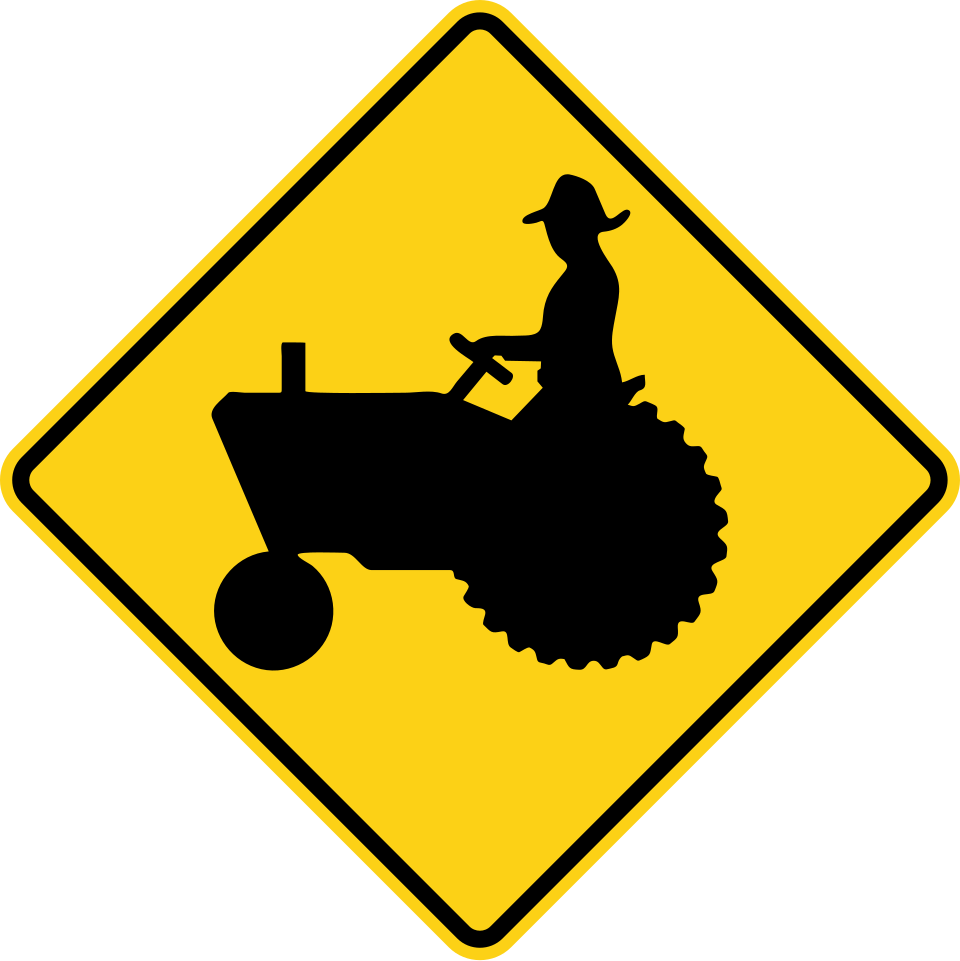
Understanding the Tractor Crossing Sign: A Guide for New Drivers
For learner drivers navigating the complex world of road signage, the Tractor Crossing sign is a critical visual cue that demands immediate attention and a shift in driving behavior. Visually, this sign is distinct and unmistakable: it is a diamond-shaped warning sign featuring a black silhouette of a farm tractor on a yellow background. The yellow color serves as a universal alert for potential hazards, while the diamond shape specifically denotes a warning rather than a regulatory command. The symbol itself is a simplified, yet recognizable, representation of a farm vehicle, often depicted with large rear wheels and a smaller front axle, sometimes accompanied by a slow-moving vehicle triangle symbol on the back of the tractor in the graphic. Unlike regulatory signs that dictate mandatory actions (like "Stop" or "Speed Limit"), this sign falls under the category of warning signs. Its primary meaning is to alert drivers that they are approaching an area where farm equipment may be entering or crossing the roadway. It does not mean a tractor is currently in the road, but rather that the conditions exist for one to appear, often unexpectedly. For a new driver, recognizing this sign is the first step in preventing high-risk collisions with slow-moving agricultural machinery.
What it Means
Formally, the Tractor Crossing sign (often designated as W11-1 in the Manual on Uniform Traffic Control Devices, or MUTCD) serves as a warning that farm vehicles may be entering the roadway from a side road, driveway, or field. The core definition is about potential conflict. It indicates that the driver is entering a zone where the normal flow of traffic may be interrupted by vehicles that travel significantly slower than the posted speed limit and may have limited maneuverability. The driver action required upon seeing this sign is one of heightened vigilance and preparation. It is not a command to stop immediately, but a command to slow down and scan. The driver must be prepared to yield the right-of-way if a tractor is actually entering the road. This involves checking side mirrors and blind spots more frequently, reducing speed to a level where the vehicle can stop safely if a tractor emerges, and avoiding passing maneuvers in the immediate vicinity of the sign. The sign essentially tells the driver: "Expect the unexpected." In many rural jurisdictions, this sign is often paired with a plaque reading "AHEAD" or "NEXT X MILES" to indicate the duration of the hazard zone. Understanding that the sign represents a dynamic environment where large, slow vehicles share the road is crucial for defensive driving.
Where You'll See It
The placement of the Tractor Crossing sign is strategic and directly related to agricultural geography and traffic patterns. You will most commonly encounter this sign in rural areas, on highways that traverse farmland, or on secondary roads that connect to large agricultural estates. Specific placement contexts include:
- Intersections with Farm Roads: The sign is frequently placed on the main road just before an intersection where a dirt or gravel farm road meets the paved highway. This warns drivers that equipment may be turning onto the main road.
- Field Entrances: It is often posted near large gates or driveways that lead directly to active crop fields or livestock areas, especially during planting or harvest seasons.
- Long Straightaways: In some cases, the sign is placed on long, straight stretches of road where visibility is good, but the risk of a tractor crossing from a side field is high. This is particularly common in the Midwest and Great Plains regions of the United States.
- Seasonal Variations: While the sign is permanent in many locations, temporary signs may be deployed during peak harvest times (late summer to early autumn) in areas where tractors are frequently moved between distant fields.
What to Do When You See It
When a learner driver spots the yellow diamond with the tractor silhouette, a specific sequence of actions should be initiated immediately. First, reduce speed. Farm tractors can travel as slowly as 15 to 25 mph, and if a tractor is crossing or merging, the speed differential can be dangerous. Slowing down gives you more time to react and reduces the severity of a potential collision. Second, increase your following distance. If you are already behind a slow-moving vehicle, do not attempt to pass. The sign warns that more slow vehicles may be ahead. Third, scan the horizon and shoulders. Look for the distinctive orange triangle (the Slow-Moving Vehicle emblem) on the back of any vehicle ahead, or look for dust clouds, headlights, or the silhouette of a tractor emerging from a field. Fourth, avoid passing. Passing a vehicle in a zone marked by a Tractor Crossing sign is risky because a tractor might be turning left across your path, or another tractor might be entering the road from the opposite direction. Finally, be patient. If you encounter a line of tractors, wait for a safe, clear opportunity to pass, ensuring you have a clear view of the road for a significant distance. Remember, these vehicles are often wide, may have attachments that extend beyond the vehicle's width, and may make wide turns that require them to use part of your lane.
Common Pitfalls
Learner drivers often make several critical errors when encountering the Tractor Crossing sign. The most common mistake is ignoring the sign because no tractor is immediately visible. Drivers often assume that because the road is clear at that exact second, it will remain clear. This is a dangerous assumption; tractors can appear suddenly from blind corners or side fields. Another pitfall is misinterpreting the sign as a command to stop. Unlike a Stop sign, the Tractor Crossing sign does not require a complete stop unless a hazard is present. Stopping unnecessarily can cause rear-end collisions from traffic behind you. Conversely, some drivers fail to adjust their speed sufficiently. They may slow down slightly but continue at a speed that is too fast for the conditions, leaving them unable to stop if a tractor enters the road. Additionally, learners often underestimate the width and turning radius of farm equipment. A tractor might look small in the distance, but it can occupy the entire lane or even cross into the opposing lane when turning. Finally, some drivers attempt to pass a tractor too quickly without realizing that the tractor may be moving slower than expected or may be carrying wide implements that make passing unsafe.
Permit-Test Context
On the written permit test, the Tractor Crossing sign is a frequent subject of multiple-choice questions. The examiners want to ensure you understand that this is a warning sign, not a regulatory one. A typical question might show an image of the sign and ask, "What does this sign mean?" with options like "Stop for tractors," "Tractors are prohibited," or "Farm vehicles may cross the road." The correct answer will always relate to the potential presence of farm equipment and the need for caution. You may also be asked about the appropriate action: "When you see a Tractor Crossing sign, you should..." The correct response will involve slowing down, scanning for hazards, and being prepared to yield. The test may also include questions about the shape and color, reinforcing that yellow diamonds indicate warnings. It is crucial to memorize that this sign does not grant tractors the right-of-way automatically; rather, it warns you to be ready to yield if they are entering your path. Understanding the distinction between a warning sign and a regulatory sign is a key learning objective for the permit exam.