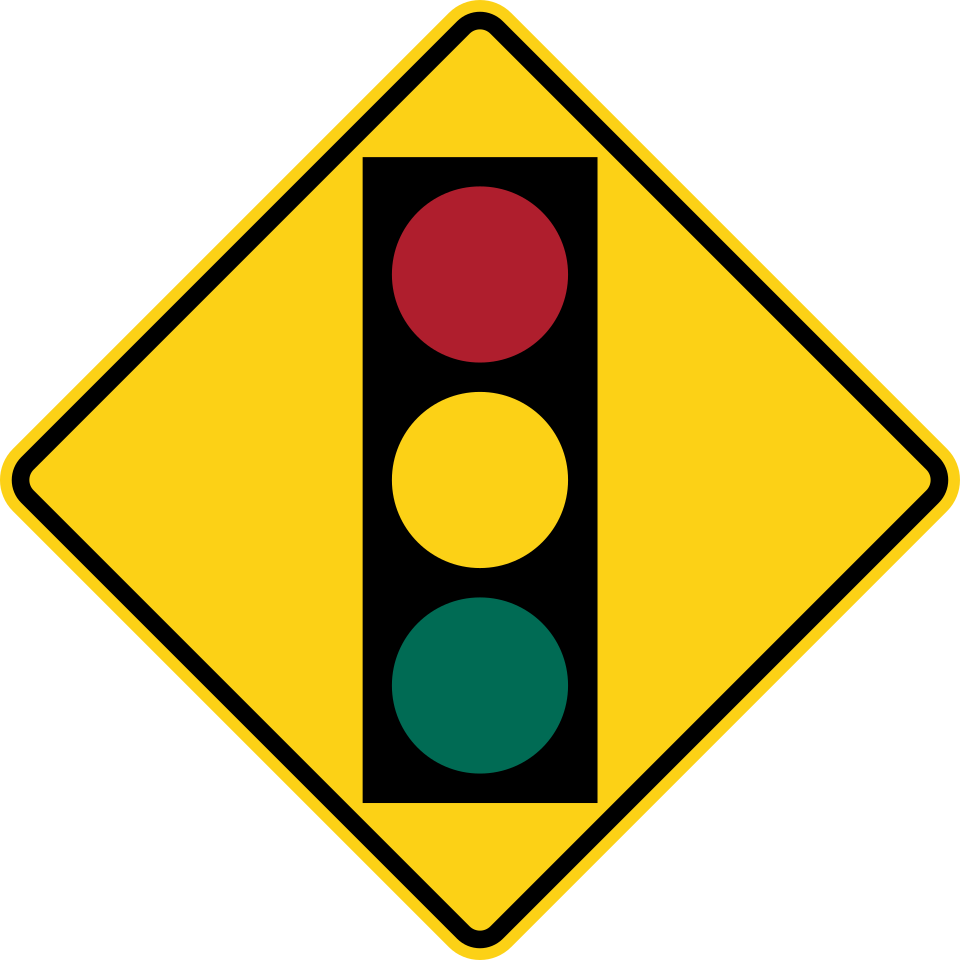
Mastering the Traffic Signal Ahead Sign: A Guide for New Drivers
For learner drivers navigating the complex web of road rules, recognizing warning signs is the first step toward safety. Among the most critical of these is the Traffic Signal Ahead sign. Visually, this sign is unmistakable: it features a yellow diamond-shaped background with a black border, containing a black graphic of a vertical traffic light with three circular lenses. The yellow color serves as a universal alert, indicating that a potential hazard or change in road conditions lies ahead. Unlike regulatory signs, which are often white rectangles or red octagons, this yellow diamond does not command an immediate stop or speed limit; rather, it warns the driver that a traffic control device is approaching, requiring heightened attention and preparation to react to changing signal phases. Understanding this sign is fundamental to defensive driving, as it bridges the gap between open-road cruising and the stop-and-go nature of urban intersections.
What It Means
Formally, the Traffic Signal Ahead sign (designated as W3-3 in the Manual on Uniform Traffic Control Devices, or MUTCD) is a warning sign. Its primary definition is to alert drivers that they are approaching an intersection controlled by a traffic signal. This is crucial because, in many cases, the signal itself may be obscured by curves, hills, vegetation, or other vehicles until the driver is dangerously close to the intersection. The sign effectively extends the driver's "sight distance," giving them the cognitive time to anticipate a potential stop.
While the sign itself is a warning, the action required is dictated by the upcoming signal. The sign means: "Prepare to stop." It does not mean the light is currently red, nor does it guarantee the light is green. It simply indicates that the regulatory environment is changing from free-flowing traffic to signal-controlled traffic. Drivers must be ready to decelerate smoothly if the light is red or yellow, or to proceed with caution if the light is green. The presence of this sign implies that the driver should scan the horizon for the actual signal heads, check their speed, and ensure they are in the correct lane for their intended direction of travel before reaching the intersection.
Where You'll See It
The placement of the Traffic Signal Ahead sign is strategic and governed by engineering standards to ensure maximum visibility and reaction time. You will typically encounter this sign on approaches to signalized intersections where the signal is not immediately visible due to geometric constraints. Common contexts include:
- Curved Approaches: If a road bends sharply before an intersection, the traffic lights on the far side may be hidden from view. The sign is placed on the outside of the curve or well before the bend to warn drivers.
- Hills and Crests: When approaching the crest of a hill, the intersection at the bottom or just over the rise is invisible. The sign is positioned on the downgrade or before the crest to provide early notice.
- High-Speed Roads: On arterial roads or highways where traffic flows at higher speeds (e.g., 45 mph or more), the stopping distance is longer. Engineers place these signs further in advance to allow drivers sufficient distance to slow down safely without slamming on their brakes.
- Urban Fringe Areas: In areas transitioning from rural to urban environments, where traffic signals may appear suddenly after a stretch of uncontrolled road, this sign is a standard fixture to prevent surprise stops.
It is important to note that the sign is often accompanied by an auxiliary plaque, such as "AHEAD" or a distance plaque (e.g., "1000 FT"), which specifies exactly how far the signal is. This additional data helps drivers gauge their braking distance more accurately.
What to Do When You See It
Upon spotting the yellow diamond with the traffic light symbol, a driver should immediately initiate a mental and physical checklist. First, lift your foot off the accelerator. This simple action, known as "covering the brake," prepares the vehicle to slow down without the delay of moving your foot from gas to brake. Second, scan the road ahead for the actual traffic signal. Look for the vertical or horizontal arrangement of lights, paying attention to the color of the light currently displayed.
If the light is green, proceed with caution, but remain vigilant for pedestrians or vehicles that might run a red light from a cross street. If the light is yellow, assess your speed and distance. Can you stop safely? If yes, stop. If you are too close to stop safely, proceed through the intersection with extreme caution. If the light is red, begin a smooth, controlled deceleration to come to a complete stop behind the limit line or crosswalk. Never slam on the brakes unless an emergency dictates it, as this can cause rear-end collisions. Additionally, check your mirrors to ensure vehicles behind you are also slowing down, and signal your intentions early if you need to change lanes to turn.
Common Pitfalls
Learner drivers often fall into specific traps when encountering this sign. The most dangerous pitfall is complacency. Some drivers see the sign, assume the light is green, and maintain their speed, only to find a red light at the last second. This leads to "hard stops," which are uncomfortable for passengers and dangerous for traffic flow. Another common error is misinterpreting the sign as a command to stop immediately. The sign is a warning, not a stop sign; stopping abruptly in the middle of the road when the light is green is a violation and a hazard.
Furthermore, learners often fail to check their mirrors after seeing the sign. If a driver slows down significantly upon seeing the warning sign but fails to check if a fast-moving vehicle is approaching from behind, they risk being rear-ended. Finally, some drivers ignore the sign entirely, assuming they can see the intersection well enough. This is a critical error, as the sign exists precisely because visibility is compromised. Relying on sightlines rather than the warning sign can lead to running red lights or failing to yield to pedestrians.
Permit-Test Context
On the written permit test, the Traffic Signal Ahead sign is a frequent subject of multiple-choice questions. Examiners want to ensure you understand the distinction between warning signs and regulatory signs. A typical question might show an image of the sign and ask, "What does this sign indicate?" The correct answer will always relate to the presence of a signal ahead, not the current state of the light. You might also be asked about the appropriate reaction: "When you see this sign, you should..." with options like "Speed up to beat the light," "Stop immediately," or "Prepare to stop and check the signal." The correct choice is always to prepare to stop and scan for the signal. Remember, the sign does not tell you the color of the light; it tells you that a light exists and you must be ready to react to it. Understanding this nuance is key to passing the written exam and, more importantly, surviving real-world driving.