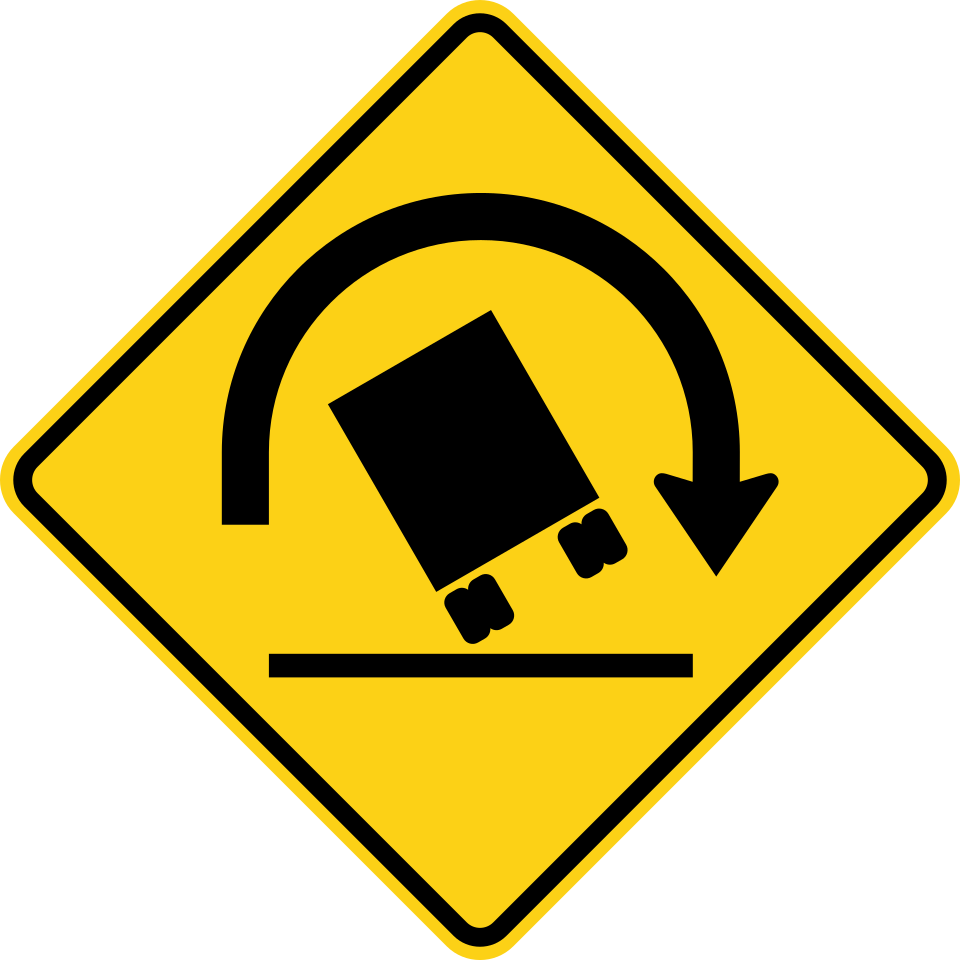
Understanding the Truck Rollover Warning Sign: A Guide for Learner Drivers
For new drivers navigating the complexities of the road, recognizing and reacting to warning signs is a critical skill that separates safe motorists from those at risk. Among the most visually distinct and practically significant of these markers is the Truck Rollover warning sign. Unlike the standard regulatory signs that dictate immediate legal actions like stopping or yielding, this sign serves as a crucial advisory warning. Visually, it typically presents as a diamond-shaped sign with a bright yellow background and a bold black border. The central graphic depicts a stylized truck tipping over onto its side, often accompanied by text such as "TRUCK ROLLOVER" or "TRUCKS USE LOWER GEAR." The yellow color immediately signals caution to the driver, indicating a potential hazard ahead rather than a strict prohibition. For learner drivers, understanding that this sign warns of a specific geometric danger—where a high-center-of-gravity vehicle might tip over on a curve—is the first step toward mastering defensive driving techniques. It is not a command to stop, but a directive to adjust speed and vehicle control immediately upon sighting.
What it means
Formally, the Truck Rollover sign is classified as a warning sign (W-series) within the Manual on Uniform Traffic Control Devices (MUTCD), specifically falling under the category of signs that warn of specific road conditions or hazards. While the MUTCD does not assign a single unique code solely for "Truck Rollover" in all contexts, it is often implemented as a variation of the W1-1 (Curve) or W1-2 (Reverse Turn) signs, augmented with a supplementary plaque (W13-1P) reading "TRUCK ROLLOVER" or integrated into a specific graphic warning sign. The core meaning of this sign is to alert drivers, particularly those operating heavy trucks, buses, or vehicles with high centers of gravity, that the upcoming horizontal curve has a radius and superelevation (banking) insufficient to safely accommodate such vehicles at normal speeds. The physics behind the sign are rooted in centrifugal force. When a vehicle travels around a curve, an outward force pushes against the vehicle. If the vehicle is tall and narrow, or heavily loaded, this force can shift the center of gravity beyond the vehicle's wheelbase, causing it to tip over. The sign indicates that the curve ahead is sharp enough that a truck traveling at the posted speed limit for passenger cars could easily roll over. For the learner driver, the required action is not merely to slow down, but to anticipate the behavior of other vehicles. You must recognize that a large truck approaching this sign may need to slow down significantly more than a sedan, or even cross the center line to navigate the turn safely. The sign demands heightened situational awareness: if you are driving a large vehicle, you must reduce speed well before the curve; if you are in a passenger car, you must be prepared for a truck to potentially encroach on your lane.
Where you'll see it
Truck rollover warning signs are strategically placed in locations where road geometry creates a specific risk for heavy vehicles. You will most commonly encounter these signs on rural highways, mountain passes, and winding two-lane roads where the terrain dictates sharp curves. They are frequently found at the entrance to a curve, often accompanied by a chevron alignment sign (W1-8) or a curve warning sign (W1-2) to reinforce the severity of the turn. In many jurisdictions, these signs are paired with a recommended speed plaque (W13-1P) displaying a specific speed, such as "25 MPH," which is often lower than the general speed limit for the road. These signs are rarely found in urban environments with wide, flat intersections. Instead, they are the guardians of the countryside, marking the transition from straight, open roads to tight, winding sections where the roadbed may not be banked enough to counteract the centrifugal force of a heavy load. You might also see them near industrial zones or ports where trucks frequently enter and exit highways, signaling that the connecting ramps or curves are not designed for high-speed truck traffic. In some cases, the sign may be accompanied by a "TRUCKS USE LOWER GEAR" plaque, emphasizing that engine braking is necessary to maintain control through the descent or curve. The placement is always calculated to give the driver enough distance to react, typically 200 to 500 feet before the hazard, depending on the speed limit and road conditions.
What to do when you see it
Upon sighting the Truck Rollover sign, your immediate response must be a proactive adjustment of your driving strategy. The first and most critical action is to reduce speed. Do not wait until you are in the curve to brake; begin slowing down well before the sign or the curve itself. If you are driving a passenger vehicle, ensure you are traveling at a speed that allows you to maintain your lane comfortably, but also be aware that the posted speed limit may be too fast for a truck. If you are operating a heavy vehicle, bus, or towing a trailer, you must treat the recommended speed on the supplementary plaque as a maximum safe speed, not a suggestion. Secondly, check your mirrors and be prepared for other vehicles to behave unexpectedly. A truck driver seeing this sign may slow down abruptly or move toward the outside of the curve to increase the turning radius. As a learner, you must never attempt to pass a large vehicle while approaching or navigating a curve marked by this sign. The risk of a rollover is high, and a passing maneuver could force the truck driver to make a sudden, dangerous correction. Additionally, ensure your vehicle is in the correct gear before entering the curve. If you are in a manual transmission vehicle or a heavy truck, downshift early to use engine braking, which provides more stable deceleration than service brakes alone. Finally, maintain a firm grip on the steering wheel and avoid sudden steering inputs. Smooth, gradual adjustments are key to keeping your vehicle stable and respecting the physics of the road ahead.
Common pitfalls
Learner drivers often fall into several traps when encountering the Truck Rollover sign. The most dangerous misconception is treating it as a regulatory sign that only applies to trucks. Many new drivers assume, "I'm in a small car, so this sign doesn't matter to me." This is a fatal error. While the sign warns of a risk specific to trucks, the road geometry that causes a truck to roll over is often sharp enough to cause a passenger car to lose traction or slide off the road if taken at high speeds. Ignoring the sign leads to entering the curve too fast, resulting in a loss of control. Another common pitfall is failing to anticipate the behavior of the truck. Learners often focus solely on their own lane and fail to notice that a truck ahead might drift into their lane to negotiate the turn. This lack of anticipation can lead to head-on collisions or sideswipes. Furthermore, some drivers mistake the sign for a command to stop, causing unnecessary braking that can confuse drivers behind them. The sign is a warning, not a stop sign. Conversely, others may see the sign and panic, slamming on their brakes right at the entrance of the curve, which can cause a skid. The correct approach is a gradual, controlled reduction in speed. Finally, learners often overlook the supplementary plaques. Missing the "TRUCKS USE LOWER GEAR" or the specific speed recommendation means missing the critical data needed to navigate the hazard safely.
Permit-test context
In the context of a learner's permit or driver's license written exam, the Truck Rollover sign is a favorite topic for testing a candidate's understanding of warning signs and defensive driving principles. Questions may present an image of the sign and ask what action is required. The correct answer will almost always involve slowing down and being prepared for a curve, rather than stopping or yielding. Examiners may also ask about the specific meaning of the sign: "What does the Truck Rollover sign indicate?" The expected response is that it warns of a curve where heavy vehicles may tip over if they do not reduce speed. Additionally, the test may include scenario-based questions. For example: "You see a Truck Rollover sign ahead. A large truck is approaching the curve. What should you do?" The correct choice would be to slow down, increase following distance, and avoid passing. The test aims to ensure that you understand that this sign is a warning of a physical hazard, not a regulatory restriction on your specific vehicle type. It also tests your knowledge of the MUTCD conventions, such as the diamond shape and yellow color, which universally denote warning. By mastering this sign, you demonstrate that you can read the road's geometry and anticipate the needs of all road users, a hallmark of a safe and responsible driver.