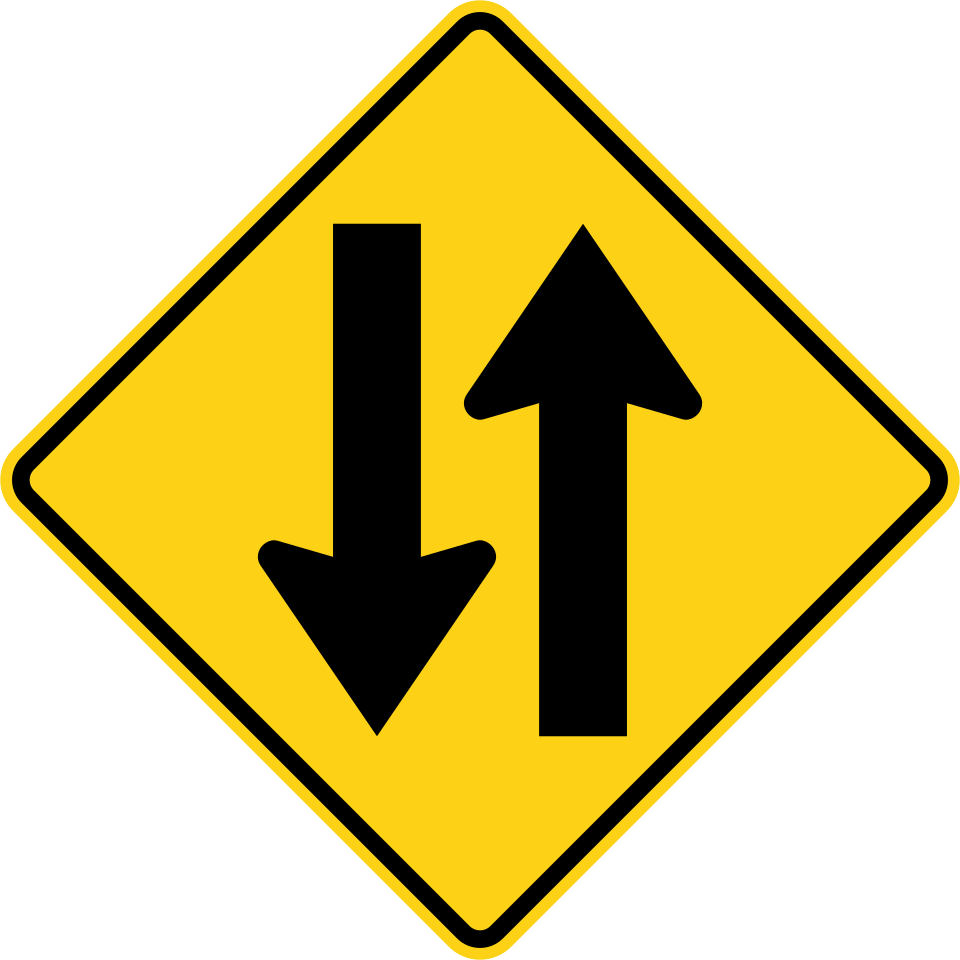
For every learner driver navigating the complex web of American roadways, recognizing the subtle yet critical cues of traffic control devices is paramount. Among these, the Two Way Traffic sign stands out as a fundamental warning that demands immediate attention and a shift in driving mindset. Visually, this sign is distinct and unmistakable: it is a yellow diamond-shaped plaque featuring two black arrows pointing in opposite vertical directions. The color yellow serves as a universal signal for caution, while the opposing arrows graphically illustrate the core concept: the road ahead, which may have previously been a one-way street or a divided highway, is transitioning into a section where traffic flows in both directions on the same roadway. Understanding the Two Way Traffic sign is not merely about memorizing a symbol; it is about grasping the meaning behind the visual cue, which dictates a fundamental change in how a driver positions their vehicle, anticipates oncoming hazards, and shares the road. This sign acts as a bridge between divided and undivided sections, warning drivers that the protective median is ending and that they must now be vigilant for vehicles approaching from the opposite direction.
What it means
The formal definition of the Two Way Traffic sign, often designated as the W6-3 in the Manual on Uniform Traffic Control Devices (MUTCD), is a warning that the road ahead carries traffic moving in opposite directions. While this may seem obvious to experienced drivers, for a learner, the meaning of this sign is profound. It signifies the end of a divided highway, a one-way street, or a separated lane configuration. When you encounter this sign, it means that the physical barrier or painted median separating your lane from oncoming traffic is about to disappear. Consequently, you are entering a roadway where you must share the pavement with vehicles traveling toward you. This is a regulatory and warning hybrid in practice; while it does not legally mandate a stop or a turn, it imposes a duty of care to adjust driving behavior immediately. The sign serves as a precursor to potential hazards, such as oncoming vehicles crossing the center line, head-on collision risks, and the need to maintain a strict position on the right side of the road. It is a critical reminder that the safety margin provided by a median is no longer present, and the driver must rely on visual scanning and defensive driving techniques to navigate safely.
Where you'll see it
Learner drivers will typically encounter the Two Way Traffic sign in specific transition zones where road geometry changes. The most common placement is at the point where a divided highway narrows or where the median strip physically ends. For instance, if you are driving on a four-lane highway with a grassy or concrete median separating the northbound and southbound lanes, you will see this sign just before the median terminates, merging the road into a two-lane undivided configuration. It is also frequently found at the exit of one-way street systems, such as downtown business districts or complex interchanges, where traffic is funneled back onto a standard two-way arterial road. Additionally, construction zones often utilize temporary versions of this sign when a divided lane is closed, forcing traffic to merge into a single undivided lane. The placement is strategic; it is positioned far enough in advance to give drivers ample time to react, usually 500 to 1,000 feet before the actual change in road configuration, depending on the speed limit of the roadway. In rural areas, this sign often appears where a divided rural highway transitions into a standard two-lane country road, a critical moment for drivers accustomed to the separation of lanes.
What to do when you see it
Upon sighting the Two Way Traffic sign, a driver must immediately initiate a series of defensive actions. The primary rule is to ensure your vehicle is firmly positioned in the right-hand lane. In a divided highway, drivers sometimes become complacent, drifting slightly toward the center line because the median provides a psychological buffer. When the sign appears, that buffer vanishes. You must consciously check your lane position and correct any drift to the right. Furthermore, you must increase your scanning frequency. Instead of looking only at the road ahead, you must actively scan for oncoming headlights, especially during dusk or dawn, and be prepared for vehicles that might cross the center line. Speed management is also crucial; if the road narrows or the environment becomes more complex, a slight reduction in speed can provide more reaction time. It is also essential to avoid overtaking other vehicles immediately after seeing this sign, as the road configuration is changing, and visibility of oncoming traffic may be compromised. The meaning of the sign is a call to heightened awareness: the road is no longer a one-way stream but a shared space requiring constant vigilance for opposing traffic.
Common pitfalls
Learner drivers often stumble over the Two Way Traffic sign due to a lack of situational awareness or misinterpretation of the road layout. One of the most common errors is failing to adjust lane position. Drivers accustomed to the wide separation of a divided highway may inadvertently drive too close to the center line, increasing the risk of a head-on collision once the median ends. Another pitfall is the assumption that the sign is merely informational and does not require an immediate change in behavior. Some learners treat it as a passive observation rather than an active warning, leading to delayed reactions when an oncoming car appears. Additionally, drivers often forget to check their mirrors and blind spots when the road narrows, failing to notice that other vehicles are also adjusting to the new configuration. A specific confusion arises when the sign is placed near a curve; learners might focus solely on the curve and miss the sign, or vice versa, failing to realize that the curve is now a two-way curve with oncoming traffic. Understanding the meaning of the sign requires connecting the visual symbol to the physical reality of the road, a connection that many novices struggle to make under the pressure of driving.
Permit-test context
In the context of the driver's permit test, the Two Way Traffic sign is a frequent subject of both written and practical examinations. On the written test, you may be shown an image of the sign and asked to identify its meaning, or you might be presented with a scenario describing a divided highway ending and asked which sign would appear. Questions often focus on the specific action required, such as "What should you do when you see this sign?" with the correct answer being "Move to the right and watch for oncoming traffic." It is crucial to distinguish this sign from others, such as the "Divided Highway Ends" sign (which often looks similar but may have different text or arrow configurations depending on the state) or the "One Way" sign. On the road test, the examiner will likely take you on a route that includes a transition from a divided to an undivided road. They will observe whether you notice the sign, whether you adjust your lane position to the right, and whether you demonstrate increased caution regarding oncoming traffic. Failing to react to the Two Way Traffic sign is a significant error, as it indicates a lack of readiness to handle the dynamic conditions of undivided roadways. Mastery of this sign is a non-negotiable component of passing the permit test and becoming a safe, licensed driver.