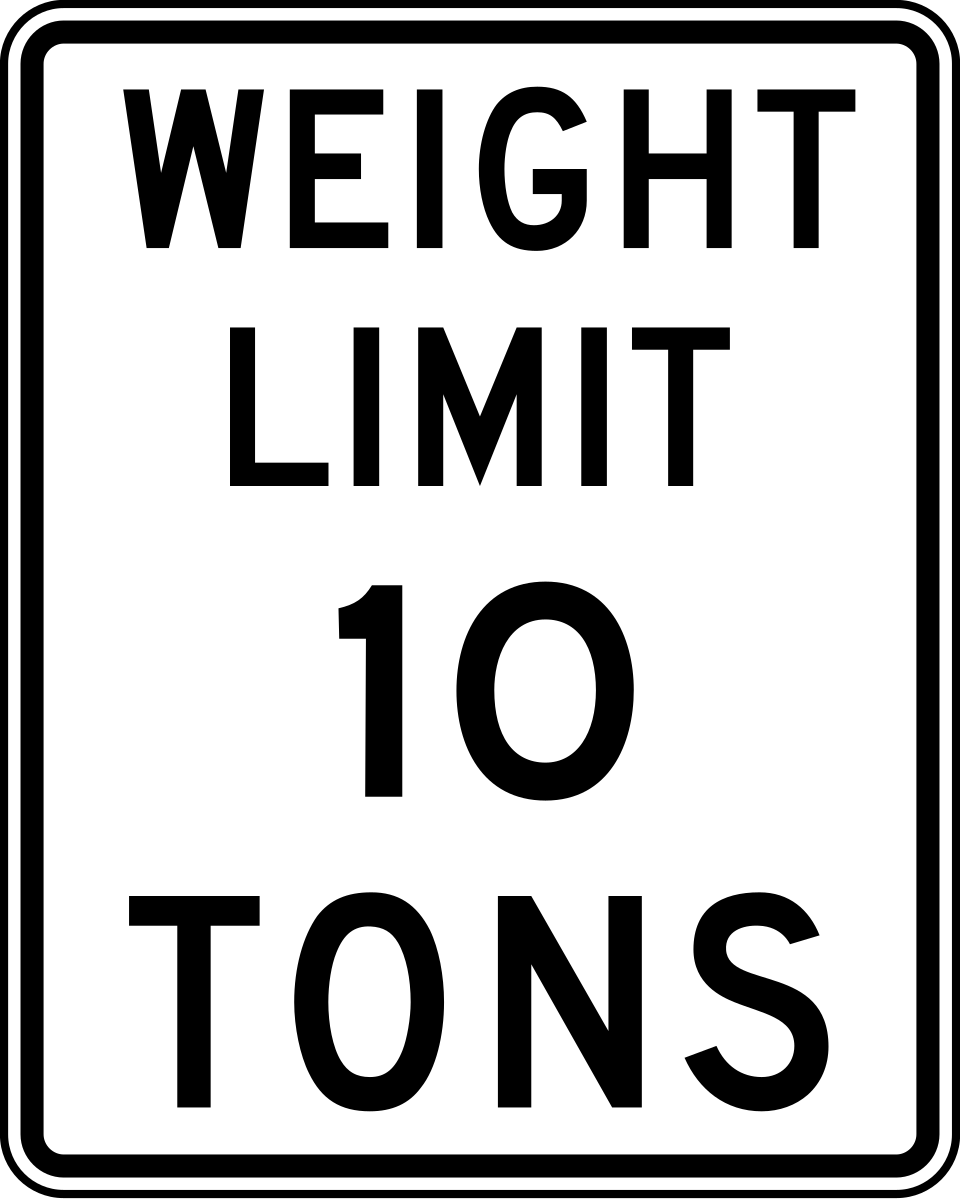
If you are a new driver studying for your permit test, you have likely encountered a variety of regulatory signs that dictate the rules of the road. Among these, the Weight Limit sign is a critical indicator often overlooked by those driving standard passenger vehicles but essential for anyone operating a commercial vehicle or towing a trailer. This sign is a rectangular white sign with black lettering and a black border, typically displaying a specific weight followed by the abbreviation "T" (for tons) or "lbs" (for pounds). Unlike warning signs that are yellow and diamond-shaped, the Weight Limit sign is a regulatory sign, meaning it carries the force of law. It explicitly states the maximum gross weight a bridge, overpass, or specific roadway section can safely support. Ignoring this sign can lead to catastrophic structural failure, severe vehicle damage, and significant legal penalties. For learner drivers, understanding this sign is not just about passing a test; it is about ensuring the safety of the infrastructure and everyone sharing the road.
What it means
Formally, the Weight Limit sign is a regulatory device used to restrict the maximum allowable gross weight of vehicles using a specific section of the highway or crossing a specific bridge. The "gross weight" refers to the total weight of the vehicle plus its cargo, passengers, and fuel. It is not merely the weight of the empty vehicle (curb weight). The sign serves as a legal boundary; crossing it with a vehicle exceeding the stated limit is a violation of traffic laws.
For the driver, the action required is immediate and decisive. Upon seeing this sign, you must know the gross weight of your vehicle and its load. If your vehicle exceeds the limit, you are legally prohibited from proceeding. You must find an alternate route that can accommodate your vehicle's weight. This is not a suggestion or a guideline for "safe driving" in the traditional sense; it is a hard physical constraint. Bridges are engineered to withstand specific loads, and exceeding these loads can cause immediate structural damage or, in worst-case scenarios, a total collapse of the bridge. The sign acts as a protective barrier for the infrastructure, ensuring that the road network remains intact for all users. In the context of the Manual on Uniform Traffic Control Devices (MUTCD), this falls under the R-series of regulatory signs, specifically designed to convey restrictions that, if violated, pose a direct threat to public safety and property.
Where you'll see it
Weight Limit signs are strategically placed well in advance of the structure they protect. You will typically encounter these signs on rural highways, near industrial zones, and in areas with older bridge infrastructure. They are almost always found on the approach to a bridge, an overpass, or a specific section of a road that has a lower load-bearing capacity than the surrounding pavement.
Placement is critical for driver reaction time. The sign is usually positioned on the right-hand side of the road, facing the approaching traffic. In many jurisdictions, you will see a series of signs: one placed a mile or half-mile in advance to give drivers ample time to turn around if necessary, followed by a second sign closer to the bridge, and finally, the sign mounted directly on the bridge structure itself. This repetition ensures that even if a driver misses the first warning, they have multiple opportunities to react before reaching the critical point. You are also likely to see these signs in areas where heavy truck traffic is common, as these are the vehicles most likely to approach or exceed weight limits. In urban environments, they may appear on older overpasses that were built before modern heavy-duty truck standards were established. For learner drivers, recognizing the context is key: if you see a narrow bridge, an older concrete structure, or a sign indicating a sharp curve, be on the lookout for a weight limit sign nearby.
What to do when you see it
When you see a Weight Limit sign, your first step is to assess your vehicle's status. If you are driving a standard passenger car, SUV, or minivan, you are almost certainly well under the limit, which is often set at 10 tons (20,000 lbs) or higher for major bridges. However, if you are driving a large pickup truck, a recreational vehicle (RV), a box truck, or a vehicle towing a heavy trailer, you must pause and calculate your total weight.
If your vehicle exceeds the limit, you must not proceed. The correct action is to safely pull over or, if you have not yet reached the bridge, turn around and find an alternate route. Do not attempt to "test" the bridge or assume that the sign is outdated. The structural integrity of the bridge is a matter of public safety, and the sign is there for a reason. If you are a commercial driver, you should have access to your vehicle's weight specifications and load manifests. For learner drivers who may be towing a boat or a small camper, it is vital to know the combined weight of the tow vehicle and the trailer before setting out. If you are unsure, it is always safer to assume you are over the limit and seek an alternative path. Proceeding over a weight-restricted bridge can result in the bridge being closed for emergency repairs, causing massive traffic delays, and leaving you liable for the costs of the damage.
Common pitfalls
One of the most common mistakes learner drivers make is confusing the weight limit sign with a speed limit or a clearance height sign. While clearance signs (often blue or white with a height measurement) warn of low overhangs, weight limit signs are strictly about mass. Another pitfall is assuming that because a large truck is crossing the bridge, it must be safe for your vehicle. This is a dangerous assumption; the truck may be operating under a special permit, or it may be a local vehicle with a known weight that is just under the limit, whereas your loaded vehicle might be heavier. Additionally, many drivers fail to account for the weight of their cargo. A vehicle that is legal when empty may become illegal once fully loaded with passengers, luggage, or equipment. Learner drivers often forget that the "gross weight" includes everything in the vehicle, not just the vehicle itself. Finally, there is the misconception that the sign only applies to the bridge deck and not the approach roads. In reality, the restriction applies to the entire structure, and attempting to bypass the sign by driving on the shoulder or an adjacent path is illegal and dangerous.
Permit-test context
On your driving permit test, the Weight Limit sign is frequently used to test your understanding of regulatory signs and your ability to interpret road safety constraints. You may be shown an image of the sign and asked what it means, or presented with a scenario where you are driving a loaded truck and see the sign. The correct answer will always involve recognizing the sign as a prohibition against exceeding the stated weight. You might also be asked about the consequences of ignoring the sign, with the correct answer focusing on the risk of bridge collapse and legal liability. The test may also include questions about the placement of the sign, expecting you to know that it appears in advance of the bridge to allow for route changes. It is crucial to memorize the visual characteristics of the sign: white rectangle, black text, and the specific weight notation. Remember, the test is designed to ensure you can identify signs that protect infrastructure, not just signs that control traffic flow. Understanding the Weight Limit sign demonstrates that you are a responsible driver who considers the physical limitations of the road network.