Mastering the Winding Road Sign: A Comprehensive Guide for Learner Drivers
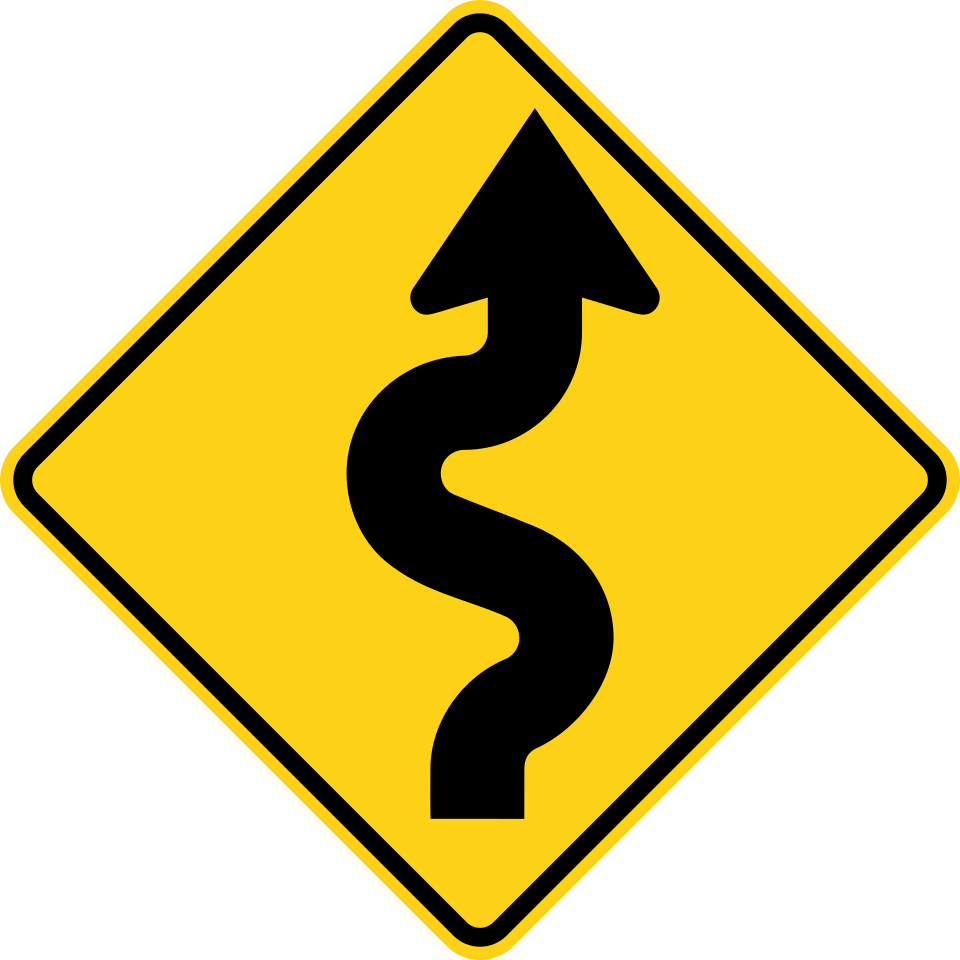
For every new driver navigating the complexities of the road, recognizing and reacting appropriately to traffic control devices is the foundation of safety. Among the most critical warning signs is the "Winding Road" sign, a distinctive yellow diamond with a black, serpentine arrow that curves sharply to the left and then to the right. This sign, officially categorized as a warning sign (despite the prompt's initial classification as regulatory, it is technically a warning sign under the MUTCD, though often grouped with regulatory discussions in learner curricula), serves as an early alert that the road ahead will not be straight. Its bright yellow background and bold black symbol are designed to catch the eye immediately, signaling that the driver must prepare for a series of curves rather than a single turn. Understanding this sign is not merely about memorizing a shape; it is about anticipating a change in road geometry that requires immediate adjustments in speed, steering, and lane position to maintain vehicle control and safety.
What It Means
The Winding Road sign, technically designated as the W1-5 sign in the Manual on Uniform Traffic Control Devices (MUTCD), provides a formal definition of the road geometry ahead: the road will curve in one direction, then immediately curve in the opposite direction, and this pattern will continue for a significant distance. Unlike a simple "Right Curve" or "Left Curve" sign, which indicates a single bend, the Winding Road sign warns of a succession of curves. The MUTCD specifies that this sign should be used where the road alignment includes three or more curves in succession, or where the curves are so frequent that a single curve sign would be insufficient to convey the hazard.
For the driver, the meaning is clear and actionable: the road ahead is unpredictable and requires sustained attention. The primary action required is a proactive reduction in speed before entering the first curve. Because the exit of the first curve leads directly into the second, there is no straight section to regain momentum or correct errors. The sign demands that the driver enter the winding section at a speed that allows the vehicle to remain within the lane throughout the entire sequence of turns. It is a signal to disengage from the comfort of straight-line driving and engage the full spectrum of defensive driving skills, including scanning far ahead, managing throttle and brake inputs smoothly, and maintaining a firm but flexible grip on the steering wheel.
Where You'll See It
The placement of the Winding Road sign is strategic, governed by the need to provide adequate reaction time. You will typically encounter this sign on rural highways, mountain passes, and scenic byways where the terrain dictates the road's path. It is rarely found in dense urban environments where traffic signals and stop signs dominate the landscape. Instead, look for it on two-lane roads that traverse rolling hills or winding valleys. The sign is usually placed well in advance of the first curve, often 500 to 1,000 feet before the hazard begins, depending on the posted speed limit and the severity of the curves.
In many jurisdictions, you may also see a supplementary plaque below the main sign indicating the length of the winding section, such as "1 Mile" or "2 Miles." This additional information is crucial for driver planning, as it tells you that the winding conditions will persist for a specific distance, preventing the driver from assuming the road straightens out after the first turn. Furthermore, in areas with steep grades, the Winding Road sign may be accompanied by a "Steep Grade" sign, compounding the need for caution. The sign is often placed on the right side of the road, but in divided highways or one-way ramps, it may appear on the left or overhead to ensure visibility for all lanes.
What to Do When You See It
Upon spotting the Winding Road sign, the immediate response should be to scan the road ahead and begin a controlled deceleration. Do not wait until you see the first curve to slow down; the sign is your cue to adjust your speed before the geometry changes. A good rule of thumb for learner drivers is to reduce speed to a level where you can comfortably stop within the distance you can see to be clear. This often means dropping below the posted speed limit, as the limit is set for ideal conditions, not necessarily for a series of blind curves.
Once you begin the winding section, maintain a steady speed through the curves. Avoid braking hard while turning, as this can cause the vehicle to lose traction and skid. Instead, brake in a straight line before the curve, release the brake as you turn the wheel, and gently accelerate as you exit the curve. Keep your eyes focused on the exit of the curve, not the immediate path in front of the hood. This technique, known as "looking through the curve," helps the driver steer more accurately and anticipate the next turn. Additionally, stay strictly in your lane. On winding roads, the temptation to drift toward the center line or the shoulder increases, especially if the curves are sharp. Maintain a consistent lane position, typically slightly to the right of the center of the lane, to maximize visibility and safety margin.
Common Pitfalls
Learner drivers often make several critical errors when encountering the Winding Road sign. The most common mistake is underestimating the severity of the curves. Drivers may see the sign, slow down slightly, and then accelerate too quickly after the first turn, only to find themselves entering the second curve at an unsafe speed. This "stop-and-go" approach is dangerous because the exit of one curve is the entry of the next. Another frequent error is overcorrecting the steering. When a driver feels the vehicle drifting, they may jerk the wheel, leading to a loss of control. Smooth, gradual steering inputs are essential on winding roads.
Additionally, many new drivers fail to adjust their speed for the specific conditions. Rain, fog, or gravel can significantly reduce traction on winding roads, yet drivers often maintain the same speed they would use on a dry, straight road. Another pitfall is failing to look far enough ahead. By focusing only on the immediate curve, the driver is surprised by the next turn, leading to panic braking or erratic steering. Finally, some drivers mistakenly believe that the sign indicates a single sharp turn followed by a straight road, leading to a false sense of security once the first curve is passed. It is vital to remember that the sign implies a continuous series of turns.
Permit-Test Context
On the written permit test, the Winding Road sign is a frequent subject of multiple-choice questions. Examiners often ask what the sign indicates, with distractors including "a single sharp turn," "a straight road with a hill," or "a construction zone." The correct answer will always relate to a series of curves or a winding road. You may also be asked about the appropriate action, such as "reduce speed and prepare for curves" rather than "maintain speed" or "stop immediately."
Some tests include scenario-based questions, such as: "You see a Winding Road sign with a plaque reading '1 Mile.' What should you do?" The correct response involves maintaining a reduced speed for the entire mile, not just slowing down for the first curve. Understanding the distinction between this sign and the "Right Curve" or "Left Curve" signs is also a common testing point. Remember, the Winding Road sign is a warning, not a regulatory command to stop or yield, but it carries a legal expectation of due care. Failing to adjust speed appropriately when this sign is posted can be cited as a traffic violation in many states, as it constitutes driving without due care and attention.