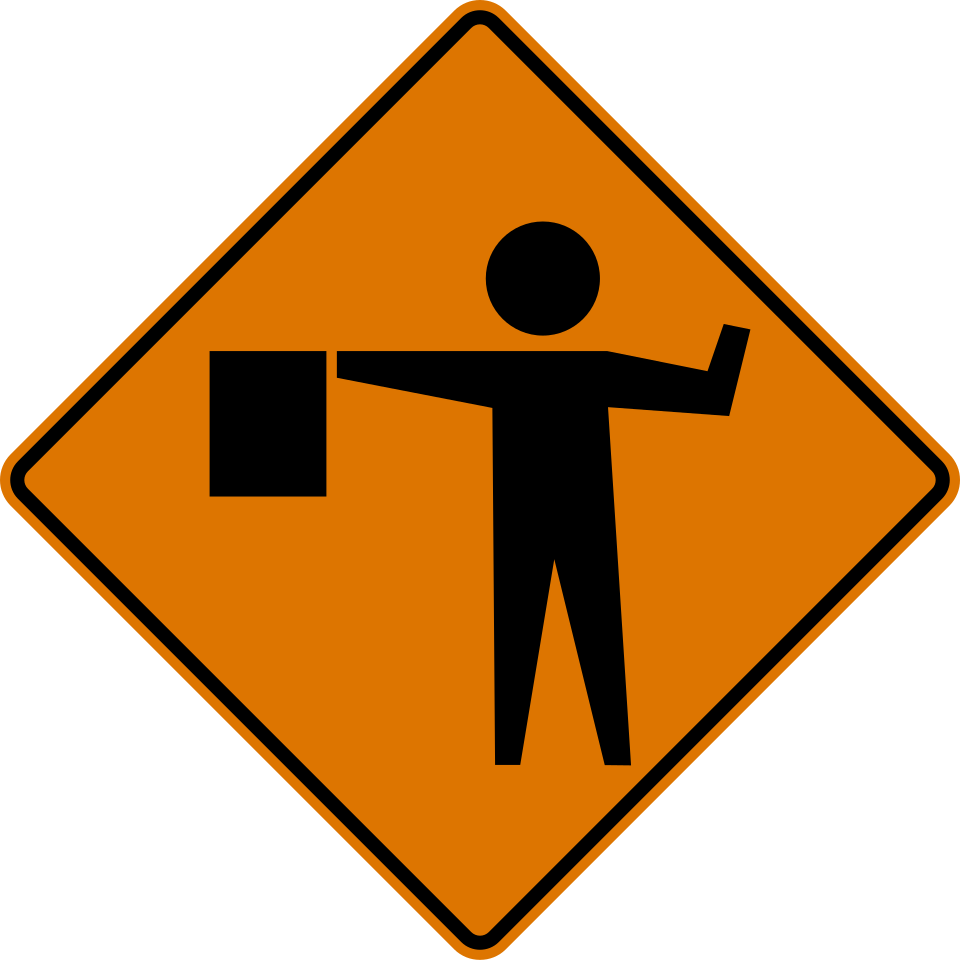
For every new driver navigating the complex web of American roadways, the Work Zone Flagger sign represents a critical intersection of caution, authority, and human interaction. Unlike static signs that rely solely on geometry and color to convey a message, this sign introduces a dynamic element: the presence of a human being directing traffic. Visually, the sign is distinct and impossible to miss. It is a diamond-shaped sign with a bright orange background and a bold black border, featuring a black silhouette of a person holding a flag. The figure is depicted in a standing position, often with one arm raised, symbolizing the act of signaling. The color orange is the universal language of construction and temporary traffic control, immediately alerting drivers that normal traffic patterns have been altered. The shape, a diamond, is standard for warning signs, indicating a potential hazard ahead. When you see this sign, it means you are approaching a construction zone where a certified flagger is actively managing the flow of vehicles, often alternating traffic between opposing lanes on a single roadway. Understanding this sign is not just about passing a permit test; it is about ensuring the safety of construction workers and fellow motorists in high-risk environments.
What It Means
Formally, the Work Zone Flagger sign serves as an advance warning that a flagger is stationed ahead to control traffic. According to the Manual on Uniform Traffic Control Devices (MUTCD), which sets the national standard for traffic signs in the United States, this sign is designated as the W20-7 sign. While the MUTCD categorizes it under "Warning Signs" due to its diamond shape and orange color, its function is deeply regulatory in practice because it signals the immediate presence of a temporary traffic control device (the flagger) whose instructions override standard right-of-way rules.
The meaning of this sign is twofold. First, it informs the driver that the road ahead is narrowed, likely due to construction, maintenance, or an emergency, and that traffic will be stopped and started by a person. Second, it serves as a precursor to the flagger's actual signals. The sign itself does not command a stop; rather, it commands preparation. It tells the driver to reduce speed, increase following distance, and be ready to stop immediately upon seeing the flagger's signal. The sign effectively bridges the gap between the open road and the controlled zone, giving the driver time to mentally shift from autonomous driving to cooperative driving. In the eyes of the law, the flagger acts as a temporary traffic officer. Therefore, the instructions given by the flagger—whether to stop, proceed, or slow down—carry the same legal weight as a traffic light or a police officer's command. Ignoring a flagger's signal is a serious traffic violation, often resulting in heavier fines than standard moving violations, particularly in active work zones.
Where You'll See It
The placement of the Work Zone Flagger sign is strategic and governed by strict guidelines to ensure maximum visibility and reaction time. You will typically encounter this sign well before the actual construction zone begins. In rural areas or on high-speed highways, the sign may be placed 500 to 1,000 feet in advance of the flagger's position. In urban environments with lower speed limits and complex intersections, the distance might be shorter, but it will always be placed far enough ahead to allow a driver traveling at the posted speed limit to come to a safe stop.
These signs are almost exclusively found in temporary traffic control zones. This includes road construction projects, bridge repairs, utility work, and emergency repair scenarios following accidents or natural disasters. You might see them on two-lane highways where one lane is closed, forcing traffic from both directions to share a single lane. They are also common in areas where road width is reduced, or where the road surface is uneven, requiring careful navigation. Often, the W20-7 sign is accompanied by other warning signs, such as "Road Work Ahead" (W20-1) or "One Lane Road" (W6-2), creating a sequence of warnings that progressively narrow the driver's focus. In some cases, you may see the sign mounted on a portable sign stand or a trailer, allowing it to be moved as the work zone progresses. It is crucial to recognize that the presence of this sign indicates a temporary condition; the road layout may change daily or even hourly, making constant vigilance essential.
What to Do When You See It
Upon spotting the Work Zone Flagger sign, your immediate action should be to slow down. Do not wait until you see the flagger to reduce your speed; the sign is your cue to begin decelerating. Scan the road ahead for the flagger, who will be positioned in a highly visible location, often wearing high-visibility safety apparel (Class 2 or Class 3) and holding a red flag or a stop/slow paddle. Once you locate the flagger, follow their instructions precisely.
If the flagger raises a red flag or holds up a paddle with "STOP" written on it, you must come to a complete halt behind the designated stopping point. Do not roll through the stop. Wait patiently until the flagger signals you to proceed. This signal is usually a waving motion with the flag or paddle, or the paddle being turned to display "SLOW" or a green arrow. If the flagger is using hand signals without a paddle, a raised palm means stop, and a waving motion means go. It is vital to maintain eye contact with the flagger if possible, as this confirms that they have seen you and are aware of your presence. Never attempt to pass a stopped vehicle in a work zone unless explicitly directed by the flagger. Furthermore, do not use your horn to urge the flagger or other drivers to move; this can be distracting and dangerous in a zone where workers are nearby. Keep your hands on the wheel, stay in your lane, and be prepared for sudden stops or changes in direction.
Common Pitfalls
Learner drivers often fall into several traps when encountering work zone flaggers. The most common mistake is failure to slow down early enough. Drivers often see the sign but maintain their speed until they are right in front of the flagger, leading to abrupt, unsafe stops that can cause rear-end collisions. Another frequent error is misinterpreting the flagger's signals. Some drivers assume that if the flagger is looking away or talking to a worker, they can proceed. This is incorrect; you must wait for a clear, affirmative signal to move. Additionally, drivers sometimes panic when stopped. In a work zone, it is normal to wait for extended periods while traffic from the other direction clears. Impatience can lead to dangerous maneuvers, such as trying to squeeze past a stopped car or ignoring the flagger's stop signal. Finally, many learners forget that the flagger's authority supersedes traffic lights. If you are approaching an intersection where a flagger is controlling traffic, you must obey the flagger, not the traffic light, even if the light is green.
Permit-Test Context
On your driver's permit test, questions regarding the Work Zone Flagger sign are designed to test your understanding of temporary traffic control and safety priorities. You may be shown an image of the sign and asked to identify its meaning, or presented with a scenario describing a construction zone and asked what the correct course of action is. A typical question might be: "What should you do when you see a Work Zone Flagger sign?" The correct answer will always involve slowing down and preparing to stop. Another common test item involves the hierarchy of authority: "Who has the right of way at a construction zone controlled by a flagger?" The answer is always the flagger. Examiners also look for your knowledge of the consequences of ignoring a flagger. You should be prepared to answer that failing to obey a flagger is a serious offense, often resulting in significant fines and points on your license. Remember, the test emphasizes safety above all else; the correct answer is almost always the one that prioritizes caution, patience, and adherence to the flagger's instructions.