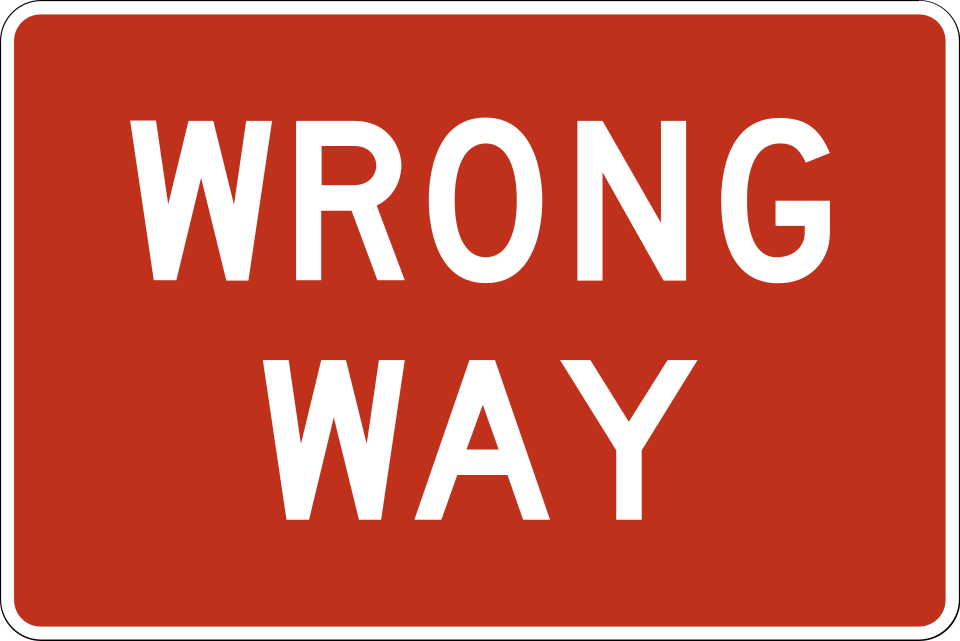
The Wrong Way sign is one of the most critical regulatory signs a driver will ever encounter. Visually, it is a square white sign with a red border and bold red lettering that reads "WRONG WAY." Unlike the circular "Do Not Enter" sign, which is often placed at the entrance of a restricted road, the Wrong Way sign is typically positioned on the roadway itself, facing traffic that is traveling in the incorrect direction. Its primary function is to provide an immediate, unmistakable warning to drivers who have inadvertently entered a one-way street, ramp, or highway against the flow of traffic. For learner drivers, recognizing this sign instantly and reacting with the correct emergency maneuver is not just a test requirement; it is a life-saving skill. The sign serves as the final barrier before a potential head-on collision, demanding immediate cessation of forward movement.
What It Means
Formally, the Wrong Way sign (R5-1 in the Manual on Uniform Traffic Control Devices, or MUTCD) is a regulatory sign that indicates the driver is traveling in a direction prohibited by traffic laws. It signifies that the roadway ahead is a one-way street or a divided highway ramp where traffic flows exclusively in the opposite direction. The presence of this sign means that continuing forward will result in driving directly into oncoming traffic, creating an extreme hazard.
For a driver, the required action is absolute and immediate: stop. You must not proceed even one inch further in the current direction. The sign implies that you have likely entered a highway ramp or one-way street from an exit point or a cross street where entry is forbidden. Unlike a "Do Not Enter" sign, which is placed at the point of entry to prevent you from starting the wrong-way journey, the Wrong Way sign is often placed further down the ramp or road to catch drivers who may have missed the initial warning or who have entered from a different access point. The legal implication is severe; proceeding past this sign constitutes a moving violation and, more importantly, creates an imminent danger of a catastrophic crash.
Where You'll See It
Learner drivers must be hyper-aware of specific locations where the Wrong Way sign is strategically deployed. These signs are almost exclusively found on exit ramps of divided highways and freeways. When you are driving on a local road and approach an on-ramp to a freeway, you might see a "Do Not Enter" sign at the very beginning of the ramp. However, if you miss that sign or enter from a side street that connects to the ramp, you will encounter the Wrong Way sign further down the ramp, facing you.
Additionally, these signs are common on one-way streets in urban environments. If a street is designated for one-way traffic, a Wrong Way sign may be placed at intersections where drivers might mistakenly turn onto the street from a cross street, or at the end of a block where a driver might attempt to turn around illegally. They are also frequently paired with the "Do Not Enter" sign (R5-1a). While the "Do Not Enter" sign is a circle with a red background and a white horizontal bar, the Wrong Way sign is a square with red text. This pairing is standard practice: the circular sign prevents entry at the source, and the square sign catches those who have already entered the restricted zone.
Another common context is construction zones or temporary traffic patterns where lanes are shifted. If a lane is closed and traffic is diverted, a Wrong Way sign might be used to prevent drivers from re-entering a closed lane or driving against the temporary flow of traffic. In all these scenarios, the sign is placed at eye level, often mounted on a post or a temporary stand, ensuring it is visible to drivers who are looking forward but may be confused about the direction of travel.
What to Do When You See It
Upon seeing a Wrong Way sign, your reaction must be instantaneous and decisive. The first step is to stop immediately. Do not attempt to "sneak" past it, do not try to find a gap in traffic, and do not assume the sign is for someone else. The sign is facing you, which means you are the one in the wrong lane.
Once stopped, do not reverse unless it is absolutely safe to do so and you are on a ramp with no oncoming traffic. Reversing on a highway ramp is illegal and dangerous. Instead, the safest course of action is to turn around if you are on a ramp or a wide enough area, or to pull over to the right shoulder and wait for a safe opportunity to exit the roadway legally. If you are on a one-way street and see the sign, you must turn around at the next legal intersection or pull over and call for assistance if you are unsure of the route.
It is crucial to check your mirrors before making any maneuver. If you are on a ramp, look for a gap in the traffic behind you (if you are reversing) or look for a safe place to turn around. If you are on a divided highway and have accidentally entered an exit ramp, you may need to drive to the end of the ramp, stop, and then turn around legally at the intersection, rather than trying to U-turn on the ramp itself, which is often prohibited. The key is to remove yourself from the path of oncoming traffic as quickly and safely as possible without creating a new hazard.
Common Pitfalls
Learner drivers often make several critical errors when encountering the Wrong Way sign. The most dangerous mistake is ignoring the sign due to panic or confusion. Some drivers, realizing they are lost, may think, "I'll just go a little further to see if I can find a turn." This is a fatal error. The sign means the road ahead is a one-way street for traffic coming toward you. Another common pitfall is confusing the Wrong Way sign with the Do Not Enter sign. While both mean the same thing regarding direction, the Wrong Way sign is often encountered after the driver has already entered the restricted area. Failing to recognize the difference can lead to hesitation.
Additionally, many learners attempt to reverse on a highway ramp. While the instinct to go back to where you came from is strong, reversing on a high-speed ramp is illegal and extremely dangerous. The correct action is to proceed to the end of the ramp and turn around legally. Another pitfall is not checking for oncoming traffic before stopping or turning. Even though you are the one in the wrong, other drivers may not see you, or may be speeding. Always ensure the path is clear before making any maneuver. Finally, some drivers fail to signal when pulling over or turning around, which can confuse other drivers who are trying to navigate around you.
Permit-Test Context
On the written permit test, the Wrong Way sign is a frequent topic. Questions often ask you to identify the sign's meaning, its shape, or the correct action to take. You may be shown an image of the sign and asked, "What does this sign mean?" or "What should you do if you see this sign?" The correct answer will always involve stopping immediately and not proceeding. You might also be asked to distinguish between the Wrong Way sign and the Do Not Enter sign. Remember: the Wrong Way sign is a square with red text, while the Do Not Enter sign is a circle with a red background and a white bar.
Scenario-based questions are also common. For example: "You are driving on a ramp and see a Wrong Way sign. What is the safest action?" The correct choice will be to stop and turn around at the end of the ramp, not to reverse. Understanding the distinction between these two signs and knowing the proper procedure is essential for passing the test and, more importantly, for safe driving. The test aims to ensure that you recognize the sign as a critical warning and respond with the appropriate caution.