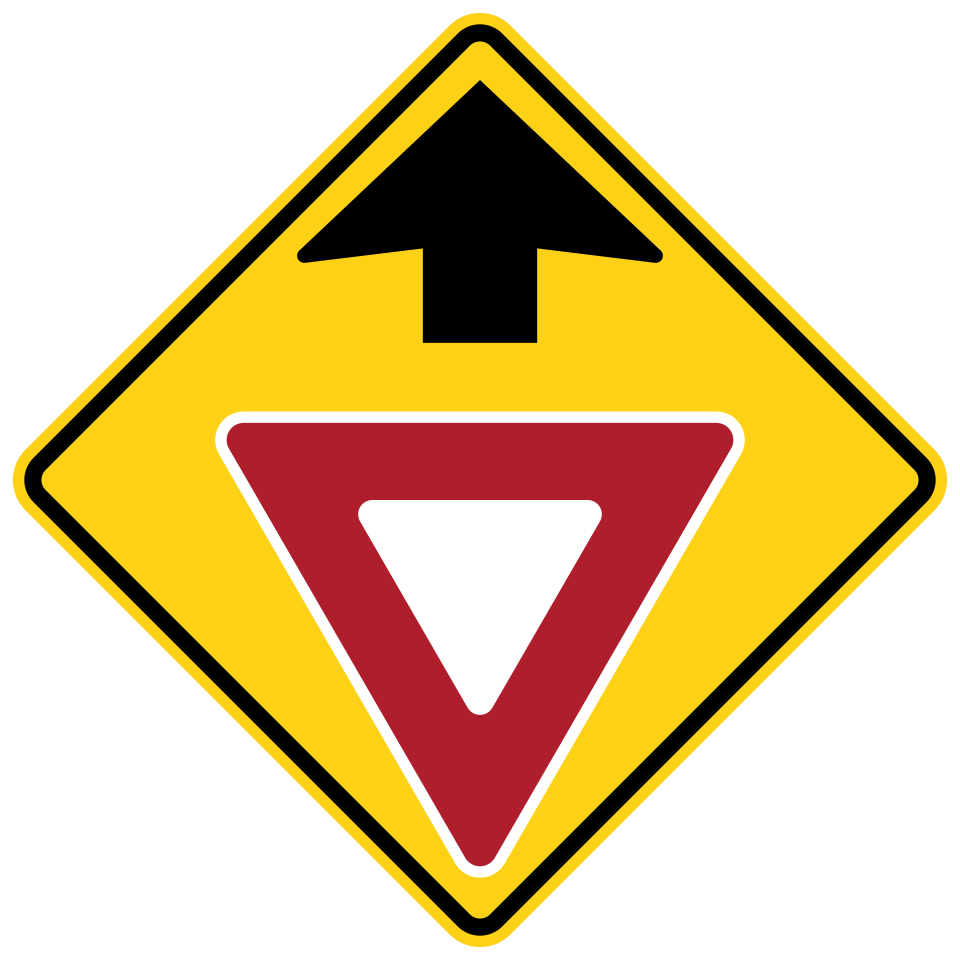
The Yield Ahead sign is a critical warning device designed to alert drivers that a yield sign is approaching, requiring them to prepare to slow down or stop. Visually, it is a diamond-shaped sign with a yellow background and black border, featuring a black symbol of an inverted triangle (the universal yield symbol) with the text "YIELD AHEAD" beneath it. Unlike the regulatory yield sign itself, which is red and white, the Yield Ahead sign is a warning sign, indicating a potential hazard or change in traffic conditions rather than an immediate command to stop. Its primary purpose is to give drivers sufficient notice to adjust their speed and position before reaching the intersection or merge point where right-of-way rules change. For learner drivers, recognizing this sign early is essential for smooth traffic flow and safety, as it prevents sudden braking and allows for a controlled approach to the upcoming yield requirement.
What It Means
Formally, the Yield Ahead sign (often designated as W3-2 in the Manual on Uniform Traffic Control Devices, or MUTCD) serves as an advance warning that a yield sign is located at the next intersection or merge point. It does not, in itself, require the driver to yield immediately; rather, it mandates that the driver must anticipate the need to yield. The core meaning is one of preparation: the driver must be ready to slow down significantly and, if necessary, come to a complete stop to allow other traffic to proceed.
When a driver encounters this sign, the required action is to reduce speed and scan the roadway ahead for the upcoming yield sign. The driver must mentally prepare to evaluate the traffic flow on the intersecting road or merging lane. If the way is clear, the driver may proceed without stopping, but if there is conflicting traffic, the driver must be prepared to stop. This sign is particularly important in areas where the yield sign might be obscured by curves, hills, or vegetation, or where the approach to the yield point is deceptive. It acts as a buffer, ensuring that drivers do not approach a yield requirement at highway speeds, which could lead to dangerous situations or collisions.
Where You'll See It
The placement of the Yield Ahead sign is strategic and governed by traffic engineering standards to maximize visibility and reaction time. You will typically see this sign on rural highways, suburban arterials, and occasionally in urban settings where traffic patterns change abruptly. Common contexts include:
- Approaching Intersections: It is frequently placed 200 to 500 feet before an intersection where the driver does not have the right-of-way. This is common when a minor road meets a major road, and the minor road has a yield sign.
- Merge Points: On highways or freeways where an entrance ramp merges with the mainline traffic, a Yield Ahead sign may be posted on the ramp to warn drivers that they must yield to through traffic before the actual merge point.
- Roundabouts: In many jurisdictions, a Yield Ahead sign is placed before the entrance to a roundabout to remind drivers that they must yield to circulating traffic before entering the circle.
- Obscured Views: If a yield sign is located around a sharp curve or over a crest of a hill where it cannot be seen until the last moment, the Yield Ahead sign is placed in advance to ensure drivers are aware of the upcoming requirement.
- Construction Zones: Temporary traffic control plans often utilize the Yield Ahead sign to warn drivers of temporary yield points created by lane shifts or detours.
The sign is almost always mounted on a post to the right of the roadway, though in some specific situations, such as divided highways or one-way streets, it may also appear on the left or overhead.
What to Do When You See It
Upon spotting the yellow diamond Yield Ahead sign, a learner driver should immediately initiate a sequence of defensive driving actions. First, lift your foot off the accelerator and begin to gently apply the brakes to reduce speed. Do not slam on the brakes unless an emergency arises; the goal is a smooth deceleration. Second, scan the environment. Look for the actual yield sign ahead, but also look for pedestrians, cyclists, and other vehicles that may be entering your path. Check your mirrors to be aware of traffic behind you, as you are slowing down.
Third, prepare to stop. Even if you do not see any traffic immediately, you must be mentally and physically ready to bring the vehicle to a halt. Your foot should hover over the brake pedal. As you approach the actual yield sign, perform a final check of the intersecting traffic. If the road is clear, you may proceed through the intersection or merge point without stopping, maintaining a safe, reduced speed. If there is traffic, you must stop completely at the limit line or before entering the intersection, wait for a safe gap, and then proceed when it is your turn. The key is to never treat the Yield Ahead sign as a suggestion; it is a mandatory warning that a regulatory requirement is imminent.
Common Pitfalls
Learner drivers often make specific mistakes when encountering the Yield Ahead sign. One of the most common errors is confusing the warning sign with the regulatory sign itself. Some drivers may stop immediately upon seeing the yellow diamond, causing a traffic hazard behind them, while others may ignore it entirely, approaching the actual yield sign at full speed and failing to yield in time. Another pitfall is failing to adjust speed early enough. Because the sign is yellow and diamond-shaped, some drivers assume it is merely informational and maintain their speed until they are dangerously close to the yield point, resulting in abrupt, unsafe stops.
Additionally, learners often forget to check their rearview mirrors when slowing down for a yield ahead. This can lead to rear-end collisions if the driver behind is not paying attention. Finally, a frequent error is misjudging the gap in traffic. Drivers may see the yield sign, assume they can squeeze in, and fail to yield to a vehicle that is already close, leading to a collision. It is crucial to remember that the Yield Ahead sign is a cue to prepare for a potential stop, not a guarantee that you will have to stop, but also not a green light to ignore the upcoming rule.
Permit-Test Context
On the written permit test, the Yield Ahead sign is a frequent subject of multiple-choice questions. Examiners often ask you to identify the sign by its shape and color or to describe the correct action to take. A typical question might show an image of the sign and ask, "What does this sign mean?" with options like "Stop immediately," "Yield to pedestrians only," "Yield sign ahead, prepare to slow down," or "Speed limit ahead." The correct answer is always the one that indicates a yield sign is approaching and that you should prepare to yield.
Another common test scenario involves a situational question: "You see a yellow diamond sign with a yield symbol. What should you do?" The correct response involves slowing down and preparing to stop if necessary, rather than stopping immediately or ignoring the sign. Test-takers must also understand the difference between this sign and the standard Yield sign (red and white inverted triangle). The distinction is that the Yield Ahead sign is a warning (yellow), while the Yield sign is a regulatory command (red). Understanding this nuance is critical for passing the exam and, more importantly, for safe driving on the road.